


Hacking it introduction to ethical hacking ppt slides designs download




Try Before you Buy Download Free Sample Product
 Impress Your
 Audience
 100%
100% Editable
 Save Hours
 of Time


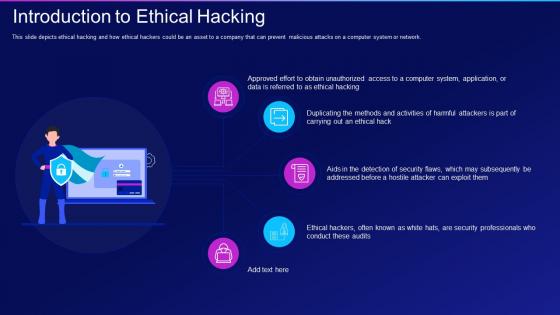
This slide depicts ethical hacking and how ethical hackers could be an asset to a company that can prevent malicious attacks on a computer system or network.
People who downloaded this PowerPoint presentation also viewed the following :
Hacking it introduction to ethical hacking ppt slides designs download with all 6 slides:
Use our Hacking It Introduction To Ethical Hacking Ppt Slides Designs Download to effectively help you save your valuable time. They are readymade to fit into any presentation structure.





FAQs for Hacking it introduction to ethical hacking ppt
Ethical hacking follows fundamental principles including explicit authorization, defined scope boundaries, responsible disclosure of vulnerabilities, minimal system impact, and comprehensive documentation of findings. Unlike malicious hacking, ethical hackers operate with organizational permission, focus on strengthening security rather than exploiting weaknesses, and prioritize protection over profit, ultimately delivering enhanced cybersecurity posture and competitive advantage.
Organizations ensure ethical hacker compliance through comprehensive legal contracts, clear scope definitions, signed non-disclosure agreements, supervised testing environments, and regular audit trails of all activities. These frameworks create accountability by establishing boundaries, requiring written authorization before testing, and implementing oversight protocols, with many financial services and healthcare institutions finding that structured ethical hacking programs significantly enhance security while maintaining regulatory compliance and stakeholder trust.
Ethical hackers use network scanners like Nmap, vulnerability assessment tools such as Nessus and OpenVAS, web application testing frameworks including Burp Suite and OWASP ZAP, and social engineering simulations. These technologies streamline security assessments by identifying system vulnerabilities, testing network defenses, and evaluating human factors, with many organizations finding that comprehensive penetration testing ultimately delivers enhanced cybersecurity posture and regulatory compliance.
Social engineering in ethical hacking involves simulating psychological manipulation tactics like phishing emails, pretexting calls, and physical infiltration to test human vulnerabilities within organizational security frameworks. Ethical hackers use these methods to identify weaknesses in employee awareness and security protocols, ultimately helping organizations strengthen their defenses through comprehensive training programs, multi-factor authentication systems, and regular security assessments.
Recommended certifications include Certified Ethical Hacker (CEH), Offensive Security Certified Professional (OSCP), CISSP, CompTIA Security+, and GIAC Security Essentials. These programs enhance cybersecurity expertise by combining theoretical knowledge with hands-on penetration testing, vulnerability assessment, and incident response training, with many organizations finding that certified professionals deliver stronger threat detection, faster breach response, and ultimately more robust security infrastructures.
Ethical hacking strengthens cybersecurity posture by identifying vulnerabilities before malicious actors exploit them, validating security controls, and testing incident response capabilities through simulated attacks. Organizations across sectors like banking, healthcare, and retail leverage these proactive assessments to enhance threat detection, streamline security protocols, and ensure regulatory compliance, ultimately delivering stronger defenses and reduced breach risks.
Ethical hackers report findings through structured vulnerability assessments, risk-prioritized documentation, and stakeholder-appropriate communication channels that emphasize remediation over threats. They present technical discoveries with clear business impact analysis, actionable mitigation steps, and realistic timelines, while many organizations finding that this measured approach enables strategic security improvements without operational disruption, ultimately strengthening defenses while maintaining stakeholder confidence.
Ethical hackers face dilemmas including balancing disclosure timelines with vendor response capabilities, determining appropriate testing boundaries without causing system disruptions, and managing conflicts between client confidentiality and broader security community responsibilities. These professionals must navigate situations where discovered vulnerabilities could impact multiple organizations, while ensuring their penetration testing methods remain within legal frameworks, ultimately delivering comprehensive security assessments without compromising organizational operations.
Ethical hackers simulate real-world attacks through penetration testing, vulnerability assessments, social engineering tests, network scanning, and payload deployment using controlled environments. These cybersecurity professionals follow structured methodologies like OWASP, PTES, and NIST frameworks, systematically identifying weaknesses in systems, applications, and human processes, ultimately delivering comprehensive security insights that enable organizations to strengthen defenses, reduce breach risks, and maintain competitive advantage in an increasingly digital landscape.
Collaboration between ethical hackers and IT departments creates a comprehensive vulnerability management framework by combining external security perspectives with internal system knowledge, accelerated patch deployment, and strategic risk prioritization. This partnership enables organizations to identify blind spots, streamline remediation processes, and develop proactive security protocols, with many enterprises finding that integrated teams deliver faster threat response and significantly enhanced overall security posture.
Ethical hacking practices adapt to industry-specific regulatory requirements, with finance focusing on transaction security and compliance audits, healthcare emphasizing patient data protection and HIPAA compliance, and government prioritizing national security and classified information systems. These specialized approaches enable organizations to address sector-specific vulnerabilities through targeted penetration testing, customized security frameworks, and industry-aligned threat modeling, ultimately delivering enhanced protection and regulatory adherence.
Emerging trends in ethical hacking include AI-powered vulnerability assessment, cloud security penetration testing, IoT device security auditing, social engineering simulations, and automated red team exercises. These approaches enable organizations to proactively identify weaknesses across increasingly complex digital infrastructures, with many financial services and healthcare institutions finding that comprehensive ethical hacking programs significantly reduce breach risks while enhancing overall cybersecurity posture.
Small businesses can leverage ethical hacking through cost-effective approaches like prioritized vulnerability assessments focusing on critical assets, automated scanning tools, and partnered penetration testing with cybersecurity firms offering scaled packages. Many organizations find that targeted ethical hacking services, combined with employee security training and phased implementation strategies, deliver significant protection improvements while maintaining budget constraints, ultimately providing competitive advantage through enhanced customer trust and regulatory compliance.
Ethical hackers may face legal challenges including unauthorized access charges, contract violations, and potential criminal liability, even with testing permissions in place. However, comprehensive legal agreements, proper authorization documentation, and adherence to defined testing scopes significantly minimize these risks, with many organizations finding that clear boundaries and incident protocols ultimately protect both parties while delivering enhanced security outcomes.
Ethical hackers assess security effectiveness through comprehensive penetration testing, vulnerability assessments, social engineering simulations, network scanning, and compliance audits. These systematic approaches identify weaknesses in firewalls, authentication systems, and employee protocols, with many organizations finding that regular ethical hacking evaluations significantly enhance their cybersecurity posture and reduce potential breach risks.
-
Very unique, user-friendly presentation interface.
-
The Designed Graphic are very professional and classic.