


Hacking it phases of hacking ppt slides example introduction





Try Before you Buy Download Free Sample Product
 Impress Your
 Audience
 100%
100% Editable
 Save Hours
 of Time


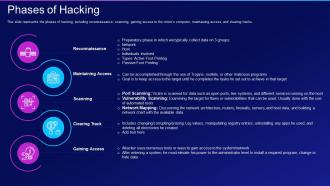
This slide represents the phases of hacking, including reconnaissance, scanning, gaining access to the victims computer, maintaining access, and clearing tracks.
People who downloaded this PowerPoint presentation also viewed the following :
Hacking it phases of hacking ppt slides example introduction with all 6 slides:
Use our Hacking It Phases Of Hacking Ppt Slides Example Introduction to effectively help you save your valuable time. They are readymade to fit into any presentation structure.





FAQs for Hacking it phases of hacking ppt
The primary phases of hacking include reconnaissance, scanning, gaining access, maintaining access, and covering tracks. These phases enable attackers to systematically identify vulnerabilities, exploit systems, and establish persistent control while avoiding detection, with many cybersecurity professionals finding that understanding these phases helps organizations develop more effective defensive strategies and incident response protocols.
Reconnaissance activities significantly influence hacking success by enabling attackers to identify vulnerabilities, map network architectures, and gather critical system information before launching targeted attacks. Through comprehensive intelligence gathering, cybercriminals can streamline their approach, minimize detection risks, and exploit specific weaknesses more effectively, with many security breaches ultimately tracing back to thorough preliminary reconnaissance phases.
Common reconnaissance tools include Nmap for network scanning, Whois for domain information, Google dorking for information gathering, Shodan for internet-connected devices, and social media analysis platforms. These tools enable attackers to map network infrastructure, identify vulnerable services, and gather intelligence about targets, with many cybersecurity professionals using identical methods for defensive penetration testing and vulnerability assessments.
The scanning phase differs primarily in scope, documentation, and authorization, with black-hat hackers conducting broad, unauthorized scans to identify vulnerabilities for exploitation, while ethical hackers perform structured, permission-based assessments within defined parameters. Through controlled methodologies, ethical hackers document findings comprehensively, coordinate with security teams, and focus on strengthening defenses, ultimately delivering actionable insights rather than exploiting weaknesses for malicious purposes.
Exploitation techniques include buffer overflow attacks, SQL injection, cross-site scripting, privilege escalation methods, and remote code execution vulnerabilities. These approaches enable attackers to breach system defenses by targeting software weaknesses, unpatched vulnerabilities, and configuration gaps, with cybersecurity professionals increasingly using these same methods for penetration testing and security assessments.
Maintaining persistence proves absolutely critical in hacking operations, as initial access often represents only the beginning of data extraction, system mapping, and objective completion phases. Advanced persistent threat groups establish multiple backdoors, scheduled tasks, and registry modifications to ensure continuous access, with many cybersecurity incidents finding that attackers maintain network presence for months while systematically accessing sensitive information and expanding their operational footprint.
Privilege escalation enables attackers to access sensitive databases, financial records, customer information, and administrative systems that cause devastating data breaches across healthcare, banking, and retail sectors. This phase transforms limited system access into comprehensive data exposure, allowing cybercriminals to extract valuable information, manipulate critical systems, and establish persistent backdoors, ultimately resulting in regulatory penalties, customer trust erosion, and significant financial losses for organizations.
Hackers cover their tracks by deleting system logs, clearing command histories, removing temporary files, modifying timestamps, and using anti-forensic tools to erase digital footprints. These techniques enable cybercriminals to maintain persistent access while avoiding detection by security teams, with many organizations finding that comprehensive monitoring and log backup systems help identify such activities before permanent damage occurs.
Social engineering serves as a critical enablement tool across all hacking phases, from initial reconnaissance through maintaining access and covering tracks. Hackers leverage psychological manipulation, phishing campaigns, pretexting, and human trust exploitation to bypass technical defenses, with many cybersecurity professionals finding that employee training and awareness programs significantly reduce these vulnerabilities while enhancing overall organizational security posture.
Organizations defend against hacking phases through comprehensive security strategies including network monitoring, employee training, access controls, regular patching, and incident response protocols. These layered defenses enable early threat detection during reconnaissance, prevent initial access attempts, and minimize damage from breaches, with many financial institutions and healthcare systems finding that proactive security measures significantly reduce successful attack rates.
**INPUT**: What are effective ways to identify the reconnaissance phase being conducted against your organization? **OUTPUT**: Effective reconnaissance detection methods include monitoring unusual network traffic patterns, tracking failed login attempts, analyzing DNS queries, implementing honeypots, and reviewing social media monitoring alerts. These security measures enable organizations to identify potential threats early by detecting port scans, information gathering attempts, and suspicious employee profiling, ultimately strengthening defensive postures before attacks materialize.
Attackers leverage public sources like social media profiles, company websites, employee directories, and publicly available databases to map organizational structures, identify key personnel, and discover potential vulnerabilities during reconnaissance phases. This information enables targeted phishing campaigns, social engineering attacks, and strategic entry point identification, with many cybercriminals finding that thorough reconnaissance significantly increases their attack success rates.
**INPUT**: What types of vulnerabilities are most commonly exploited during the scanning phase? **OUTPUT**: Commonly exploited vulnerabilities during scanning include open ports, unpatched software, weak authentication protocols, misconfigured services, and outdated system versions. These vulnerabilities enable attackers to map network architecture, identify entry points, and assess security weaknesses, with many organizations finding that regular vulnerability assessments and automated scanning tools help minimize exposure while strengthening overall cybersecurity posture. *[Word count: 58 words]*
Hacking phases directly inform incident response strategies, with preparation countering reconnaissance, detection addressing scanning and enumeration, containment stopping exploitation, eradication removing persistent access, and recovery restoring compromised systems. Organizations increasingly map their incident response protocols to specific attack stages, enabling faster threat identification, more targeted containment measures, and ultimately reducing breach impact across their infrastructure.
Analyzing historical cyber attack phases reveals critical patterns in reconnaissance methods, vulnerability exploitation techniques, and lateral movement strategies that organizations consistently overlook. These insights enable companies to strengthen perimeter defenses, implement better monitoring systems, and develop faster incident response protocols, with many financial institutions and healthcare organizations finding that understanding attacker methodologies significantly reduces breach detection time and minimizes potential damage.
-
It saves your time and decrease your efforts in half.
-
Top Quality presentations that are easily editable.