


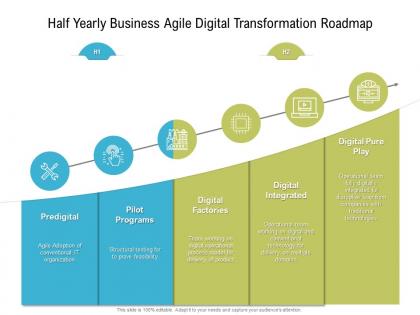
Half yearly business agile digital transformation roadmap




Try Before you Buy Download Free Sample Product
 Impress Your
 Audience
 100%
100% Editable
 Save Hours
 of Time


The success rate of business plans is hugely dependent on the plan of action, and this editable Half Yearly Business Agile Digital Transformation Roadmap rightly serves the purpose. Encapsulate all the information related to the project in a well structured manner to obtain maximum efficiency by incorporating our stunning PowerPoint theme. State the critical deliverable, steps involved, time frame, workforce allocation, and lots more in an easy to understand manner by utilizing this pre designed roadmap PowerPoint layout. You can also prioritize your tasks and discuss the problem areas with your colleagues by incorporating this tailor made PPT layout. Empower your work plan by employing this professionally designed PPT theme. Entrepreneurs can download Half Yearly Business Agile Digital Transformation Roadmap as a beneficial communication tool that facilitates in collaborating with different tasks and achieve targets.
People who downloaded this PowerPoint presentation also viewed the following :
Half yearly business agile digital transformation roadmap with all 2 slides:
Give your audience a fulfilling experience. They will find our Half Yearly Business Agile Digital Transformation Roadmap elevating.
FAQs for Half yearly business agile
Key components include strategic vision alignment, cross-functional team formation, iterative technology implementation, customer experience mapping, and continuous feedback loops. These elements work together by enabling rapid adaptation to market changes, fostering collaborative innovation, and delivering incremental value, with many organizations finding that this approach significantly reduces transformation risks while accelerating competitive advantage.
Organizations can assess their digital maturity through comprehensive audits evaluating technology infrastructure, data capabilities, workforce digital skills, customer experience platforms, and process automation levels. Financial services companies and healthcare institutions increasingly use maturity frameworks and benchmarking tools to identify gaps, prioritize investments, and establish baseline metrics, ultimately enabling strategic roadmaps that deliver measurable transformation outcomes.
Leadership serves as the catalyst for Agile digital transformation by establishing clear vision, fostering cultural change, removing organizational barriers, and empowering cross-functional teams with decision-making authority. Through strategic sponsorship and continuous communication, leaders enable faster adaptation cycles, streamline resource allocation, and drive employee engagement, with many organizations finding that committed leadership accelerates transformation timelines and delivers sustainable competitive advantage.
Teams can effectively prioritize Agile transformation initiatives by assessing business impact, implementation complexity, and resource requirements, while focusing on quick wins that build momentum and stakeholder confidence. This strategic approach enables organizations to sequence changes systematically, with many companies finding that starting with high-impact, low-complexity initiatives delivers early results and supports broader transformation goals.
Tools and practices supporting Agile digital transformation include cloud-native platforms, DevOps automation, microservices architecture, continuous integration pipelines, and cross-functional team frameworks. These approaches streamline implementation by enabling rapid prototyping, iterative development, and seamless scalability, with many organizations finding that combining agile methodologies with modern infrastructure ultimately delivers faster time-to-market and enhanced operational flexibility.
Customer feedback directly shapes Agile digital transformation roadmaps by informing priority setting, feature development, user experience design, and technology selection decisions. Through continuous feedback loops, organizations can pivot strategies, validate assumptions, and ensure transformation initiatives align with actual user needs, ultimately delivering more targeted solutions and higher adoption rates across departments.
Organizations should track customer satisfaction scores, employee engagement levels, operational efficiency metrics, revenue growth from digital channels, and time-to-market improvements for new products or services. These metrics work together to provide comprehensive insights, with many companies finding that combining customer experience data with internal productivity measures delivers the clearest picture of transformation success and competitive advantage.
Cross-functional collaboration in Agile digital transformation frameworks is fostered through shared workspaces, regular cross-team ceremonies, integrated communication platforms, and unified project management tools. These approaches streamline coordination by breaking down departmental silos, enabling real-time knowledge sharing, and creating transparency across functions, with many organizations finding that collaborative sprints ultimately deliver faster innovation and enhanced operational efficiency.
Common pitfalls include inadequate change management, siloed team structures, unrealistic timelines, insufficient stakeholder buy-in, and lack of clear success metrics. Organizations avoid these challenges by implementing comprehensive training programs, fostering cross-functional collaboration, establishing realistic sprint goals, and maintaining transparent communication channels, with many enterprises finding that continuous feedback loops and iterative adjustments ultimately deliver sustainable transformation outcomes.
Change management strategies integrate into Agile digital transformation roadmaps through continuous stakeholder engagement, iterative training programs, transparent communication loops, and adaptive feedback mechanisms. These approaches enable organizations to address resistance proactively, build digital literacy incrementally, and maintain team alignment throughout transformation sprints, with many enterprises finding that embedded change management accelerates adoption rates and minimizes operational disruption.
Effective employee preparation includes comprehensive digital literacy programs, hands-on training with new technologies, change management workshops, mentorship programs, and continuous learning platforms. Through strategic upskilling initiatives, organizations enhance workforce adaptability, reduce resistance to change, and accelerate technology adoption, with many companies finding that investing in employee development ultimately delivers smoother transitions and sustained competitive advantage.
Agile methodology aligns with emerging technologies by emphasizing iterative development, continuous feedback, and adaptive planning, which enables organizations to integrate AI, cloud computing, IoT, and automation more effectively. This approach allows businesses to test and refine digital solutions incrementally, reducing implementation risks while accelerating innovation cycles, with many enterprises finding that Agile frameworks enhance their ability to scale transformative technologies across operations.
Agile transformation emphasizes iterative development, cross-functional collaboration, rapid feedback cycles, and adaptive planning, while traditional digital transformation follows linear phases, departmental silos, and rigid timelines. Through agile methodologies, organizations streamline decision-making, accelerate product launches, and respond quickly to market changes, with many companies finding that this flexibility ultimately delivers faster ROI and enhanced competitive advantage.
Organizations sustain momentum through regular retrospectives, continuous stakeholder feedback, iterative refinement of processes, and establishing dedicated transformation teams that monitor progress. This approach enables companies to adapt quickly to market changes, identify optimization opportunities, and maintain competitive advantage, with many finding that embedding agile principles into their culture drives long-term innovation and operational excellence.
External partnerships accelerate Agile digital transformation by providing specialized expertise, reducing development timelines, and enabling access to cutting-edge technologies without substantial internal investment. Strategic collaborations with cloud providers, software vendors, and consulting firms allow organizations to scale rapidly, share implementation risks, and leverage proven methodologies, ultimately delivering faster market entry and enhanced competitive positioning.
No Reviews