


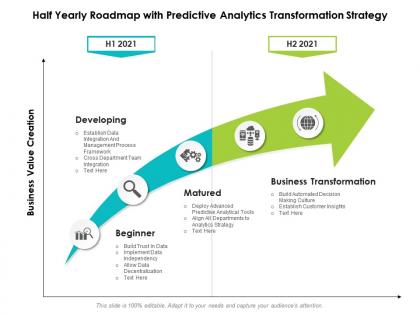
Half yearly roadmap with predictive analytics transformation strategy




Try Before you Buy Download Free Sample Product
 Impress Your
 Audience
 100%
100% Editable
 Save Hours
 of Time


A well thought out action plan makes execution easier and increases the possibility of success significantly. Ensure hitting all the milestones within the deadlines by introducing our fully customizable Half Yearly Roadmap With Predictive Analytics Transformation Strategy. Streamline the work related information, budget, timeframe, key deliverable, landmarks, and major steps involved, all in one place to give an organized overview of the project by utilizing our PowerPoint theme. Minimize time lag and increase work efficiency by providing insight into the process with our comprehensively researched roadmap PowerPoint layout. Color coding helps in highlighting the process and grabs the attention of the audience. Download our handy Half Yearly Roadmap With Predictive Analytics Transformation Strategy to identify the possible problem areas in a much shorter time and propose solutions. Have a productive brainstorming session with your workforce by utilizing our action plan visualization tool.
People who downloaded this PowerPoint presentation also viewed the following :
Half yearly roadmap with predictive analytics transformation strategy with all 2 slides:
Use our Half Yearly Roadmap With Predictive Analytics Transformation Strategy to effectively help you save your valuable time. They are readymade to fit into any presentation structure.
FAQs for Half yearly roadmap with predictive
A successful predictive analytics roadmap includes data strategy, infrastructure development, model building, deployment, and ongoing monitoring. These components work together to enable organizations to leverage data for insights, predict future trends, and make data-driven decisions. For instance, financial institutions use predictive analytics to assess credit risk, while retailers utilize it to personalize customer experiences and optimize inventory management, ultimately enhancing operational efficiency and profitability.
Organizations can assess their analytics maturity by evaluating their data infrastructure, analytical capabilities, and organizational culture. This involves analyzing data accessibility, the types of analyses conducted, and the level of data-driven decision-making across departments. By identifying strengths and weaknesses in these areas, organizations can pinpoint specific areas for improvement and tailor their roadmap accordingly, ultimately enabling them to leverage data more effectively for strategic decision-making and competitive advantage.
Data governance plays a crucial role in the development of a successful predictive analytics strategy, ensuring accuracy, reliability, and ethical use of data. It establishes clear policies and procedures for data access, quality control, and security, which are essential for building robust predictive models. With strong data governance, organizations like financial institutions and healthcare providers can confidently leverage data to make accurate predictions, optimize operations, and gain a competitive edge.
Prioritizing predictive analytics projects involves balancing potential business impact with the feasibility of implementation. Begin by identifying projects that address critical business challenges, such as optimizing marketing campaigns, improving customer churn prediction, or streamlining operations in sectors like finance or healthcare. These projects should leverage readily available data and align with existing technological infrastructure, ensuring a realistic timeline and budget. By focusing on projects that deliver high-value insights with achievable resources, organizations can maximize the return on investment in predictive analytics.
A robust predictive analytics roadmap incorporates technologies like machine learning algorithms, data mining tools, and cloud computing platforms. These technologies enable organizations to analyze vast datasets, identify patterns, and generate accurate predictions. Many financial institutions, for example, leverage these tools for fraud detection and risk assessment, ultimately enhancing security and profitability.
Ensuring data quality and accuracy in predictive models is crucial for reliable insights and effective decision-making. Organizations can achieve this by implementing robust data governance policies, establishing clear data quality standards, and leveraging data cleansing and validation techniques. Through these measures, financial institutions, for example, can minimize errors in fraud detection models, while healthcare providers can enhance the accuracy of patient risk assessments, ultimately leading to improved operational efficiency and better patient outcomes.
Fostering a data-driven culture involves implementing strategies like establishing clear data governance policies, providing data literacy training across all departments, and prioritizing data-informed decision-making at all levels. This empowers employees to leverage data effectively, ultimately leading to more informed strategies, improved operational efficiency, and better customer experiences, while simultaneously enabling organizations to stay competitive in an increasingly data-driven landscape.
Success metrics for predictive analytics initiatives are defined by quantifiable improvements in key business areas. These metrics can include increased revenue through targeted marketing campaigns, reduced operational costs by optimizing resource allocation, and enhanced customer experiences through personalized service. With many organizations finding that predictive analytics delivers a significant competitive advantage, success is ultimately measured by tangible outcomes such as higher conversion rates, improved forecasting accuracy, and minimized risk.
Developing a predictive analytics roadmap presents several challenges for organizations, including identifying the right use cases, securing sufficient data, and building the necessary technical expertise. These challenges can be overcome by starting with a clear understanding of business goals, investing in data infrastructure, and fostering a culture of data-driven decision making. With a well-defined roadmap, organizations can leverage predictive analytics to gain a competitive advantage by optimizing operations, personalizing customer experiences, and mitigating risks.
Cross-functional collaboration significantly enhances the predictive analytics process by bringing together diverse perspectives and expertise. Data scientists collaborate with domain experts, business analysts, and IT professionals to ensure data accuracy, model relevance, and seamless implementation. This integrated approach leads to more robust models, actionable insights, and ultimately, better decision-making across departments, driving operational efficiency and competitive advantage.
Deploying predictive analytics models raises several ethical considerations, including data privacy, bias, transparency, and accountability. Ensuring data anonymization and secure storage protects individual privacy while mitigating risks of misuse. Organizations must also actively identify and mitigate biases within datasets to prevent discriminatory outcomes, particularly in sensitive areas like hiring or loan applications. Transparency in model development and decision-making processes fosters trust and allows for scrutiny, while establishing clear lines of accountability ensures responsible use and addresses potential harm.
Predictive analytics roadmaps should be living documents, continuously evolving to match shifting business priorities. Flexibility is maintained by incorporating iterative development cycles, prioritizing key performance indicators (KPIs) aligned with current goals, and fostering cross-functional collaboration between data scientists, business stakeholders, and technology teams. This agile approach enables organizations to adapt to new data insights, emerging trends, and evolving market demands, ultimately ensuring the roadmap delivers maximum value and remains strategically relevant.
Machine learning is integral to shaping advanced predictive analytics strategies, playing a crucial role in automating complex pattern recognition and generating accurate forecasts. It enables organizations to leverage vast datasets, identifying trends and correlations that humans might miss, enabling more precise predictions across diverse sectors like finance, healthcare, and retail. These insights ultimately deliver enhanced decision-making, optimized resource allocation, and a significant competitive advantage in an increasingly data-driven landscape.
Organizations can leverage historical data to inform and optimize predictive models by employing techniques like data cleaning, feature engineering, and model selection. This involves identifying relevant variables, transforming data into usable formats, and experimenting with different algorithms to find the best fit for their specific needs. Through these processes, businesses can enhance model accuracy, uncover hidden patterns, and ultimately make more informed decisions across various functions, from marketing to operations.
Communicating predictive analytics insights effectively involves clearly outlining the problem addressed, the methods used, and the key findings in a concise and understandable manner. It's crucial to present visualizations like charts and graphs to illustrate trends and patterns, while also providing real-world examples from sectors like finance or healthcare to demonstrate the practical implications of the insights. Ultimately, stakeholders need to understand how these insights can be leveraged to make better decisions, optimize operations, and gain a competitive advantage.
No Reviews