


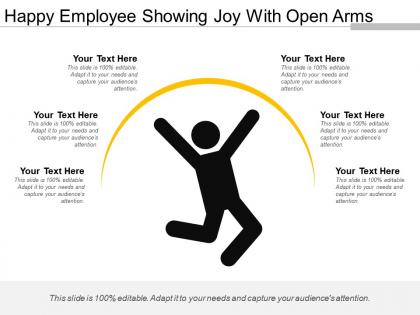
Happy employee showing joy with open arms




Try Before you Buy Download Free Sample Product
 Impress Your
 Audience
 100%
100% Editable
 Save Hours
 of Time


Address their gripes with our Happy Employee Showing Joy With Open Arms. Identify cause for genuine complaint.
People who downloaded this PowerPoint presentation also viewed the following :
Happy employee showing joy with open arms with all 5 slides:
Maintain your demeanour with our Happy Employee Showing Joy With Open Arms. They will help you keep your cool.




FAQs for Happy employee showing joy
Key factors influencing employee happiness include meaningful work, supportive management, career development opportunities, work-life balance, and positive workplace culture. Organizations across industries, from tech companies to healthcare systems, find that employees thrive when they receive regular feedback, fair compensation, and autonomy in their roles, ultimately delivering higher productivity and retention rates.
Organizations measure employee happiness through regular pulse surveys, anonymous feedback platforms, one-on-one check-ins, exit interviews, and sentiment analysis tools. These methods enable companies to track engagement levels, identify workplace concerns, and monitor satisfaction trends across departments, with many finding that combining quantitative metrics with qualitative insights delivers more comprehensive understanding and drives targeted improvements.
Management plays a pivotal role in fostering employee happiness through clear communication, recognition programs, professional development opportunities, flexible work arrangements, and creating psychologically safe environments. These leadership approaches enhance retention, boost productivity, and improve workplace morale, with many organizations finding that engaged managers ultimately deliver higher employee satisfaction scores and reduced turnover rates.
Employee happiness significantly enhances productivity and performance by reducing absenteeism, increasing engagement levels, improving collaboration quality, and fostering innovation within teams. Organizations with satisfied employees often experience 31% higher productivity, 37% better sales performance, and three times higher creativity rates, while also benefiting from reduced turnover costs and stronger customer relationships, ultimately delivering sustainable competitive advantage.
Companies can implement flexible work arrangements, recognition programs, professional development opportunities, wellness initiatives, and transparent communication channels to enhance employee happiness. These strategies streamline workplace satisfaction by improving work-life balance, acknowledging contributions, and fostering growth, with many organizations finding that happier employees deliver increased productivity, reduced turnover, and ultimately stronger competitive advantage.
Employee happiness directly correlates with retention rates, as satisfied employees are significantly less likely to seek opportunities elsewhere, reducing turnover costs and maintaining institutional knowledge. Companies with higher employee satisfaction scores, particularly in sectors like technology and healthcare, experience retention rates 40% higher than industry averages, ultimately delivering competitive advantages through reduced recruitment expenses and enhanced team stability.
Teams can leverage feedback to enhance employee happiness by implementing regular one-on-one sessions, anonymous surveys, pulse checks, and open-door policies that encourage honest communication. Through systematic feedback collection and response, organizations streamline workplace improvements, address concerns proactively, and create more engaging environments, with many companies finding that consistent feedback loops ultimately deliver higher retention rates and improved productivity.
Remote work arrangements influence employee happiness by offering greater work-life balance, eliminating commute stress, providing flexible scheduling options, and enabling personalized work environments. These benefits enhance job satisfaction and reduce burnout, with many organizations finding that remote employees report higher engagement levels, improved productivity, and stronger loyalty, ultimately delivering competitive advantages in talent retention.
Common misconceptions about employee happiness include believing it's solely about salary increases, that happy employees lack ambition, or that workplace perks automatically create satisfaction. While competitive compensation matters, organizations increasingly find that meaningful work, growth opportunities, and supportive management drive deeper engagement, ultimately delivering higher productivity, reduced turnover, and sustained competitive advantage.
Recognition and appreciation significantly boost employee happiness by fostering emotional connection, reinforcing positive behaviors, and creating a sense of valued contribution to organizational success. These practices enhance workplace morale, reduce turnover rates, and increase productivity levels, with many companies finding that consistent appreciation programs ultimately deliver stronger employee engagement and improved business performance.
Work-life balance significantly enhances employee happiness by reducing stress, preventing burnout, and enabling personal fulfillment alongside professional growth. Through flexible schedules, remote work options, and supportive policies, organizations streamline retention while enhancing productivity and job satisfaction, with many companies finding that balanced employees deliver higher performance and stronger loyalty.
Diversity and inclusion initiatives improve employee happiness by creating psychologically safe environments, fostering belonging, reducing workplace bias, and enabling authentic self-expression. These programs enhance collaboration, innovation, and mutual respect, with many organizations finding that inclusive cultures significantly boost engagement, retention, and overall job satisfaction while attracting top talent.
Creative ways to celebrate employee achievements include personalized recognition ceremonies, team experience days, skill development opportunities, flexible reward choices, and peer-to-peer appreciation programs. These approaches enhance workplace culture by fostering genuine connection, supporting professional growth, and creating memorable moments, with many organizations finding that varied recognition strategies significantly boost morale, retention, and overall employee satisfaction.
Career development and training significantly enhance employee happiness by providing growth opportunities, skill advancement, and clear progression pathways that increase job satisfaction and engagement. These initiatives demonstrate organizational investment in employees' futures, with companies like Google and Microsoft finding that comprehensive training programs reduce turnover, boost morale, and ultimately create more motivated workforces while strengthening competitive advantage.
Workplace design significantly impacts employee happiness through ergonomic furniture, natural lighting, collaborative spaces, noise control, and flexible layouts that support both teamwork and focused work. Well-designed environments enhance productivity, reduce stress, and improve job satisfaction, with companies like Google and Microsoft finding that thoughtful office design ultimately delivers higher employee retention and competitive advantage.
-
Awesome presentation, really professional and easy to edit.
-
Informative design.