


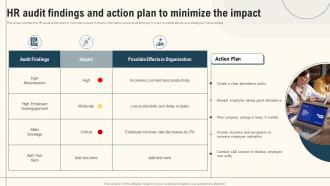
HR Audit Findings And Action Plan To Minimize The Impact





Try Before you Buy Download Free Sample Product
 Impress Your
Audience
 100%
Editable
 Save Hours
of Time


This slide signifies the HR audit action plan to minimize impact. It covers information about audit findings, impact, possible effects and strategies implemented.
People who downloaded this PowerPoint presentation also viewed the following :
HR Audit Findings And Action Plan To Minimize The Impact with all 6 slides:
Use our HR Audit Findings And Action Plan To Minimize The Impact to effectively help you save your valuable time. They are readymade to fit into any presentation structure.





FAQs for HR Audit Findings And Action Plan To
Key components of an effective HR audit include compliance assessment, policy review, documentation analysis, performance management evaluation, and compensation benchmarking. These elements work together by identifying regulatory gaps, streamlining outdated procedures, and enhancing talent retention strategies, with many organizations finding that comprehensive audits ultimately deliver improved operational efficiency and reduced legal risks.
Organizations can prepare for an HR audit by conducting comprehensive policy reviews, organizing employee documentation, updating compliance records, standardizing processes across departments, and training management teams on audit procedures. This strategic preparation streamlines the audit process, reduces disruption to daily operations, and enables companies to identify improvement opportunities early, ultimately delivering enhanced compliance confidence and operational efficiency while positioning the organization for sustained growth.
Common signs indicating the need for an HR audit include high employee turnover, frequent compliance violations, inconsistent policy application, outdated job descriptions, and poor performance management systems. These indicators often surface in organizations experiencing rapid growth or regulatory changes, with many companies finding that proactive audits streamline operations, reduce legal risks, and enhance overall workforce efficiency.
Technology revolutionizes modern HR audits by automating data collection, enhancing accuracy through analytics, and streamlining compliance tracking across multiple systems. Through AI-powered platforms and cloud-based HRIS systems, organizations minimize manual errors, accelerate audit timelines, and deliver real-time insights into workforce trends, ultimately enabling more strategic decision-making and competitive advantage.
**INPUT**: What metrics should be evaluated during an HR audit? **OUTPUT**: HR audit metrics include employee turnover rates, compensation benchmarking, compliance adherence, recruitment efficiency, performance management effectiveness, and training ROI. These assessments enable organizations to identify talent retention gaps, salary disparities, and operational inefficiencies, with many companies finding that comprehensive audits ultimately streamline processes and enhance workforce productivity. [Word count: 54 words]
HR audits help improve employee engagement and retention by identifying gaps in compensation structures, career development programs, recognition systems, and workplace culture initiatives. Through comprehensive analysis of policies and practices, organizations can address underlying issues like inadequate feedback mechanisms, limited advancement opportunities, and inconsistent management approaches, ultimately delivering enhanced job satisfaction and reduced turnover rates.
Neglecting HR audits can result in costly legal violations, including discrimination lawsuits, wage and hour penalties, OSHA fines, tax compliance issues, and regulatory sanctions. These oversights expose organizations to significant financial liability, reputational damage, and operational disruptions, with many companies finding that proactive auditing ultimately delivers legal protection and competitive advantage.
Organizations should conduct comprehensive HR audits annually, with quarterly reviews of critical areas like compliance, compensation equity, and performance management systems. This strategic combination enables companies to identify gaps, ensure regulatory adherence, and optimize talent retention, with many enterprises finding that regular auditing ultimately delivers improved operational efficiency and competitive advantage in talent acquisition.
Stakeholders provide critical input, feedback, and validation throughout HR audit processes by participating in interviews, reviewing findings, and ensuring audit objectives align with organizational goals. Through their diverse perspectives, employees, managers, executives, and external parties help auditors identify compliance gaps, assess policy effectiveness, and prioritize improvements, ultimately delivering comprehensive insights that enhance strategic HR decision-making.
An HR audit impacts organizational culture by identifying gaps in policies, communication practices, and employee engagement initiatives that shape workplace dynamics. Through systematic evaluation of recruitment standards, performance management systems, and inclusion practices, organizations can address cultural inconsistencies, strengthen alignment between stated values and actual practices, ultimately fostering more cohesive, productive work environments.
**INPUT**: What are some best practices for documenting findings during an HR audit? **OUTPUT**: Best practices include maintaining detailed records with timestamps, categorizing findings by risk level and compliance area, using standardized templates for consistency, and creating clear action items with assigned owners. These documentation methods streamline remediation efforts by providing comprehensive audit trails, enabling systematic tracking of improvements, and ensuring regulatory compliance, with many organizations finding that structured documentation ultimately delivers faster resolution times and enhanced operational transparency. [Word count: 60 words]
An HR audit comprehensively evaluates all human resources functions including recruitment, performance management, compensation, employee relations, and strategic alignment, while a compliance audit specifically focuses on adherence to legal requirements and regulatory standards. Through broader assessment scope, HR audits enable organizations to identify operational inefficiencies, enhance employee experiences, and strengthen strategic workforce planning, ultimately delivering competitive advantage beyond mere regulatory compliance.
Organizations typically face challenges including outdated documentation, employee resistance to transparency, incomplete data systems, resource allocation constraints, and lack of standardized audit frameworks. These obstacles can significantly impact audit accuracy and thoroughness, with many companies finding that poor record-keeping and insufficient HR technology integration ultimately compromise their ability to identify compliance gaps and strategic improvement opportunities.
HR audit outcomes drive strategic decision-making by identifying talent gaps, compliance risks, and operational inefficiencies that directly impact business performance. These insights enable leaders to prioritize resource allocation, restructure underperforming departments, and align workforce capabilities with growth objectives, with many organizations finding that data-driven HR strategies ultimately deliver competitive advantage and improved organizational effectiveness.
**INPUT**: What tools or software are recommended for HR audits? **OUTPUT**: Recommended HR audit tools include BambooHR, Workday, ADP Workforce Now, SAP SuccessFactors, and specialized compliance platforms like GoCo and Zenefits. These technologies streamline data collection, automate compliance tracking, and enhance reporting accuracy, with many organizations finding that integrated HRIS platforms significantly reduce audit timelines while delivering comprehensive insights and strategic workforce analytics. **Word count: 56 words**
-
Great quality slides in rapid time.
-
Like always a great experience with you guys. Always there on the drop of hat to help.