


HR Competency Scorecard With Major Initiatives




Try Before you Buy Download Free Sample Product
 Impress Your
 Audience
 100%
100% Editable
 Save Hours
 of Time


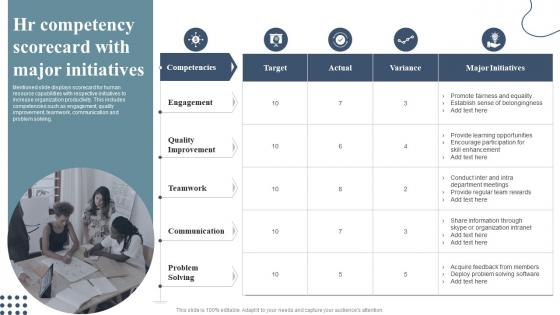
Mentioned slide displays scorecard for human resource capabilities with respective initiatives to increase organization productivity. This includes competencies such as engagement, quality improvement, teamwork, communication and problem solving.
People who downloaded this PowerPoint presentation also viewed the following :
HR Competency Scorecard With Major Initiatives with all 6 slides:
Use our HR Competency Scorecard With Major Initiatives to effectively help you save your valuable time. They are readymade to fit into any presentation structure.





FAQs for HR Competency Scorecard
Key components of an HR competency scorecard include technical skills assessment, behavioral competencies evaluation, performance metrics tracking, development gap analysis, and career progression indicators. These elements work together by providing comprehensive talent visibility, enabling targeted training investments, and streamlining succession planning processes, with many organizations finding that structured competency measurement ultimately delivers improved retention and strategic workforce alignment.
Organizations effectively align their HR competency scorecard with business objectives by mapping core competencies to strategic goals, integrating performance metrics with operational targets, and establishing clear connections between talent capabilities and revenue outcomes. Through strategic workforce planning, companies streamline talent development initiatives, enhance resource allocation, and accelerate business performance, with many organizations finding that competency-driven approaches ultimately deliver measurable competitive advantage and sustainable growth.
HR competency scorecards should include recruitment efficiency metrics, employee retention rates, training effectiveness scores, performance management outcomes, and employee engagement levels. These metrics enable organizations to streamline talent acquisition, enhance workforce development, and ultimately deliver improved productivity and competitive advantage, with many companies finding that comprehensive scorecards significantly improve strategic HR decision-making.
An HR competency scorecard facilitates talent management by systematically measuring employee skills, identifying development gaps, and tracking performance against role-specific requirements. This strategic tool enables organizations to streamline succession planning, enhance targeted training programs, and optimize resource allocation, with many companies finding that structured competency assessment ultimately delivers improved employee engagement and accelerated career development across all organizational levels.
Technology streamlines HR competency scorecard creation through automated data collection, real-time performance tracking, analytics dashboards, and integration with existing HRIS systems. These digital platforms enable organizations to continuously monitor competency gaps, generate actionable insights, and deliver personalized development recommendations, with many companies finding that automated scorecards reduce administrative burden while enhancing strategic workforce planning capabilities.
Organizations can ensure HR competency scorecard relevance by conducting regular reviews with business leaders, incorporating emerging industry trends, and aligning competencies with evolving strategic objectives and technological changes. Through quarterly assessments and stakeholder feedback, companies streamline their talent strategies while adapting to market shifts, ultimately delivering competitive advantage and enhanced workforce capabilities in an increasingly dynamic business landscape.
Effective strategies include creating visual dashboards that translate HR metrics into business outcomes, conducting stakeholder-specific presentations highlighting ROI and competitive advantages, and establishing regular reporting cycles that demonstrate progress. These approaches enable organizations to showcase how competency scorecards streamline talent management, reduce hiring costs, and enhance workforce performance, with many executives finding that clear data visualization and outcome-focused messaging ultimately delivers stronger organizational buy-in.
HR professionals can use competency scorecards to identify skill gaps by systematically evaluating current performance against required competencies, mapping individual and team capabilities through structured assessments, and analyzing variance between expected and actual skill levels. Through comprehensive competency mapping, organizations in sectors like healthcare, manufacturing, and financial services can pinpoint development priorities, create targeted training programs, and enhance workforce effectiveness, ultimately delivering improved productivity and strategic talent alignment.
Common HR competency scorecard implementation challenges include inconsistent competency definitions, subjective assessment criteria, employee resistance to evaluation, inadequate manager training, and data collection complexities. Organizations often struggle with aligning scorecards to business objectives and maintaining regular updates, with many finding that insufficient stakeholder buy-in and unclear performance metrics ultimately undermine the system's effectiveness and strategic value.
Employee feedback can be integrated into HR competency scorecards through 360-degree reviews, anonymous surveys, peer evaluations, and structured interviews that assess HR professionals' communication, problem-solving, and support capabilities. These feedback mechanisms enable organizations to identify skill gaps, enhance professional development programs, and improve employee satisfaction, with many companies finding that incorporating diverse perspectives ultimately delivers more accurate competency assessments and stronger HR-employee relationships.
Benchmarking against industry standards provides crucial context for HR competency scorecards by establishing realistic performance baselines, identifying competitive gaps, and ensuring alignment with market expectations. This strategic approach enables organizations to calibrate their talent development priorities effectively, while helping HR teams demonstrate measurable progress against recognized industry metrics, ultimately delivering enhanced workforce capabilities and sustainable competitive advantage.
An HR competency scorecard enhances employee engagement and satisfaction by providing clear development pathways, transparent performance expectations, and personalized growth opportunities that align individual strengths with organizational goals. Through regular competency assessments, organizations enable targeted skill building, meaningful career conversations, and recognition of progress, with many companies finding that employees become more invested when they understand their development trajectory and see tangible advancement opportunities.
Best practices for reviewing and updating HR competency scorecards include conducting quarterly assessments, aligning competencies with evolving business objectives, incorporating employee feedback, benchmarking against industry standards, and integrating performance data analytics. These systematic approaches streamline talent development by identifying skill gaps, enhancing succession planning, and optimizing training investments, with many organizations finding that regular updates ultimately deliver improved employee engagement and competitive advantage.
HR competency scorecards support diversity and inclusion initiatives by establishing measurable benchmarks for inclusive leadership behaviors, bias recognition skills, cultural competency development, and equitable talent management practices across all organizational levels. These assessment tools enable companies to track progress systematically, identify skill gaps in inclusive management, and create targeted development programs, with many organizations finding that structured competency measurement significantly enhances their ability to build more diverse, equitable workplace cultures.
Leadership buy-in significantly enhances HR competency scorecard effectiveness by ensuring adequate resource allocation, driving organizational adoption, and establishing clear accountability frameworks. With strong executive support, companies achieve higher employee participation rates, more accurate competency assessments, and better alignment between individual development goals and strategic business objectives, ultimately delivering improved talent management and competitive advantage.
-
I have been using SlideTeam for the past six months. Very happy and satisfied!
-
The presentations are very helpful. I am always able to get appropriate templates for the different topics related to my profession.