


HR Recruitment Process Stages With Hiring Status




Try Before you Buy Download Free Sample Product
 Impress Your
 Audience
 100%
100% Editable
 Save Hours
 of Time


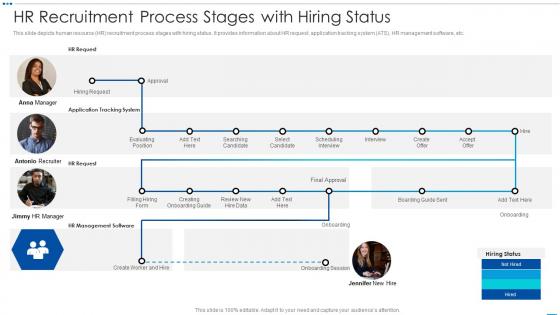
This slide depicts human resource HR recruitment process stages with hiring status. It provides information about HR request, application tracking system ATS, HR management software, etc.
People who downloaded this PowerPoint presentation also viewed the following :
HR Recruitment Process Stages With Hiring Status with all 6 slides:
Use our HR Recruitment Process Stages With Hiring Status to effectively help you save your valuable time. They are readymade to fit into any presentation structure.





FAQs for HR Recruitment Process Stages
The key stages include job analysis, sourcing candidates, screening applications, conducting interviews, reference checks, and onboarding new hires. Each stage streamlines talent acquisition by defining role requirements, attracting qualified applicants, and assessing cultural fit, with organizations finding that structured processes reduce hiring costs, minimize turnover, and ultimately deliver stronger team performance and competitive advantage.
Organizations effectively define job requirements by conducting thorough job analyses, consulting with current role holders and department managers, reviewing industry benchmarks, and aligning responsibilities with strategic business objectives. This comprehensive approach enables HR teams to create precise qualification criteria, competitive compensation packages, and realistic performance expectations, while ensuring new hires seamlessly integrate and deliver immediate value to organizational goals.
Employer branding significantly influences talent attraction by showcasing company culture, values, career growth opportunities, and employee experiences across digital platforms and professional networks. Strong employer brands help organizations differentiate themselves in competitive markets, reduce recruitment costs, and attract higher-quality candidates, with many companies finding that authentic branding ultimately delivers faster hiring cycles and improved employee retention rates.
Technology and recruitment software optimize HR recruitment by automating candidate screening, streamlining interview scheduling, and enhancing applicant tracking through AI-powered tools. These solutions enable HR teams to reduce time-to-hire, improve candidate experiences, and make data-driven hiring decisions, with many organizations finding that automated systems significantly increase recruitment efficiency while minimizing administrative burdens.
Best practices for writing engaging and inclusive job descriptions include using clear, jargon-free language, focusing on essential qualifications rather than extensive wish lists, highlighting company culture and growth opportunities, and avoiding biased terminology that might discourage diverse candidates. These approaches streamline the recruitment process by attracting broader talent pools, reducing time-to-hire, and enhancing candidate experience, with many organizations finding that inclusive descriptions significantly improve both application quality and workforce diversity.
HR ensures fair recruitment through structured interviews, diverse hiring panels, standardized evaluation criteria, blind resume screening, and comprehensive bias training for recruiters. These approaches streamline candidate assessment by removing subjective judgments, enhancing decision-making transparency, and creating consistent evaluation frameworks, with many organizations finding that systematic processes ultimately deliver better hiring outcomes and stronger workforce diversity.
Strategies include personalized communication, transparent timelines, interactive assessments, regular feedback loops, and streamlined application processes. These approaches enhance candidate experience by reducing uncertainty, demonstrating company culture, and maintaining momentum throughout hiring stages, with many organizations finding that engaged candidates are more likely to accept offers and become long-term employees.
Common recruitment challenges include talent shortages, lengthy hiring processes, unconscious bias, poor candidate experience, and skills mismatches. Organizations overcome these through strategic workforce planning, streamlined interview processes, structured bias-reduction training, and enhanced candidate communication, with many companies finding that leveraging recruitment analytics and employer branding initiatives significantly reduces time-to-hire while improving candidate quality.
HR professionals can measure recruitment effectiveness through key metrics including time-to-fill, cost-per-hire, quality of hire ratings, candidate experience scores, and retention rates of new employees. These measurements enable organizations to streamline their hiring processes, optimize resource allocation, and enhance candidate experiences, with many companies finding that data-driven recruitment strategies ultimately deliver faster placements and stronger long-term employee performance.
Company culture significantly influences recruitment by shaping job descriptions, interview questions, assessment criteria, and candidate evaluation methods to identify cultural fit alongside technical skills. Organizations with strong cultures often attract like-minded candidates through authentic employer branding, while recruiters increasingly prioritize values alignment, communication styles, and behavioral traits, ultimately delivering better employee retention, enhanced team dynamics, and reduced turnover costs.
A structured interview process is crucial for consistent candidate evaluation, reducing bias, ensuring legal compliance, and improving hiring quality across organizations. Key elements include standardized questions aligned with job requirements, multiple interviewers for diverse perspectives, clear scoring rubrics, and structured follow-up processes, with many companies finding that this approach significantly enhances candidate experience while delivering faster decisions and better long-term retention rates.
HR can enhance diversity and inclusion through blind resume screening, diverse interview panels, inclusive job descriptions, targeted outreach to underrepresented communities, and structured behavioral interviews. These techniques streamline bias reduction while expanding talent pools, with many organizations finding that diverse hiring practices ultimately deliver stronger team performance, enhanced innovation, and improved competitive advantage in increasingly global markets.
Candidate feedback improves recruitment by identifying process bottlenecks, communication gaps, and experience pain points that may deter top talent. This input enables HR teams to streamline interview workflows, enhance transparency around timelines, and refine candidate communications, ultimately delivering faster hiring cycles and stronger employer branding that attracts higher-quality applicants.
Social media serves as a powerful recruitment tool for sourcing candidates, building employer brand, showcasing company culture, and engaging passive talent across platforms like LinkedIn, Twitter, and Instagram. Organizations should strategically leverage these platforms by posting authentic content, actively networking with potential candidates, and maintaining professional profiles, while balancing outreach efforts with traditional recruitment methods to maximize talent acquisition effectiveness.
Organizations leverage employee referrals by implementing structured referral programs with clear incentives, utilizing digital platforms to streamline submissions, and establishing transparent tracking systems for referral status updates. These programs significantly reduce time-to-hire and recruitment costs while improving candidate quality, with many companies finding that referred employees demonstrate higher retention rates and faster onboarding, ultimately delivering stronger cultural fit and enhanced team performance.
-
Like always a great experience with you guys. Always there on the drop of hat to help.
-
Wide collection of templates available. SlideTeam has made it easier to create presentations in just a few minutes.