


HR Service Value Chain Advanced Model




Try Before you Buy Download Free Sample Product
 Impress Your
 Audience
 100%
100% Editable
 Save Hours
 of Time


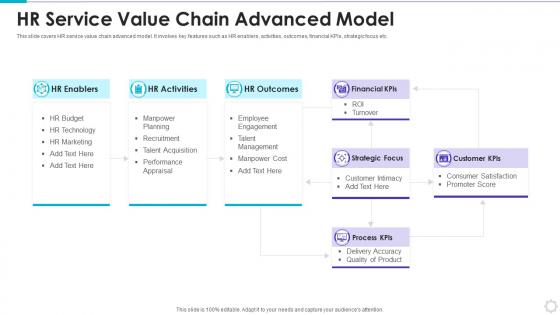
This slide covers HR service value chain advanced model. It involves key features such as HR enablers, activities, outcomes, financial KPIs, strategic focus etc.
People who downloaded this PowerPoint presentation also viewed the following :
HR Service Value Chain Advanced Model with all 6 slides:
Use our HR Service Value Chain Advanced Model to effectively help you save your valuable time. They are readymade to fit into any presentation structure.





FAQs for HR Service Value
The HR service value chain includes talent acquisition, employee onboarding, performance management, learning and development, compensation and benefits administration, and employee relations. These interconnected components streamline workforce operations by enhancing recruitment efficiency, accelerating skill development, and optimizing resource allocation, with many organizations finding that integrated HR services ultimately deliver improved employee experiences and stronger competitive advantage.
Technology enhances HR service value chain steps through automated recruitment platforms, AI-powered talent screening, cloud-based onboarding systems, performance management software, and predictive analytics for workforce planning. These solutions streamline administrative tasks, improve data accuracy, and enable strategic decision-making, with companies like Amazon and Google finding significantly faster hiring processes and enhanced employee experiences.
Organizations should measure HR service value chain effectiveness through employee satisfaction scores, time-to-fill for open positions, cost-per-hire ratios, training ROI, and retention rates across different departments. These metrics enable HR teams to identify bottlenecks, optimize resource allocation, and demonstrate strategic value, with many companies finding that comprehensive measurement drives both operational efficiency and enhanced employee experiences.
Employee feedback directly influences HR service value chain optimization by identifying process bottlenecks, highlighting service gaps, and revealing automation opportunities across recruitment, onboarding, and performance management. Through regular surveys and feedback mechanisms, organizations streamline workflows, enhance employee experiences, and reduce administrative costs, with many companies finding that data-driven improvements ultimately deliver faster services and stronger competitive advantage.
Talent acquisition strategies significantly impact the HR service value chain by improving candidate quality, reducing time-to-hire, enhancing onboarding experiences, and strengthening employer branding across all touchpoints. These strategic approaches streamline workforce planning, talent development, and retention efforts, with many organizations finding that integrated acquisition processes ultimately deliver better employee experiences, reduced turnover costs, and stronger competitive positioning in talent markets.
Data analytics revolutionizes HR service value chain efficiency by automating recruitment processes, predicting employee turnover, optimizing workforce planning, and personalizing development programs. Through advanced analytics platforms, organizations streamline talent acquisition, enhance performance management, and reduce administrative costs, with many companies finding that data-driven HR decisions ultimately deliver faster hiring cycles and improved employee retention rates.
Organizations align their HR service value chain with business goals by integrating strategic workforce planning, performance management systems, and talent development programs directly with operational objectives. This strategic alignment enables companies to optimize resource allocation, enhance employee productivity, and accelerate decision-making processes, with many enterprises finding that synchronized HR services ultimately deliver improved organizational agility and competitive advantage in increasingly dynamic markets.
Common obstacles include fragmented systems, resistance to change, limited budgets, skill gaps, and inadequate data analytics capabilities. These challenges often create silos between HR functions, while many organizations find that addressing technology integration and change management simultaneously enables streamlined processes, improved employee experiences, and ultimately delivers greater operational efficiency across their entire HR service delivery.
Outsourcing specific HR functions enhances the service value chain by allowing organizations to leverage specialized expertise, reduce operational costs, and improve service quality through dedicated providers. This strategic approach enables companies to focus internal resources on core business activities while external partners handle payroll processing, recruitment, and benefits administration, ultimately delivering faster response times, enhanced compliance, and improved employee experiences across the organization.
Recommended practices include standardized handoff protocols, integrated technology platforms, cross-functional training programs, clear communication channels, and shared performance metrics across service areas. These approaches streamline employee experiences by eliminating redundancies, reducing processing delays, and ensuring consistent service quality, with many organizations finding that seamless integration ultimately delivers faster resolution times and enhanced employee satisfaction.
Employee onboarding fits into the HR service value chain by connecting talent acquisition to performance management, ensuring seamless integration through structured orientation, skills development, and cultural assimilation processes. This strategic positioning enables organizations to accelerate productivity timelines, reduce turnover rates, and enhance employee engagement, with many companies finding that comprehensive onboarding delivers measurable improvements in retention and organizational effectiveness.
Continuous learning and development drives organizational adaptability, employee retention, and competitive advantage by upskilling talent, fostering innovation, and aligning capabilities with evolving business needs. Through strategic training programs, companies enhance productivity, reduce recruitment costs, and build internal expertise, with many organizations finding that invested employees deliver superior performance and drive long-term growth.
Cultural differences significantly influence the HR service value chain by affecting recruitment practices, performance evaluation methods, communication styles, compensation structures, and employee engagement strategies. Global organizations must adapt their HR processes to accommodate diverse cultural expectations around hierarchy, feedback delivery, work-life balance, and career development, with many multinational companies finding that localized HR approaches ultimately deliver higher employee satisfaction and retention rates.
Strategies include cross-functional project teams, shared performance metrics, regular interdepartmental meetings, joint training programs, and integrated technology platforms. These approaches streamline communication and align objectives across departments, with many organizations finding that collaborative HR partnerships enhance operational efficiency, accelerate decision-making, and ultimately deliver better employee experiences while reducing organizational silos.
Leveraging employee experience initiatives enhances the HR service value chain by improving engagement touchpoints, streamlining feedback mechanisms, and personalizing service delivery across recruitment, onboarding, and retention processes. These strategic approaches enable organizations to reduce turnover costs, accelerate productivity, and create competitive advantage, with many companies finding that enhanced experiences directly correlate with improved operational efficiency.
-
I didn’t expect such a good service for the money I am paying. But, they exceed my expectations. Great work SlideTeam.
-
SlideTeam is my go-to resource for professional PPT templates. They have an exhaustive library, giving you the option to download the best slide!