


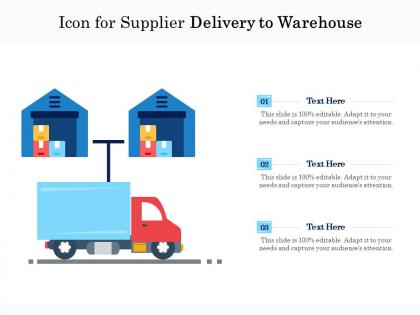
Icon for supplier delivery to warehouse




Try Before you Buy Download Free Sample Product
 Impress Your
 Audience
 100%
100% Editable
 Save Hours
 of Time


Our Icon For Supplier Delivery To Warehouse are topically designed to provide an attractive backdrop to any subject. Use them to look like a presentation pro.
People who downloaded this PowerPoint presentation also viewed the following :
Icon for supplier delivery to warehouse with all 2 slides:
Use our Icon For Supplier Delivery To Warehouse to effectively help you save your valuable time. They are readymade to fit into any presentation structure.

FAQs for Icon for supplier
Key elements include clear visual hierarchy, recognizable delivery symbols like trucks or packages, consistent color schemes, scalable vector formatting, and intuitive directional indicators. These design components enhance user experience by providing immediate recognition, maintaining brand consistency across platforms, and ensuring accessibility, with many e-commerce and logistics companies finding that well-designed icons significantly improve customer navigation and operational efficiency.
A well-designed supplier delivery icon enhances user experience by providing instant visual recognition, reducing cognitive load, and creating professional consistency throughout presentations. These icons streamline complex supply chain concepts, enable faster audience comprehension, and maintain visual hierarchy, with many organizations finding that strategic iconography ultimately delivers clearer communication and more engaging stakeholder presentations.
Blue, green, and gray are most effective colors for conveying reliability in supplier delivery icons, as blue represents trust and dependability, green signifies success and completion, while gray communicates professionalism and stability. These colors enhance user confidence in delivery systems by creating immediate visual associations with punctuality and dependable service, with many logistics companies finding that consistent color usage ultimately strengthens brand reliability perception.
Symbolism in supplier delivery icons communicates speed and efficiency through visual elements like arrows indicating forward movement, clock symbols representing timely delivery, and streamlined truck or package designs suggesting swift transportation. These symbolic choices enable businesses to instantly convey reliability and performance expectations, with logistics companies, e-commerce platforms, and manufacturing firms finding that clear visual messaging enhances customer confidence and operational transparency.
Typography in supplier delivery icons enhances readability, brand consistency, and information hierarchy through careful font selection, size optimization, and strategic placement of text elements like delivery dates, tracking numbers, and status updates. Well-chosen typography streamlines user comprehension across digital platforms, with many e-commerce and logistics companies finding that clear, scalable fonts significantly improve customer engagement and operational efficiency.
Cultural differences significantly affect delivery icon perception through varying color associations, symbolic meanings, directional preferences, and visual metaphors across global markets. While red signifies luck in China but danger in Western cultures, companies like Amazon and DHL increasingly adapt their iconography for regional markets, finding that localized visual elements enhance customer recognition, reduce confusion, and ultimately deliver better user experiences and market penetration.
Adobe Illustrator, Canva Pro, Figma, Sketch, and Inkscape offer robust capabilities for creating custom supplier delivery icons. These platforms streamline icon development through vector-based design, extensive symbol libraries, and collaborative features, with many logistics companies finding that custom iconography enhances brand consistency and operational communication across supply chain dashboards.
Icons can be tested through user comprehension studies, A/B testing with target audiences, cognitive load assessments, and cross-cultural validation surveys. Through usability testing platforms, organizations conduct recognition speed tests, contextual understanding evaluations, and accessibility assessments across different demographics, with many design teams finding that iterative testing reduces miscommunication risks while enhancing user interface effectiveness.
Emerging trends in supplier delivery icon design include minimalist vector graphics, dynamic arrow formations, interconnected network nodes, real-time status indicators, and mobile-responsive scalability. These design elements enhance presentation clarity by streamlining visual communication, emphasizing supply chain connectivity, and delivering intuitive user experiences, with many organizations finding that modern iconography significantly improves stakeholder comprehension and engagement.
Scalability is crucial when designing supplier delivery icons, ensuring clarity across digital platforms, mobile apps, dashboards, and print materials without losing visual impact. Through scalable vector formats, logistics companies, e-commerce platforms, and supply chain management systems maintain consistent brand recognition and operational efficiency, while delivering seamless user experiences that enhance customer satisfaction and competitive advantage.
Common mistakes when creating supplier delivery icons include using overly complex designs, inconsistent visual elements, poor color contrast, unclear symbolism, and neglecting scalability across different platforms. These design flaws can confuse users and reduce operational efficiency, with many logistics companies finding that simplified, universally recognizable icons enhance user experience and streamline supply chain communications.
A supplier delivery icon integrates into brand identity through consistent color schemes, typography alignment, visual style matching, logo placement strategies, and cohesive design language across all touchpoints. This strategic integration enhances brand recognition, reinforces reliability messaging, and creates seamless customer experiences, with many logistics companies finding that unified iconography strengthens their competitive positioning in increasingly crowded markets.
Animated supplier delivery icons are most effective in e-commerce platforms, logistics dashboards, supply chain management systems, and customer-facing tracking interfaces where real-time status communication is crucial. These dynamic visual elements enhance user engagement by providing immediate feedback, reducing customer anxiety during shipping delays, and streamlining operational workflows, with many retail and logistics companies finding that animated icons significantly improve customer satisfaction and reduce support inquiries.
Customer preferences significantly influence supplier delivery icon design through demands for clarity, accessibility, cultural relevance, and mobile optimization. Companies analyze user feedback, conduct A/B testing, and study regional preferences to create intuitive symbols, with many e-commerce platforms finding that culturally adapted, colorblind-friendly icons enhance user experience and reduce delivery confusion across diverse markets.
Minimalism significantly enhances supplier delivery icon effectiveness by improving recognition speed, reducing cognitive load, and ensuring clarity across diverse platforms and screen sizes. These streamlined designs enable faster user comprehension, better mobile responsiveness, and consistent brand communication, with many e-commerce and logistics companies finding that simplified icons ultimately deliver improved user experiences and operational efficiency.
-
Visually stunning presentation, love the content.
-
Out of the box and creative design.
-
Informative presentations that are easily editable.