


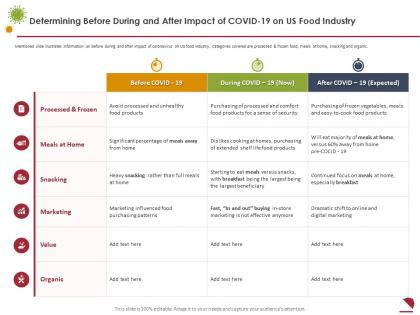
Determining before during and after impact of covid 19 on us food industry processed ppt professional




Try Before you Buy Download Free Sample Product
 Impress Your
 Audience
 100%
100% Editable
 Save Hours
 of Time


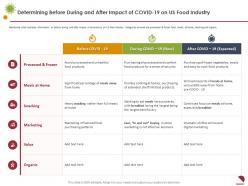
Mentioned slide illustrates information on before during and after impact of coronavirus on US food industry. Categories covered are processed and frozen food, meals at home, snacking and organic
People who downloaded this PowerPoint presentation also viewed the following :
Determining before during and after impact of covid 19 on us food industry processed ppt professional with all 2 slides:
Use our Determining Before During And After Impact Of COVID 19 On Us Food Industry Processed Ppt Professional to effectively help you save your valuable time. They are readymade to fit into any presentation structure.
FAQs for Determining before during and after impact of covid 19 on us food industry
COVID-19 immediately disrupted US food supply chains through widespread restaurant closures, panic buying creating grocery shortages, labor shortages in processing facilities, and transportation bottlenecks affecting distribution networks. These disruptions forced rapid pivots to direct-to-consumer models, contactless delivery systems, and enhanced safety protocols, with many food companies finding that supply chain diversification and digital transformation became essential for operational resilience.
COVID-19 dramatically shifted consumer food purchasing toward online grocery shopping, bulk buying, comfort food preferences, local sourcing, and increased home cooking. These behavioral changes drove restaurants to pivot toward delivery services, grocery stores to enhance digital platforms, and food manufacturers to adjust packaging sizes, with many retailers finding that contactless shopping options and meal kit services delivered sustained competitive advantages beyond the pandemic period.
COVID-19 accelerated contactless payment systems, online ordering platforms, delivery app integration, automated inventory management, and digital menu technologies across restaurants and food retailers. These implementations enabled safer customer interactions, streamlined operations, and enhanced supply chain visibility, with many establishments finding that technology adoption ultimately delivered operational resilience and competitive advantages in an increasingly digital marketplace.
Restaurant closures significantly disrupted food distribution networks by eliminating a major commercial channel, forcing suppliers to rapidly pivot from bulk institutional packaging to consumer-ready formats for retail and delivery services. This shift required extensive supply chain restructuring, with many distributors finding new partnerships with grocery chains, meal kit services, and direct-to-consumer platforms, ultimately accelerating digital transformation and creating more resilient, diversified distribution models.
E-commerce became essential for food industry survival during COVID-19, enabling grocery delivery, restaurant takeout platforms, direct-to-consumer sales, and contactless payment systems. This digital transformation streamlined operations by reducing physical contact, expanding market reach, and maintaining revenue streams, with many restaurants and grocery chains finding that online sales now represent 30-50% of total business.
COVID-19 has transformed food safety protocols through enhanced sanitation procedures, contactless delivery systems, temperature monitoring, UV sanitization technologies, and stricter supply chain tracking. These comprehensive measures streamline operations by reducing contamination risks, accelerating cleaning processes, and improving consumer confidence, with many restaurants and food manufacturers finding that these protocols ultimately deliver competitive advantage and operational resilience.
Small food businesses faced revenue losses from lockdowns, supply chain disruptions, labor shortages, increased safety costs, and shifting consumer behaviors during COVID-19. Many adapted by pivoting to delivery services, outdoor dining, contactless ordering systems, and direct-to-consumer sales channels, with restaurants and cafes finding that digital transformation and flexible service models ultimately delivered enhanced customer reach and operational resilience.
The pandemic significantly affected food prices through supply chain disruptions, labor shortages, and increased demand for packaged goods, while consumer spending shifted dramatically toward grocery purchases and away from restaurant dining. These changes resulted in higher prices for meat, dairy, and processed foods, with many households increasing their food budgets by 20-30% while restaurants experienced substantial revenue losses, ultimately reshaping how Americans approach food purchasing and meal planning.
COVID-19 severely disrupted US food production through widespread plant closures, labor shortages from illness and quarantine requirements, and significant supply chain bottlenecks across meat processing, dairy, and produce sectors. Agricultural operations faced critical workforce reductions, with many farms, processing facilities, and distribution centers implementing costly safety protocols while struggling to maintain production levels, ultimately leading to food price increases and temporary shortages in grocery stores nationwide.
The food industry has learned to prioritize supply chain diversification, accelerate digital transformation, enhance employee safety protocols, and maintain flexible operational models during crises. These lessons have enabled restaurants, grocery chains, and food manufacturers to build resilient business strategies, with many companies finding that strategic technology investments and agile workforce management ultimately deliver stronger market positioning.
The pandemic accelerated plant-based food adoption through heightened health consciousness, supply chain disruptions in traditional meat processing, and increased home cooking experimentation. Restaurants, grocery retailers, and food manufacturers expanded alternative protein offerings, with many finding that consumers prioritize immune-boosting nutrition and sustainable options, ultimately delivering new revenue streams and competitive positioning.
Food manufacturers implemented diversification of supplier networks, acceleration of digital supply chain technologies, strategic inventory management, direct-to-consumer sales channels, and enhanced safety protocols. These approaches enabled companies to maintain operations by reducing single-source dependencies, improving visibility through real-time tracking systems, and pivoting distribution models, with many finding that these adaptations ultimately delivered greater resilience and operational flexibility.
The pandemic significantly increased food waste at farms and processing facilities due to supply chain disruptions and restaurant closures, while simultaneously reducing household food waste as consumers became more mindful of grocery purchases and cooking at home. This shift created a paradox where upstream waste surged from cancelled orders and logistics challenges, yet downstream waste decreased, with many food companies ultimately finding opportunities to diversify distribution channels and enhance supply chain resilience.
COVID-19 accelerated food delivery innovations including contactless delivery, ghost kitchens, AI-powered logistics, drone delivery pilots, and integrated app ecosystems with real-time tracking. These technologies revolutionized restaurant operations by reducing overhead costs, expanding market reach, and enhancing customer safety, with many establishments finding that hybrid delivery models deliver sustained competitive advantage.
Public health messaging has significantly shaped consumer food choices by emphasizing safety, nutrition, and immune system support, driving increased demand for fresh produce, organic products, and functional foods with health claims. Retailers and food manufacturers have responded by enhancing transparency around sourcing, fortifying products with vitamins and minerals, and promoting local supply chains, ultimately delivering stronger consumer trust and competitive positioning in an increasingly health-conscious marketplace.
-
Best way of representation of the topic.
-
Designs have enough space to add content.
-
Great designs, really helpful.
-
I discovered this website through a google search, the services matched my needs perfectly and the pricing was very reasonable. I was thrilled with the product and the customer service. I will definitely use their slides again for my presentations and recommend them to other colleagues.
-
Excellent template with unique design.