


Health Information Exchange Technology System




Try Before you Buy Download Free Sample Product
 Impress Your
 Audience
 100%
100% Editable
 Save Hours
 of Time


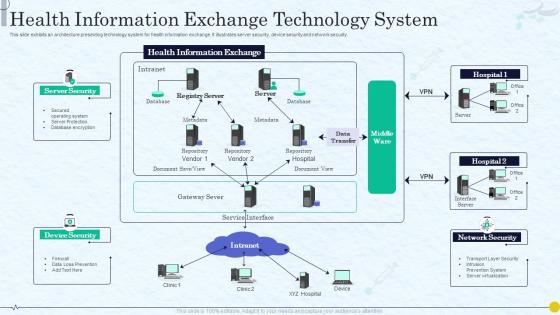
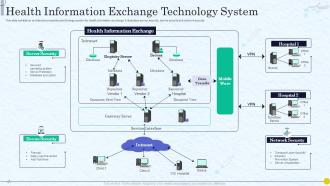
This slide exhibits an architecture presenting technology system for health information exchange. It illustrates server security, device security and network security.
People who downloaded this PowerPoint presentation also viewed the following :
Health Information Exchange Technology System with all 6 slides:
Use our Health Information Exchange Technology System to effectively help you save your valuable time. They are readymade to fit into any presentation structure.





FAQs for Health Information
Health Information Exchange delivers enhanced care coordination, reduced medical errors, elimination of duplicate testing, improved patient safety, and streamlined administrative processes for healthcare providers. Through seamless data sharing, hospitals and clinics can access comprehensive patient histories instantly, enabling faster diagnoses and treatment decisions, while ultimately reducing costs and improving patient outcomes across healthcare networks.
HIE enhances patient outcomes by enabling seamless data sharing across hospitals, clinics, and specialty practices, reducing medical errors, eliminating duplicate tests, and ensuring comprehensive care histories are accessible. Through real-time access to patient records, healthcare providers deliver more coordinated treatment plans, faster diagnoses, and improved medication management, ultimately reducing readmissions while enhancing patient safety.
Organizations face challenges including interoperability issues between different EHR systems, data standardization complexities, privacy and security compliance requirements, significant implementation costs, and workflow integration difficulties. While these obstacles present initial hurdles, many healthcare institutions find that strategic planning, phased rollouts, and staff training ultimately streamline patient care coordination and enhance operational efficiency across departments.
Data privacy and security within Health Information Exchanges are maintained through robust encryption protocols, multi-factor authentication systems, role-based access controls, audit trails, and compliance frameworks like HIPAA. These technologies streamline secure data sharing by minimizing unauthorized access, tracking user interactions, and ensuring regulatory compliance, with many healthcare networks finding that strategic security combinations ultimately deliver enhanced patient trust and operational efficiency.
Technology serves as the backbone of Health Information Exchange by enabling secure data transmission, standardizing medical records formats, automating patient matching, and providing real-time access to critical health information. Through cloud-based platforms and API integrations, hospitals, clinics, and specialists can seamlessly share patient data, ultimately reducing duplicate tests, minimizing medical errors, and delivering faster, more coordinated care across healthcare networks.
Centralized Health Information Exchanges store all data in one repository enabling faster access and standardized formats, while federated systems maintain data at original sources, preserving institutional control but requiring complex integration protocols. Centralized models streamline emergency care and population health analytics, whereas federated approaches enhance privacy compliance and reduce migration costs, with many healthcare networks finding that hybrid combinations deliver optimal balance between accessibility and security.
Health Information Exchange regulatory requirements include HIPAA compliance in the US, GDPR in Europe, PIPEDA in Canada, privacy legislation in Australia, and local data protection laws globally. These frameworks streamline healthcare data sharing by establishing trust protocols, consent mechanisms, and security standards, with many healthcare systems finding that regulatory compliance ultimately enhances patient care coordination and reduces administrative burdens.
Patients access their health information through HIEs via secure patient portals, mobile applications, and direct requests to participating healthcare providers, enabling comprehensive view of medical records, test results, and treatment histories. This access empowers patients with better health management, informed decision-making during medical consultations, and seamless care coordination across multiple providers, ultimately delivering improved health outcomes and enhanced patient engagement in their care journey.
Interoperability significantly enhances HIE effectiveness by enabling seamless data sharing across diverse healthcare systems, reducing medical errors, and accelerating clinical decision-making. Through standardized protocols and unified data formats, hospitals, clinics, and specialty practices achieve improved care coordination, reduced duplicate testing, and enhanced patient outcomes, ultimately delivering cost savings and competitive advantages in increasingly integrated healthcare markets.
Blockchain and artificial intelligence are revolutionizing Health Information Exchange by enhancing security, interoperability, and data analytics capabilities. Through blockchain's immutable records and AI's predictive insights, healthcare organizations streamline patient data sharing, automate clinical workflows, and improve diagnostic accuracy, with many hospitals finding that these technologies ultimately deliver faster care coordination and enhanced patient outcomes.
Best practices for ensuring data integrity and accuracy in Health Information Exchanges include standardized data formats, robust validation protocols, regular audit procedures, secure transmission methods, and comprehensive staff training programs. These approaches streamline healthcare operations by minimizing errors, enhancing patient safety, and improving clinical decision-making, with many hospitals and health systems finding that strategic implementation ultimately delivers better care coordination and reduced operational costs.
Health Information Exchange initiatives deliver distinct advantages across healthcare ecosystems, with providers gaining streamlined care coordination and reduced duplicate testing, payers achieving better risk assessment and fraud detection capabilities, and patients experiencing improved care continuity and faster treatment decisions. Through seamless data sharing, hospitals reduce readmission rates, insurance companies enhance claims processing efficiency, and patients receive more personalized care, ultimately creating a more integrated healthcare landscape where all stakeholders benefit from enhanced operational efficiency and improved health outcomes.
Key HIE success metrics include data exchange volume, provider adoption rates, patient record completeness, system interoperability scores, and clinical decision support utilization. These measurements enable healthcare organizations to track operational efficiency, care coordination improvements, and patient safety outcomes, with many health systems finding that comprehensive metric tracking ultimately delivers faster diagnoses, reduced medical errors, and enhanced care quality across their networks.
The COVID-19 pandemic significantly accelerated HIE adoption by creating urgent needs for real-time patient data sharing, remote care coordination, and interoperability across healthcare systems. Healthcare organizations rapidly expanded HIE capabilities to support telehealth services, contact tracing, vaccination tracking, and seamless care transitions, with many finding that enhanced data exchange ultimately delivered faster patient services, improved care quality, and stronger operational resilience in crisis management.
Future HIE trends include cloud-based interoperability platforms, AI-powered data analytics, blockchain security protocols, patient-controlled access systems, and real-time clinical decision support tools. These technologies streamline care coordination by enabling instant data sharing, predictive health insights, and enhanced security measures, with healthcare networks finding that integrated systems ultimately deliver faster diagnoses, reduced medical errors, and significantly improved patient outcomes.
-
It is my first time working with them and that too on a friend's recommendation. I would say, I am not expecting such a worldly service at this low price.
-
Perfect template with attractive color combination.