


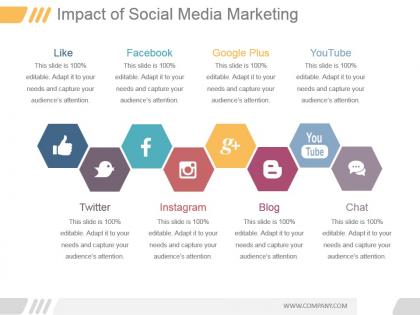
Impact of social media marketing ppt background template




Try Before you Buy Download Free Sample Product
 Impress Your
 Audience
 100%
100% Editable
 Save Hours
 of Time


Deliver better on every demand with our Impact Of Social Media Marketing Ppt Background Template. They allow you to beat customer expectations.
People who downloaded this PowerPoint presentation also viewed the following :
Impact of social media marketing ppt background template with all 5 slides:
Add to the existing cordiality with our Impact Of Social Media Marketing Ppt Background Template. Feelings of bonhomie will get a definite boost.
FAQs for Impact of social media marketing
Key components of an effective social media marketing strategy include audience research and segmentation, content planning and creation, platform-specific optimization, engagement management, and performance analytics. These elements work together by targeting relevant demographics, delivering consistent brand messaging, and fostering authentic customer relationships, with many businesses finding that strategic social media presence significantly enhances brand awareness, drives website traffic, and ultimately delivers measurable ROI through increased conversions and customer loyalty.
Small businesses can leverage social media marketing through organic content creation, community engagement, user-generated content campaigns, strategic hashtag usage, and partnerships with micro-influencers. These cost-effective approaches enable businesses to build authentic relationships, increase brand visibility, and drive customer acquisition without significant advertising spend, with many small retailers and service providers finding that consistent, targeted social media presence delivers measurable growth and competitive advantage.
The most impactful social media marketing metrics include engagement rate, conversion rate, reach and impressions, click-through rate, and cost per acquisition. These metrics enable businesses to measure audience interaction, revenue generation, and campaign efficiency, with retail brands, SaaS companies, and e-commerce platforms finding that tracking these delivers measurable ROI and competitive advantage.
Different social media platforms cater to distinct demographics through unique features, content formats, and user behaviors, with LinkedIn targeting professionals, Instagram appealing to younger visual-focused users, and Facebook serving broader age ranges. These platform distinctions enable businesses to strategically allocate marketing resources, customize messaging approaches, and maximize engagement rates, ultimately delivering more targeted campaigns and better ROI across diverse customer segments.
User-generated content serves as authentic social proof, driving engagement, building community trust, and expanding brand reach through customer testimonials, reviews, photos, and videos. This strategic approach reduces content creation costs while delivering higher conversion rates, with retail brands and hospitality companies finding that customer-shared experiences generate significantly more engagement than traditional branded content, ultimately enhancing credibility and competitive advantage.
Brands can effectively handle negative feedback by responding promptly and professionally, acknowledging concerns publicly, taking detailed conversations private when needed, and demonstrating genuine commitment to resolution. This approach transforms potentially damaging situations into opportunities for showcasing customer service excellence, with many companies finding that transparent, empathetic responses often convert critics into advocates while building trust with broader audiences.
Social media marketing trends will increasingly focus on AI-powered personalization, short-form video content, social commerce integration, augmented reality experiences, and authentic influencer partnerships. These developments enable brands to streamline customer engagement, enhance targeting precision, and deliver more immersive shopping experiences, with many retailers and service providers finding that strategic social media integration ultimately drives higher conversion rates and competitive advantage.
Storytelling enhances social media presence by creating emotional connections, increasing engagement rates, and building authentic brand personality that resonates with target audiences. Through compelling narratives, brands like Nike and Airbnb transform product features into relatable experiences, ultimately driving higher follower loyalty, improved content sharing, and stronger customer relationships across platforms.
Creative social media lead generation strategies include interactive polls and quizzes, behind-the-scenes content, user-generated campaigns, live Q&A sessions, and exclusive resource gateways. These approaches enhance engagement by building authentic connections, showcasing expertise, and creating value-driven touchpoints, with many businesses finding that interactive content generates significantly higher conversion rates than traditional promotional posts.
Businesses use analytics to improve social media marketing by tracking engagement rates, audience demographics, content performance, and conversion metrics across platforms. These insights enable companies to optimize posting schedules, refine content strategies, and allocate resources more effectively, with many organizations finding that data-driven approaches increase ROI and enhance customer targeting significantly.
**INPUT**: What are the ethical considerations in social media marketing? **OUTPUT**: Ethical considerations in social media marketing include data privacy protection, transparent advertising disclosure, authentic content creation, responsible targeting practices, and respectful community engagement. These principles streamline brand trust-building by ensuring compliance, minimizing legal risks, and fostering genuine customer relationships, with many organizations finding that ethical approaches ultimately deliver stronger engagement and sustainable competitive advantage.
Influencers can be incorporated through sponsored content partnerships, product collaborations, brand ambassadorships, event activations, and user-generated content campaigns. These strategic partnerships enhance brand credibility and reach by leveraging authentic audience connections, targeted demographic access, and trusted recommendations, with many brands finding that influencer collaborations deliver higher engagement rates and improved conversion metrics than traditional advertising approaches.
Strategies to increase organic reach include creating high-quality, engaging content, posting consistently during peak audience hours, using relevant hashtags strategically, encouraging meaningful interactions through questions and polls, and leveraging user-generated content. These approaches enhance visibility by boosting algorithm favorability, building authentic community engagement, and maximizing content discoverability, with many brands finding that consistent, value-driven posting ultimately delivers sustained audience growth and stronger customer relationships.
Businesses should balance social media advertising and organic content by using paid ads for targeted reach, lead generation, and immediate conversions, while leveraging organic content for brand authenticity, community building, and long-term engagement. This strategic combination enables companies to maximize visibility and nurture relationships, with many retail and service businesses finding that integrated approaches deliver both immediate results and sustained customer loyalty.
**INPUT**: What are the best practices for managing multiple social media accounts? **OUTPUT**: Best practices include using centralized management platforms, creating consistent brand messaging, scheduling content strategically, monitoring engagement across channels, and analyzing performance metrics regularly. These approaches streamline operations by reducing manual tasks, ensuring brand coherence, and optimizing posting times, with many organizations finding that automated tools and clear content calendars ultimately deliver enhanced efficiency and stronger audience engagement. [Word count: 60 words]
-
It saves your time and decrease your efforts in half.
-
Commendable slides with attractive designs. Extremely pleased with the fact that they are easy to modify. Great work!