


Implementing Quality Assurance QA Transformation Tools Powerpoint Presentation Slides





Try Before you Buy Download Free Sample Product
 Impress Your
 Audience
 100%
100% Editable
 Save Hours
 of Time


QA Quality Assurance Transformation builds a gradual approach to measuring, managing, and integrating processes to consistently deliver financial and timely benefits to the company. To improve the product quality and overall efficiency, it is essential to implement effective QA transformation techniques. Check out our competently designed template on Implementing Quality Assurance QA Transformation Tools for Continuous Process Improvement. The factors that are affected by poor implementation of QA Transformation Techniques are High Active Defect Rate, fall in the Product Quality, increase in Product Delivery Time, decrease in overall Team Effectiveness, etc. Hence the company must adopt specific testing techniques to improve the product quality leading to effective QA Transformation. This proposal provides information on Information Technology company overview, need for QA transformation in the company, QA key performance indicators, QA team structure, the importance of QA Transformation and testing, strategies and approaches to improve QA Transformation, performance metrics, benefits of Software Testing, testing tools for Effective QA Transformation, recommendations for QA Transformation, outcomes of successful Transformation, estimated future results and performance after Strategy Implementation, the cost involved in Transformation Process, dashboard analysis, etc. Grab the template and download it now.
People who downloaded this PowerPoint presentation also viewed the following :
Content of this Powerpoint Presentation
Slide 1: This slide introduces Implementing Quality Assurance (QA) Transformation Tools for Continuous Process Improvement. State Your Company Name and begin.
Slide 2: This slide states Agenda of the presentation.
Slide 3: This slide presents Table of Content for the presentation.
Slide 4: This is another slide continuing Table of Content for the presentation.
Slide 5: This slide depicts title for 'Company overview, need, & performance indicators'.
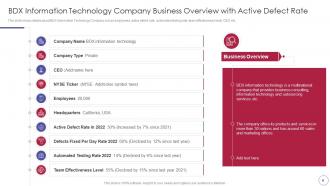
Slide 6: This slide shows details about BDX Information Technology Company such as employees, active defect rate, etc.
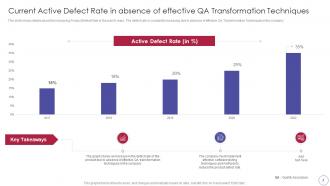
Slide 7: This slide shows details about the increasing Product Defect Rate in the past 5 years.
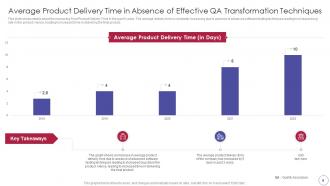
Slide 8: This slide shows details about the increasing Final Product Delivery Time in the past 5 years.
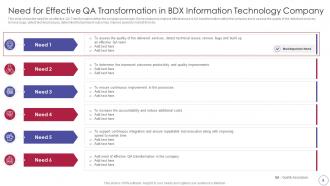
Slide 9: This slide shows the need for an effective QA Transformation within the company processes.
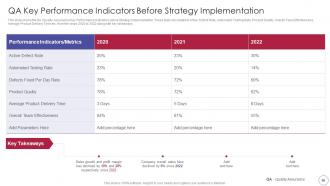
Slide 10: This slide shows the QA (Quality Assurance) Key Performance Indicators before Strategy Implementation.
Slide 11: This slide show the various members of the QA Team structure along with their designations.
Slide 12: This slide displays title for 'Aspects & importance of QA transformation'.
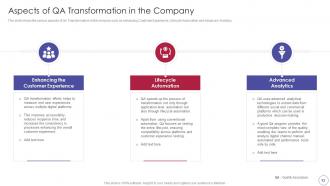
Slide 13: This slide shows the various aspects of QA Transformation in the company.
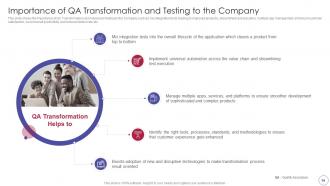
Slide 14: This slide shows the Importance of QA Transformation and Advanced Testing to the Company.
Slide 15: This slide presents title for 'Strategies & approaches, performance metrics & benefits of software testing processes'.
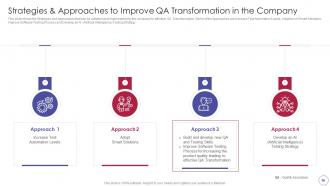
Slide 16: This slide shows the Strategies and Approaches that can be adopted and implemented by the company for effective QA Transformation.
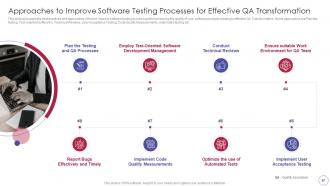
Slide 17: This slide discusses the best practices and approaches of how to improve software testing process and for increasing the quality of your software products.
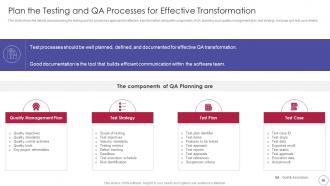
Slide 18: This slide shows the details about planning the Testing and QA processes approach for Effective Transformation.
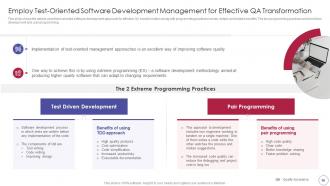
Slide 19: This slide shows the details about Test-Oriented Software Development Approach for Effective QA Transformation.
Slide 20: This slide shows the details about Technical Review Approach for Effective QA Transformation along with Types of FTR and Benefits of FTR.
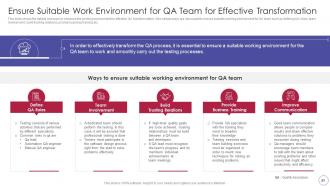
Slide 21: This slide shows the details and ways to enhance the Working Environment for Effective QA Transformation.
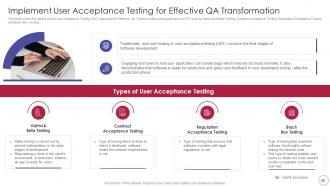
Slide 22: This slide shows the details about User Acceptance Testing (UAT) Approach for Effective QA Transformation.
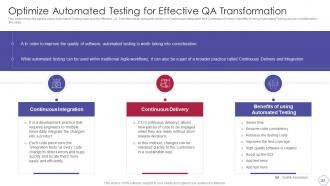
Slide 23: This slide shows the details about Automated Testing Approach for Effective QA Transformation.
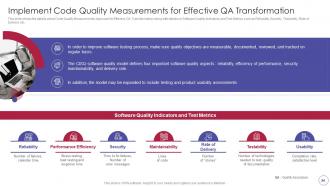
Slide 24: This slide shows the details about Code Quality Measurements Approach for Effective QA Transformation.
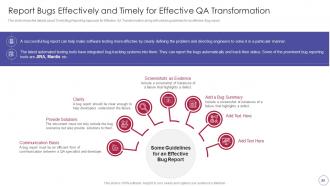
Slide 25: This slide shows the details about Timely Bug Reporting Approach for Effective QA Transformation.
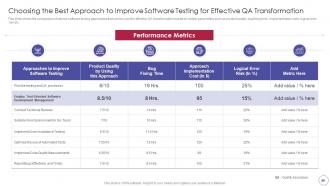
Slide 26: This slide shows the comparison of various Software Testing Approaches that can be used for effective QA transformation.
Slide 27: This slide shows the comparison of various Software Testing Approaches that can be used for effective QA transformation.
Slide 28: This slide exhibits title for 'Testing tools, recommendations & outcomes of transformation'.
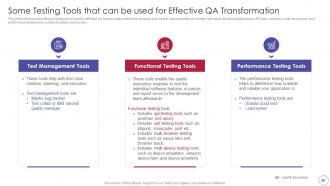
Slide 29: This slide shows some Testing Tools that can be used for Effective QA Transformation within the company.
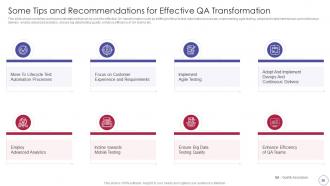
Slide 30: This slide shows some Tips and Recommendations that can be used for Effective QA Transformation.
Slide 31: This slide shows some Positive Outcomes and Results of Effective QA Transformation in long term.
Slide 32: This slide depicts title for 'Estimated future results, cost involved & dashboard'.
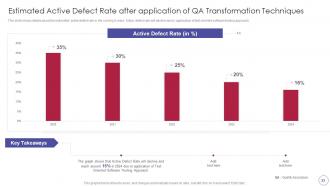
Slide 33: This slide shows details about the Estimated Active Defect Rate in the coming 5 years.
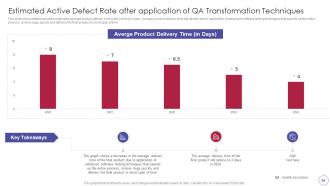
Slide 34: This slide shows details about the Estimated Average Product Delivery Time in the coming 5 years.
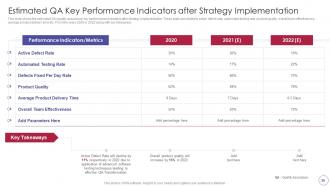
Slide 35: This slide shows the Estimated QA (Quality Assurance) Key Performance Indicators after Strategy Implementation.
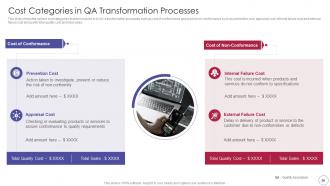
Slide 36: This slide shows the various cost categories that are involved in in QA Transformation Processes.
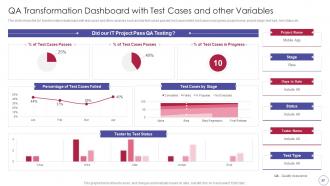
Slide 37: This slide shows the QA Transformation Dashboard with Test Cases and other Variables.
Slide 38: This slide displays Icons for Implementing Quality Assurance (QA) Transformation Tools for Continuous Process Improvement.
Slide 39: This slide is titled as Additional Slides for moving forward.
Slide 40: This is Our Team slide with names and designation.
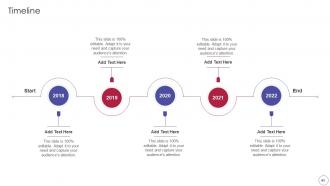
Slide 41: This is a Timeline slide. Show data related to time intervals here.
Slide 42: This slide contains Puzzle with related icons and text.
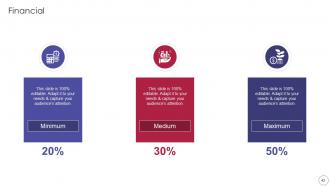
Slide 43: This is a Financial slide. Show your finance related stuff here.
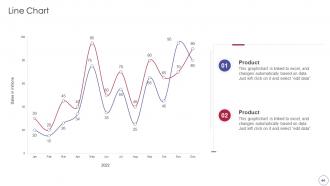
Slide 44: This slide describes Line chart with two products comparison.
Slide 45: This slide shows Post It Notes. Post your important notes here.
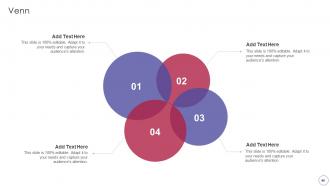
Slide 46: This slide depicts Venn diagram with text boxes.
Slide 47: This is a Thank You slide with address, contact numbers and email address.
Implementing Quality Assurance QA Transformation Tools Powerpoint Presentation Slides with all 52 slides:
Use our Implementing Quality Assurance QA Transformation Tools Powerpoint Presentation Slides to effectively help you save your valuable time. They are readymade to fit into any presentation structure.





















FAQs for Implementing Quality Assurance QA Transformation Tools
Effective quality assurance tools should include automated testing capabilities, comprehensive reporting dashboards, integration with development workflows, real-time defect tracking, and collaborative feedback mechanisms. These features streamline testing processes by reducing manual effort, enhancing visibility across development cycles, and enabling faster issue resolution, with many software teams finding that strategic tool selection ultimately delivers improved product quality and accelerated release timelines.
QA tools integrate with development environments through APIs, plugins, and direct integrations that enable automated testing, continuous integration, and real-time code analysis. Popular tools like Selenium, JIRA, and TestRail seamlessly connect with IDEs such as Visual Studio, Eclipse, and IntelliJ, while Jenkins and GitLab facilitate automated workflows, ultimately streamlining development cycles and enhancing code quality across teams.
Automation streamlines modern QA processes by accelerating test execution, reducing manual effort, and enabling continuous integration workflows. Through automated testing frameworks, organizations enhance regression testing, minimize human error, and deliver faster release cycles, with many software companies finding that strategic automation ultimately reduces costs while improving product quality and competitive time-to-market.
Teams measure QA tool effectiveness through key performance indicators like defect detection rates, testing cycle times, automation coverage percentages, and post-release bug counts. By tracking these metrics alongside cost-per-defect ratios and team productivity measures, organizations can evaluate whether their tools streamline processes, enhance software quality, and ultimately deliver faster releases with fewer customer-reported issues.
Open-source QA tools offer cost-effectiveness, customization flexibility, and community support, while commercial tools provide dedicated support, comprehensive features, and enterprise-grade security. While open-source solutions like Selenium and TestNG work well for organizations with technical expertise, commercial platforms deliver streamlined implementation, professional training, and guaranteed reliability, ultimately enabling faster deployment and reduced maintenance overhead for many businesses.
QA tools support agile and DevOps methodologies by enabling continuous testing, automated feedback loops, and seamless integration across development pipelines. These platforms streamline sprint cycles, facilitate rapid deployment validation, and enhance collaboration between development teams, with many organizations finding that automated testing frameworks significantly reduce release times while maintaining quality standards.
QA tools should provide defect density rates, test coverage percentages, automation success ratios, mean time to resolution, and release readiness scores. These metrics enable development teams to identify bottlenecks, prioritize testing efforts, and accelerate deployment cycles, with many software organizations finding that comprehensive analytics ultimately streamline quality processes while reducing time-to-market.
QA tools streamline cross-browser and cross-device testing by automating test execution across multiple environments, providing real device clouds, and offering comprehensive compatibility reports. Through platforms like BrowserStack and Sauce Labs, organizations can simultaneously test applications across hundreds of browser-device combinations, significantly reducing testing time while ensuring consistent user experiences, ultimately delivering broader market reach and enhanced customer satisfaction.
Common challenges include resistance to change, integration complexity with existing systems, inadequate training, tool selection overwhelming, and initial setup costs. While these obstacles can slow adoption, organizations increasingly find that strategic implementation with proper change management, comprehensive training programs, and phased rollouts ultimately delivers improved testing efficiency, reduced defects, and enhanced product quality across development cycles.
Collaboration features in QA tools significantly enhance team productivity by enabling real-time communication, centralized defect tracking, shared test case repositories, and seamless integration across development cycles. These capabilities streamline workflows by reducing email chains, accelerating bug resolution, and improving transparency, with many software teams finding that unified collaboration ultimately delivers faster release cycles and higher-quality products.
Training resources for mastering quality assurance tools include online certification programs, vendor-specific courses, hands-on workshops, mentorship programs, and industry conferences. These educational approaches enhance technical proficiency, automation skills, and testing methodologies, with many organizations finding that comprehensive training programs significantly improve software delivery speed, reduce defect rates, and ultimately deliver higher-quality products to market.
QA tools streamline bug tracking and reporting by automating issue detection, centralizing defect logs, and enabling real-time collaboration between development and testing teams. Through integrated dashboards and automated workflows, organizations can reduce resolution times, improve communication transparency, and maintain comprehensive audit trails, ultimately delivering faster product releases and enhanced software quality.
User feedback is crucial for selecting QA tools because it reveals real-world usability, integration challenges, and performance gaps that specifications alone cannot capture. This input helps organizations evaluate how tools perform across different testing scenarios, team sizes, and project complexities, with many development teams finding that peer insights significantly reduce implementation risks and accelerate tool adoption success.
AI and machine learning enhance QA tools by automating test case generation, predicting defect patterns, and enabling intelligent test execution across complex scenarios. These technologies streamline quality processes by reducing manual testing overhead, accelerating bug detection, and improving test coverage accuracy, with many software development teams finding that AI-driven QA delivers faster release cycles and significantly enhanced product reliability.
Emerging QA technology trends include AI-powered testing automation, shift-left testing integration, cloud-based testing platforms, low-code test automation tools, and predictive analytics for defect prevention. These technologies streamline testing cycles by reducing manual effort, accelerating release timelines, and enhancing accuracy, with many software organizations finding that strategic adoption ultimately delivers faster time-to-market and improved customer experiences.
-
Placing an order on SlideTeam is very simple and convenient, saves you a lot of your time.
-
Great combination of visuals and information. Glad I purchased your subscription.