


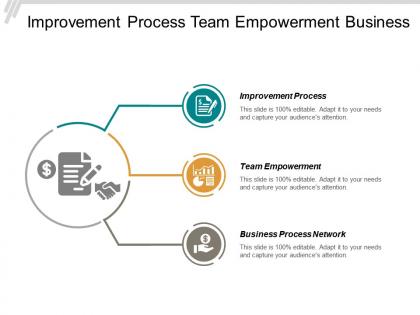
Improvement process team empowerment business process networks collaborative process cpb





Try Before you Buy Download Free Sample Product
 Impress Your
 Audience
 100%
100% Editable
 Save Hours
 of Time


Our Improvement Process Team Empowerment Business Process Networks Collaborative Process Cpb are as good as any insignia. It is akin to a badge of authority.
People who downloaded this PowerPoint presentation also viewed the following :
Improvement process team empowerment business process networks collaborative process cpb with all 5 slides:
Identify areas demanding cooperation with our Improvement Process Team Empowerment Business Process Networks Collaborative Process Cpb. Guide folks on how to coordinate effectively.




FAQs for Improvement process team empowerment business process networks
Effective process empowerment includes clear decision-making authority, comprehensive training programs, real-time performance feedback systems, resource accessibility, and defined accountability frameworks. These components work together by enhancing employee autonomy, streamlining operational workflows, and accelerating response times, with organizations across manufacturing, healthcare, and financial services finding that empowered teams deliver improved customer experiences and sustainable competitive advantage.
Organizations measure process empowerment success through key performance indicators like cycle time reduction, employee satisfaction scores, decision-making speed, and operational efficiency metrics. Through regular assessments and feedback mechanisms, companies in manufacturing, healthcare, and financial services track improved productivity, reduced bottlenecks, and enhanced employee engagement, ultimately delivering faster customer service and competitive advantage.
Leadership plays a crucial role in process empowerment by establishing clear governance frameworks, providing necessary resources and training, delegating decision-making authority, and consistently communicating the strategic vision behind process improvements. Effective leaders champion empowerment initiatives by removing organizational barriers, recognizing employee contributions, and creating psychological safety for innovation, with many organizations finding that leadership commitment directly correlates with successful process transformation outcomes.
Technology facilitates process empowerment through automation platforms, AI-driven analytics, cloud-based collaboration tools, mobile applications, and real-time monitoring systems. These solutions streamline workflows by eliminating manual bottlenecks, enhancing decision-making capabilities, and enabling seamless cross-functional coordination, with organizations across healthcare, manufacturing, and financial services finding significantly improved operational efficiency and competitive advantage.
Common barriers to process empowerment include resistance to change, lack of clear communication, insufficient training, rigid hierarchical structures, and inadequate technology infrastructure. These challenges can be overcome by fostering a culture of continuous improvement, providing comprehensive employee development programs, implementing collaborative decision-making frameworks, and leveraging digital tools that streamline workflows, ultimately delivering enhanced operational efficiency and stronger competitive advantage.
Process empowerment significantly enhances employee engagement by granting autonomy over workflows, decision-making authority, and ownership of outcomes, while reducing micromanagement and bureaucratic constraints. Through strategic delegation and streamlined processes, organizations enable faster problem-solving, increased job satisfaction, and improved retention rates, with many companies finding that empowered employees deliver higher productivity and innovation.
Yes, process empowerment significantly enhances decision-making by providing employees with clear frameworks, access to relevant data, and defined authority levels within structured workflows. When organizations streamline decision-making processes through empowerment initiatives, teams can respond faster to customer needs, reduce bottlenecks, and leverage local expertise more effectively, ultimately delivering improved outcomes and competitive advantage.
**INPUT**: What methodologies or frameworks are best suited for implementing process empowerment? **OUTPUT**: Process empowerment implementation thrives through Lean Six Sigma, agile methodologies, continuous improvement frameworks, employee engagement models, and cross-functional team structures. These approaches streamline decision-making authority, enhance operational efficiency, and minimize bottlenecks, with many organizations finding that strategic combinations of these methodologies ultimately deliver faster response times and competitive advantage. **Word count: 52 words**
Organizations identify processes requiring empowerment by analyzing bottlenecks where employee decisions are delayed by approval chains, monitoring customer complaints about slow responses, and reviewing areas with high error rates or employee frustration. Through process mapping and feedback systems, companies in banking, healthcare, and retail discover that empowering frontline staff in customer service, quality control, and problem resolution significantly reduces response times while improving satisfaction scores.
Process empowerment and continuous improvement share a symbiotic relationship, where empowered teams drive innovation through enhanced decision-making authority, streamlined feedback loops, and direct problem-solving capabilities. This strategic combination enables organizations to accelerate optimization cycles, reduce operational bottlenecks, and foster sustainable growth, with many companies finding that empowered employees consistently identify improvement opportunities faster than traditional hierarchical approaches.
Teams can be trained to embrace process empowerment through comprehensive skill development, clear communication of decision-making boundaries, mentoring programs, and hands-on practice with real scenarios. This approach enables organizations to build confidence systematically while providing safety nets, with many companies finding that gradual responsibility transfer, combined with regular feedback sessions, ultimately delivers higher employee engagement and faster operational responses.
Process empowerment risks include inconsistent decision-making, increased errors from inexperienced staff, potential policy violations, reduced oversight control, and initial productivity dips during transition periods. These challenges can be managed through comprehensive training programs, clear decision-making frameworks, regular coaching sessions, and phased implementation approaches, with many organizations finding that structured support systems ultimately deliver enhanced employee engagement and operational efficiency.
Process empowerment varies significantly across industries, with healthcare focusing on patient safety protocols, manufacturing emphasizing lean production workflows, financial services streamlining compliance procedures, and retail optimizing customer experience touchpoints. These sector-specific approaches enable organizations to address unique regulatory requirements, operational challenges, and stakeholder expectations, ultimately delivering enhanced efficiency and competitive advantage within their respective markets.
Feedback serves as the critical mechanism for identifying bottlenecks, measuring performance gaps, and validating decision-making effectiveness within empowered processes. Through regular feedback loops, organizations can streamline workflows, enhance employee confidence in autonomous decisions, and optimize resource allocation, with many companies finding that continuous feedback cycles ultimately deliver faster process improvements and stronger competitive advantage.
Process empowerment supports workplace innovation by giving employees authority to modify workflows, experiment with new approaches, and implement creative solutions without excessive approval layers. When teams control their processes, organizations see faster idea implementation, increased experimentation, and enhanced problem-solving capabilities, with many companies finding that empowered processes ultimately deliver breakthrough innovations and competitive advantages.
No Reviews