


Inbound Recruiting Powerpoint Presentation Slides






Try Before you Buy Download Free Sample Product
 Impress Your
 Audience
 100%
100% Editable
 Save Hours
 of Time


Inbound Recruiting approaches make your organizations culture visible and attractive to top talent. Here is a professionally designed Inbound Recruiting template that includes organization inbound strategies and techniques for finding, attracting, engaging, and nurturing talent before they apply for a position, often known as the pre applicant phase of talent acquisition. This presentation aims to promote the value of working for the organization and establish a company culture or brand to attract appropriate candidates. The outline of this presentation is as follows consulting company introduction, the need for inbound recruiting for the organization and inbound recruiting goals. Further, it includes candidate persona development, employee value proposition, candidate awareness journey, marketing plan maturity model, etc. This PPT also consists of an inbound recruiting plan, content plan, the impact of the recruitment campaigns, and overall marketing campaign impact on the organization. Lastly, it provides an inbound recruiting timeline, budget, dashboards, etc. Customize this 100 percent editable template based on your needs now.
People who downloaded this PowerPoint presentation also viewed the following :
Content of this Powerpoint Presentation
Slide 1: This slide displays title i.e. 'Inbound Recruiting' and your Company Name.
Slide 2: This slide presents agenda.
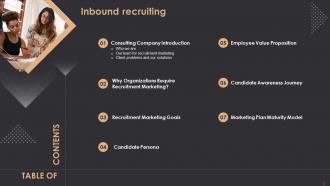
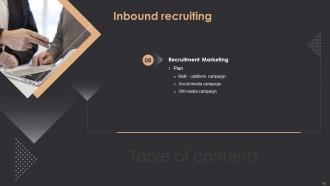
Slide 3: This slide exhibits table of contents.
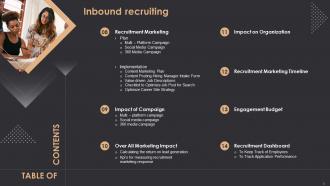
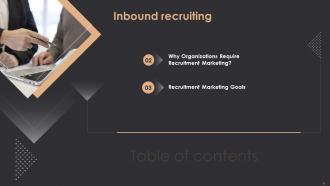
Slide 4: This slide also shows table of contents.
Slide 5: This slide depicts title for three topics that are to be covered next in the template.
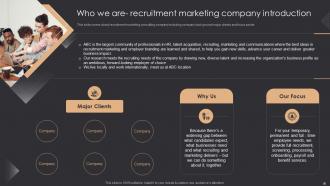
Slide 6: This slide covers about recruitment marketing consulting company including company back ground major clients and focus points.
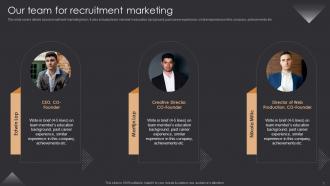
Slide 7: This slide covers details about recruitment marketing team.
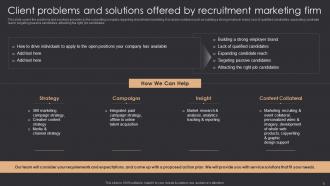
Slide 8: This slide covers the problems and solutions provides by the consulting company regarding recruitment marketing.
Slide 9: This slide depicts title for two topics that are to be covered next in the template.
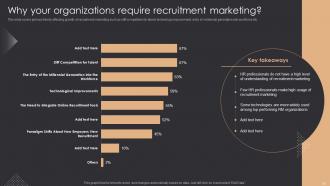
Slide 10: This slide covers primary trends affecting growth of recruitment marketing such as stiff competition for talent, technology improvement, etc.
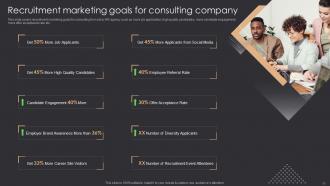
Slide 11: This slide covers recruitment marketing goals for consulting firm set by HR agency such as more job application, high quality candidates, etc.
Slide 12: This slide depicts title for four topics that are to be covered next in the template.
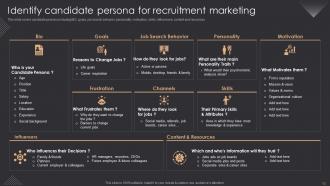
Slide 13: This slide covers candidate persona including BIO, goals, job search behavior, personality, motivation, skills, influencers, content and resources.
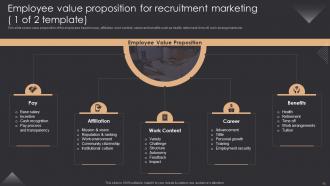
Slide 14: This slide covers value proposition of the employees based on pay, affiliation, work content, career and benefits.
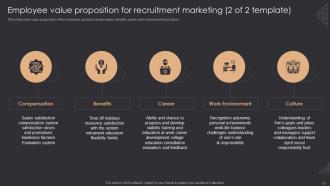
Slide 15: This slide covers value proposition of the employees based on compensation, benefits, career, work environment and culture.
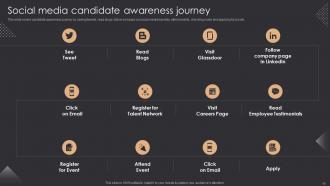
Slide 16: This slide covers candidate awareness journey by seeing tweets, read blogs, follow company on social media handles, etc.
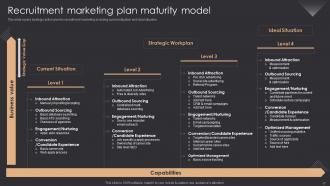
Slide 17: This slide covers strategic action plan for recruitment marketing including current situation and ideal situation
Slide 18: This slide depicts title for four topics that are to be covered next in the template.
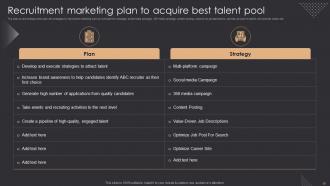
Slide 19: This slide covers strategic action plan and strategies for recruitment marketing such as multi-platform campaign, etc.
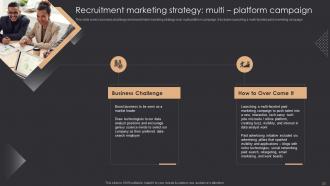
Slide 20: This slide covers business challenge and recruitment marketing strategy such multi platform campaign.
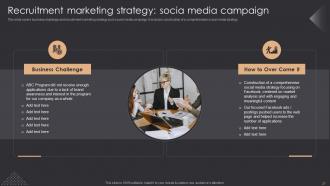
Slide 21: This slide covers business challenge and recruitment marketing strategy such social media campaign.
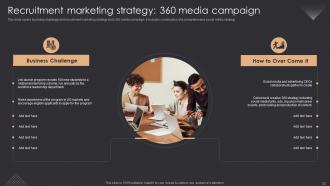
Slide 22: This slide covers business challenge and recruitment marketing strategy such 360 media campaign.
Slide 23: This slide depicts title for six topics that are to be covered next in the template.
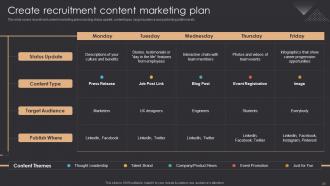
Slide 24: This slide covers recruitment content marketing plan including status update, content types, target audience and publishing platforms etc.
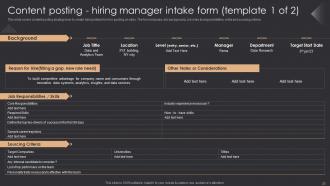
Slide 25: This slide covers content posting strategy how to create hiring intake form for posting on sites.
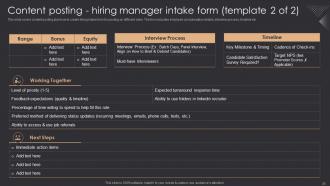
Slide 26: This slide covers content posting plan how to create hiring intake form for posting on different sites.
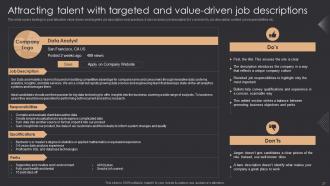
Slide 27: This slide covers strategy to post attractive value driven and targeted job description best practices.
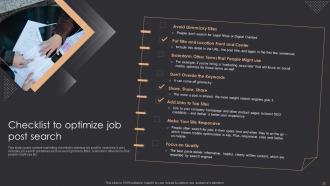
Slide 28: This slide covers content marketing checklist to optimize job post for searches.
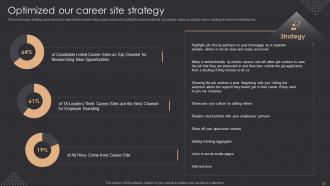
Slide 29: This slide covers strategy and reasons to optimize the career sites pages such as to highlight company website, etc.
Slide 30: This slide depicts title for three topics that are to be covered next in the template.
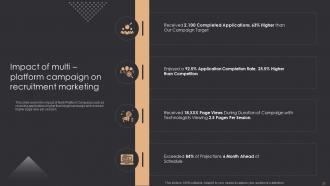
Slide 31: This slide covers the impact of Multi Platform Campaign such as receiving applications higher than target campaign and received higher page view per session.
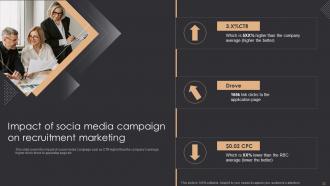
Slide 32: This slide covers the impact of social media Campaign such as CTR higher than the company’s average, higher clicks drove to appicatop page etc.
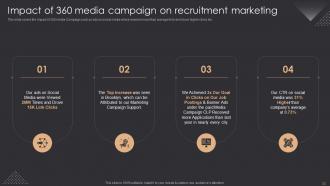
Slide 33: This slide covers the impact of 360 media Campaign such as ads on social media where viewed moran than average time and drove higher clicks etc.
Slide 34: This slide depicts title for three topics that are to be covered next in the template.
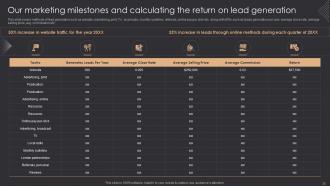
Slide 35: This slide covers methods of lead generation such as website, advertising, print, TV, local radio, monthly bulletins, referrals, etc.
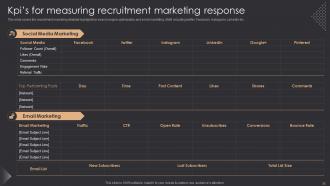
Slide 36: This slide covers the recruitment marketing detailed highlights for search engine optimization and email marketing, SMM including twitter, etc.
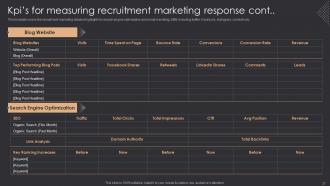
Slide 37: This template covers the recruitment marketing detailed highlights for search engine optimization and email marketing, etc.
Slide 38: This slide depicts title for three topics that are to be covered next in the template.
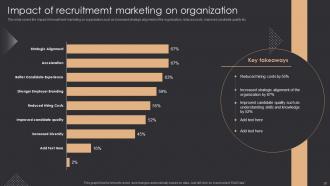
Slide 39: This slide covers the impact of recruitment marketing on organization such as Increased strategic alignment of the organization, etc.
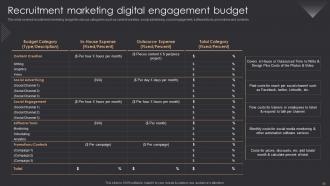
Slide 40: This slide covered recruitment marketing budget for various categories such as content creation, social advertising, social engagement, etc.
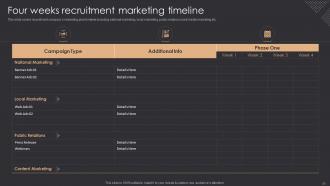
Slide 41: This slide covers recruitment company’s marketing plan timeline including national marketing, local marketing, public relation social media marketing etc.
Slide 42: This slide depicts title for two topics that are to be covered next in the template.
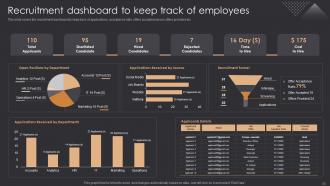
Slide 43: This slide covers the recruitment dashboard to keep track of applications, acceptance ratio, offers accepted versus offers provided etc.
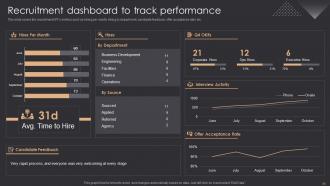
Slide 44: This slide covers the recruitment KPI’s metrics such as hiring per month, hiring by department, candidate feedback, offer acceptance ratio etc.
Slide 45: This is the icons slide.
Slide 46: This slide presents title for additional slides.
Slide 47: This slide shows roadmap.
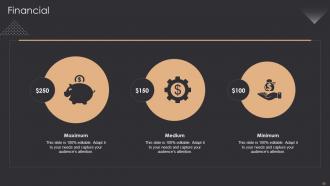
Slide 48: This slide showcases financials.
Slide 49: This slide exhibits ideas generated.
Slide 50: This slide depicts 30-60-90 days plan for projects.
Slide 51: This slide depicts posts for past experiences of clients.
Slide 52: This slide presents circular process.
Slide 53: This slide exhibits yearly timeline.
Slide 54: This slide displays targets of the company.
Slide 55: This is thank you slide & contains contact details of company like office address, phone no., etc.
Inbound Recruiting Powerpoint Presentation Slides with all 60 slides:
Use our Inbound Recruiting Powerpoint Presentation Slides to effectively help you save your valuable time. They are readymade to fit into any presentation structure.










FAQs for Inbound Recruiting
Inbound recruiting principles include creating compelling employer branding, optimizing job postings for search visibility, leveraging social media engagement, building talent communities, and nurturing candidate relationships over time. Unlike traditional recruiting's reactive approach of posting jobs and waiting, inbound recruiting proactively attracts candidates through content marketing, showcases company culture authentically, and builds ongoing relationships, ultimately delivering higher-quality hires and reduced time-to-fill metrics.
Companies effectively use content marketing for inbound recruiting by creating employee testimonials, behind-the-scenes workplace content, thought leadership articles, career development resources, and company culture videos. This strategic approach enables organizations to showcase their employer brand, demonstrate growth opportunities, and highlight unique workplace benefits, ultimately attracting passive candidates who align with company values and long-term objectives.
Employer branding and storytelling serve as the foundation of successful inbound recruiting by creating authentic narratives that attract, engage, and convert top talent organically. These strategic elements enable companies to differentiate themselves in competitive markets, build emotional connections with candidates, and ultimately reduce hiring costs while improving candidate quality and cultural fit.
Social media enhances inbound recruiting by showcasing company culture, sharing employee testimonials, and creating targeted content that attracts qualified candidates organically. Platforms like LinkedIn, Instagram, and Twitter enable recruiters to build authentic employer brands, engage with passive candidates through interactive content, and leverage employee advocacy networks, ultimately creating sustainable talent pipelines while reducing traditional recruitment costs.
Businesses should track key metrics including website traffic and source attribution, content engagement rates, candidate conversion funnel progression, application quality scores, and cost-per-hire comparisons. These metrics enable organizations to optimize their recruitment content, identify high-performing channels, and demonstrate ROI, with many companies finding that data-driven inbound strategies reduce hiring costs while improving candidate quality and experience.
Employers create engaging candidate experiences by developing compelling employer branding, streamlining application processes, maintaining transparent communication throughout hiring stages, and leveraging social media to showcase company culture. These inbound strategies attract quality candidates organically, with many organizations finding that personalized interactions, prompt feedback, and authentic storytelling significantly enhance their talent acquisition outcomes while reducing recruitment costs.
Personalization enhances candidate engagement by customizing job descriptions to individual backgrounds, sending targeted content based on career interests, leveraging social media insights for relevant messaging, and creating role-specific communication sequences. Through these tailored approaches, companies in sectors like technology and healthcare significantly increase response rates, build stronger employer brand connections, and ultimately attract higher-quality candidates who feel valued throughout the recruitment process.
**INPUT**: What tools and technologies can assist organizations in implementing an inbound recruiting strategy? **OUTPUT**: Inbound recruiting technologies include applicant tracking systems, social media management platforms, content management systems, marketing automation tools, and analytics dashboards. These solutions streamline talent attraction by enhancing employer branding, automating candidate nurturing, and tracking engagement metrics, with many organizations finding that strategic integration delivers faster hiring cycles and higher-quality candidate experiences. [Word count: 54 words]
Organizations can ensure diversity and inclusion in inbound recruiting by creating inclusive job descriptions, partnering with diverse professional networks, implementing bias-free screening processes, and showcasing diverse company culture across multiple platforms. These strategies enable broader candidate pools, reduce unconscious bias, and attract talent from varied backgrounds, with many companies finding that inclusive practices significantly enhance innovation, employee satisfaction, and competitive advantage in today's diverse marketplace.
Companies should develop career insights blogs, employee success stories, behind-the-scenes workplace content, industry trend analyses, and skill development resources to nurture talent relationships. These content types enhance employer branding by showcasing company culture, growth opportunities, and expertise, with many organizations finding that consistent, valuable content keeps top candidates engaged and more likely to accept future opportunities.
Inbound recruiting builds sustainable talent pipelines by attracting passive candidates through employer branding, thought leadership content, and strategic social media presence, creating continuous engagement with potential hires. This approach enables organizations to nurture relationships with top talent over time, significantly reducing time-to-hire and recruitment costs while establishing competitive advantage in tight labor markets.
Companies face challenges including shifting from reactive to proactive mindset, developing compelling employer branding content, mastering digital marketing techniques, and training recruiters in content creation and social media engagement. While building an authentic online presence and nurturing candidate relationships requires significant time investment, organizations increasingly find that these efforts ultimately deliver higher-quality candidates, reduced hiring costs, and stronger competitive advantage in talent acquisition.
Analytics enhance inbound recruiting strategies by tracking candidate source effectiveness, measuring content engagement rates, optimizing job posting performance, and identifying conversion patterns throughout the talent funnel. Through predictive modeling and performance metrics, organizations streamline their talent acquisition processes, reduce time-to-hire, and improve candidate quality, while ultimately delivering more strategic resource allocation and competitive hiring advantages.
Optimizing job descriptions involves clear role expectations, competitive compensation details, company culture highlights, growth opportunities, and keyword-rich content for search visibility. Effective career pages showcase employee testimonials, diversity initiatives, and workplace benefits, with companies in tech and healthcare finding that authentic storytelling and mobile-optimized formats significantly increase qualified candidate applications and reduce hiring timelines.
Employee advocacy and referrals integrate into inbound recruiting through social media amplification, structured referral programs, employee-generated content, and internal brand ambassadorship initiatives. These approaches leverage existing workforce networks to expand talent reach organically, with many organizations finding that employee advocates deliver higher-quality candidates, reduced hiring costs, and faster recruitment cycles while strengthening employer brand authenticity.
-
Fantastic collection. Loved how we can personalize these templates as per the requirements.
-
Great designs, Easily Editable.