


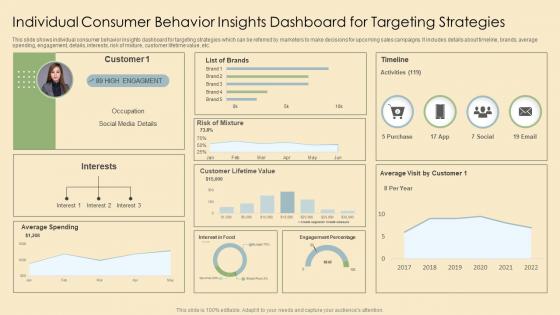
Individual Consumer Behavior Insights Dashboard For Targeting Strategies




Try Before you Buy Download Free Sample Product
 Impress Your
 Audience
 100%
100% Editable
 Save Hours
 of Time


This slide shows individual consumer behavior insights dashboard for targeting strategies which can be referred by marketers to make decisions for upcoming sales campaigns. It includes details about timeline, brands, average spending, engagement, details, interests, risk of mixture, customer lifetime value, etc.
People who downloaded this PowerPoint presentation also viewed the following :
Individual Consumer Behavior Insights Dashboard For Targeting Strategies with all 7 slides:
Use our Individual Consumer Behavior Insights Dashboard For Targeting Strategies to effectively help you save your valuable time. They are readymade to fit into any presentation structure.





FAQs for Individual Consumer Behavior Insights Dashboard
Social media recommendations, personalized online experiences, peer reviews, mobile accessibility, and real-time price comparisons most influence consumer decision-making today. Through AI-driven personalization and omnichannel strategies, retailers in fashion, electronics, and food delivery streamline purchase journeys, reduce decision fatigue, and enhance customer satisfaction, ultimately delivering faster conversions and competitive advantage.
Social media shapes consumer preferences through influencer endorsements, peer reviews, targeted advertising, and viral trends that create awareness and desire. Platforms like Instagram and TikTok enable brands to showcase products directly to consumers, while user-generated content builds trust and social proof, ultimately driving purchase decisions and brand loyalty across retail, fashion, and consumer goods sectors.
Emotional branding significantly influences consumer behavior by creating deep psychological connections, building trust, evoking memorable experiences, and driving loyalty beyond rational product features. Through storytelling and values alignment, companies like Nike and Apple foster emotional attachments that translate into repeat purchases, premium pricing acceptance, and brand advocacy, ultimately delivering sustained competitive advantage.
Cultural differences significantly impact consumer choices through varying values, communication styles, purchasing patterns, and product preferences across regions. Companies operating globally must adapt their marketing strategies, product offerings, and customer engagement approaches to local cultural norms, with many international retailers finding that localized experiences drive higher conversion rates and customer loyalty than standardized approaches.
Emerging post-pandemic consumer behavior trends include heightened digital adoption, increased health consciousness, sustainability prioritization, local business support, and contactless payment preferences. These shifts enable retailers, healthcare providers, and service organizations to enhance customer experiences, streamline operations, and build stronger brand loyalty, with many businesses finding that adapting to these behaviors delivers significant competitive advantages and revenue growth.
Impulse buying manifests differently across demographics, with younger consumers driven by social media influences and instant gratification, while older demographics respond to nostalgic triggers and perceived scarcity. Through targeted marketing strategies, retailers capitalize on generational spending patterns, income levels, and lifestyle factors, with many finding that personalized approaches significantly increase conversion rates and customer lifetime value.
Consumer reviews and ratings significantly influence purchase decisions by building trust, reducing perceived risk, providing social proof, and offering authentic product insights from real users. Through detailed feedback and star ratings, shoppers gain confidence in their choices, with many retailers finding that products with higher ratings and positive reviews generate increased conversions, reduced return rates, and enhanced customer satisfaction.
Psychological triggers include scarcity, social proof, reciprocity, authority endorsements, and loss aversion, which tap into fundamental human decision-making patterns. These approaches enhance appeal by creating urgency through limited-time offers, showcasing customer testimonials, and leveraging influencer partnerships, with retail and e-commerce brands finding these strategies significantly boost conversion rates and customer engagement.
Brand loyalty significantly influences premium pricing acceptance by creating emotional connections, reducing price sensitivity, and establishing perceived value differentiation among consumers. Loyal customers in sectors like automotive, technology, and luxury goods demonstrate willingness to pay 10-20% more for trusted brands, with many companies finding that consistent quality delivery and brand experience ultimately drive sustained revenue growth and competitive market positioning.
Environmental concerns significantly influence purchasing decisions, with consumers increasingly prioritizing sustainable products, eco-friendly packaging, ethical sourcing practices, and brands with strong environmental commitments. This shift drives companies across retail, food service, and manufacturing to adopt greener practices, ultimately delivering competitive advantage through enhanced brand loyalty, reduced operational costs, and access to the growing market of environmentally conscious consumers.
Consumers perceive value through a combination of product quality, price fairness, brand reputation, convenience, and emotional satisfaction relative to cost. This perception directly drives purchase decisions, with retail and hospitality sectors finding that customers prioritize different value components, ultimately choosing brands that deliver the most comprehensive benefits for their investment.
Millennials prioritize brand loyalty, peer reviews, and value-driven purchases through social media research, while Gen Z favors authenticity, visual content, and impulse buying via mobile platforms. These generational differences enable retailers to tailor marketing strategies, with fashion brands finding millennials respond to detailed product information whereas Gen Z engages more with short-form video content and influencer partnerships.
Businesses leverage data analytics to predict consumer behavior through machine learning algorithms, predictive modeling, sentiment analysis, purchase pattern recognition, and social media monitoring. These technologies enable retailers to anticipate demand fluctuations, financial services to predict customer churn, and e-commerce platforms to personalize recommendations, ultimately delivering enhanced customer experiences and competitive advantage.
Companies can implement personalized marketing campaigns, proactive customer service interventions, loyalty program optimization, targeted product recommendations, and predictive churn prevention strategies based on behavior insights. These approaches streamline customer experiences by anticipating needs, addressing pain points before escalation, and delivering relevant offerings, with many retailers and financial services finding that behavior-driven retention strategies significantly reduce churn while enhancing long-term customer value.
Advertising channels significantly influence consumer awareness and engagement by determining message reach, frequency, and contextual relevance across different touchpoints. Digital channels like social media and search enable targeted, interactive experiences, while traditional media builds broad awareness, with many brands finding that strategic multichannel approaches deliver higher engagement rates and stronger brand recall than single-channel campaigns.
-
I am really satisfied with their XYZ products. Used their slides for my business presentations and now I am taking their help for my son's high-school assignments. Super satisfied!!
-
The designs are very attractive and easy to edit. Looking forward to downloading more of your PowerPoint Presentations.