


Information System Security And Risk Administration Plan Powerpoint Presentation Slides




Try Before you Buy Download Free Sample Product
 Impress Your
 Audience
 100%
100% Editable
 Save Hours
 of Time


Risk assessment and management plan can help the organization identify the cybersecurity threats and implement a plan to mitigate the risks. Here is an efficiently designed template on Information System Security and Risk Administration Plan. It will help a company to safeguard information and critical data of organizational assets. This presentation covers different types of cybersecurity threats faced by firms worldwide and the process of managing the information security risks. A major chunk of the presentation covers an information security risk management plan that can help to identify assets vulnerable to information security risks. It also covers the assessment of information security risks through vulnerability rating and risk assessment matrix. It also showcases mitigation plans that can help an organization resolve information security risks promptly and strategies to avoid information breaches. This presentation also shows training that can help the organization train employees to respond and manage the information security threat. This presentation also covers the roles and responsibilities of the risk management team and budget allocation for managing cybersecurity risks. At last, this presentation highlights the impact of a risk management plan on the information security capabilities of the organization. Get access to this powerful template now.
People who downloaded this PowerPoint presentation also viewed the following :
Content of this Powerpoint Presentation
Slide 1: This slide introduces Information System Security and Risk Administration Plan. State your company name and begin.
Slide 2: This slide states Agenda of the presentation.
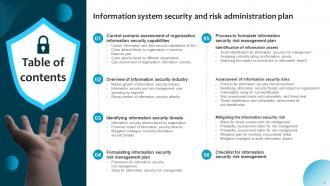
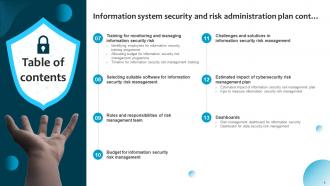
Slide 3: This slide presents Table of Content for the presentation.
Slide 4: This is another slide continuing Table of Content for the presentation.
Slide 5: This slide highlights title for topics that are to be covered next in the template.
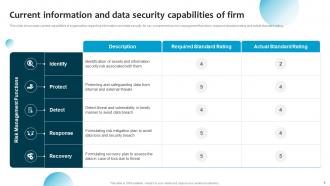
Slide 6: This slide shows Current Information and Data Security Capabilities of firm.
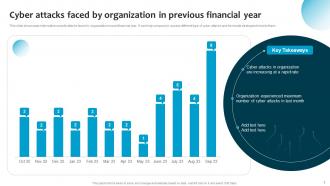
Slide 7: This slide presents Cyber Attacks Faced by Organization in Previous Financial Year.
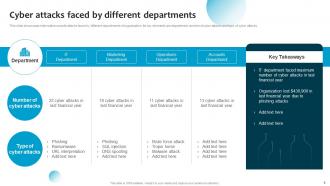
Slide 8: This slide displays Cyber Attacks Faced by Different Departments.
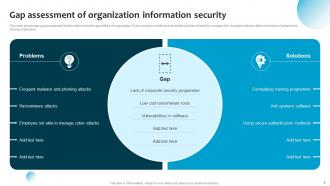
Slide 9: This slide represents Gap Assessment of Organization Information Security.
Slide 10: This slide highlights title for topics that are to be covered next in the template.
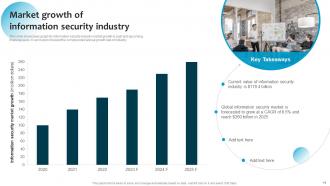
Slide 11: This slide showcases Market Growth of Information Security Industry.
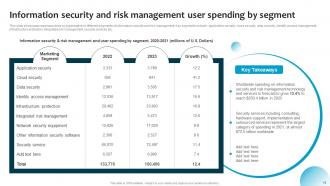
Slide 12: This slide shows Information Security and Risk Management User Spending by Segment.
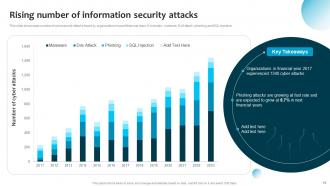
Slide 13: This slide presents Rising Number of Information Security Attacks.
Slide 14: This slide highlights title for topics that are to be covered next in the template.
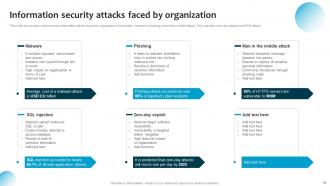
Slide 15: This slide displays Information Security Attacks Faced by Organization.
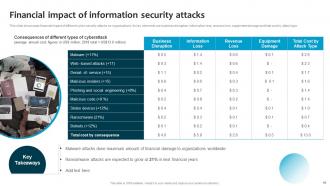
Slide 16: This slide represents Financial Impact of Information Security Attacks.
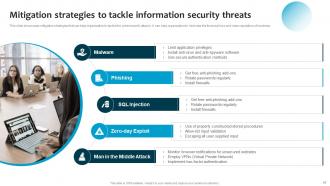
Slide 17: This slide showcases Mitigation Strategies to Tackle Information Security Threats.
Slide 18: This slide highlights title for topics that are to be covered next in the template.
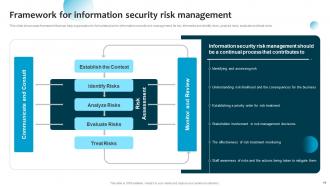
Slide 19: This slide shows Framework for Information Security Risk Management.
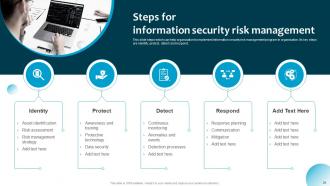
Slide 20: This slide presents Steps for Information Security Risk Management.
Slide 21: This slide highlights title for topics that are to be covered next in the template.
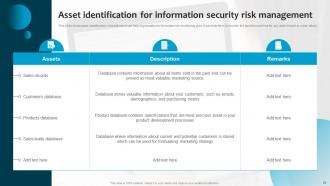
Slide 22: This slide displays Asset Identification for Information Security Risk Management.
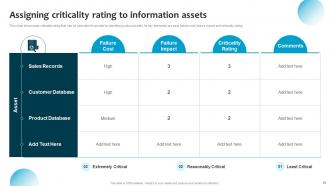
Slide 23: This slide represents Assigning Criticality Rating to Information Assets.
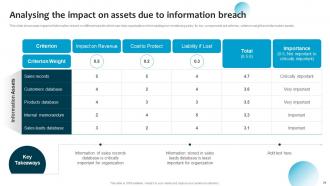
Slide 24: This slide showcases Analyzing the Impact on Assets due to Information Breach.
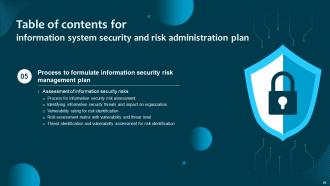
Slide 25: This slide highlights title for topics that are to be covered next in the template.
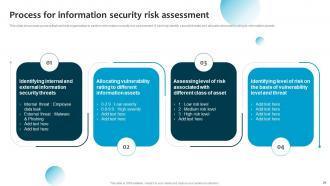
Slide 26: This slide shows Process for Information Security Risk Assessment.
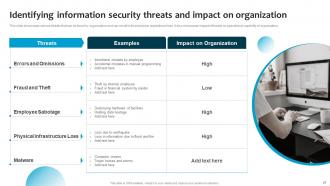
Slide 27: This slide presents Identifying Information Security Threats and Impact on Organization.
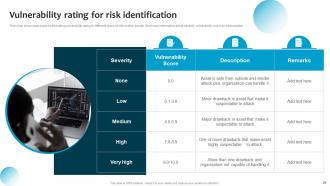
Slide 28: This slide displays Vulnerability Rating for Risk Identification.
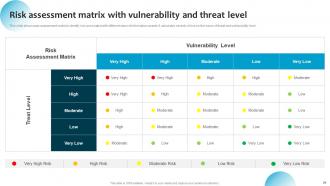
Slide 29: This slide represents Risk Assessment Matrix with Vulnerability and Threat Level.
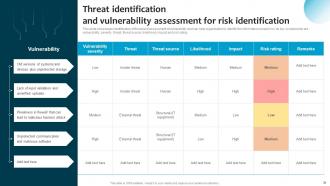
Slide 30: This slide showcases Threat Identification and Vulnerability Assessment for Risk Identification.
Slide 31: This slide highlights title for topics that are to be covered next in the template.
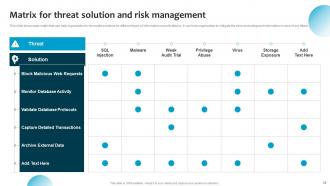
Slide 32: This slide shows Matrix for Threat Solution and Risk Management.
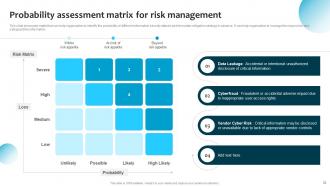
Slide 33: This slide presents Probability Assessment Matrix for Risk Management.
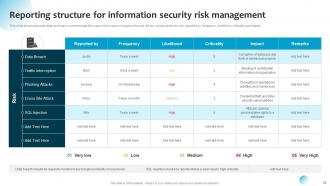
Slide 34: This slide displays Reporting Structure for Information Security Risk Management.
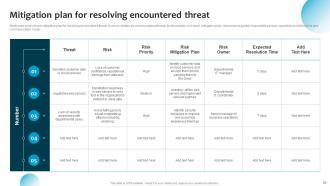
Slide 35: This slide represents Mitigation Plan for Resolving Encountered Threat.
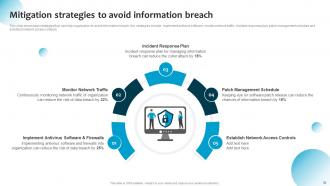
Slide 36: This slide showcases Mitigation Strategies to Avoid Information Breach.
Slide 37: This slide highlights title for topics that are to be covered next in the template.
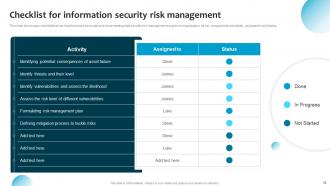
Slide 38: This slide shows Checklist for Information Security Risk Management.
Slide 39: This slide highlights title for topics that are to be covered next in the template.
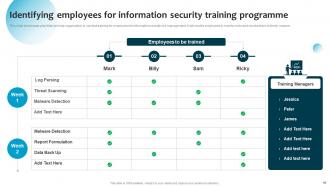
Slide 40: This slide presents Identifying Employees for Information Security Training Programme.
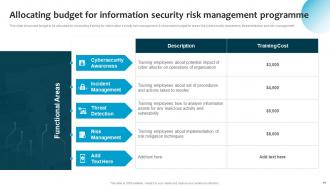
Slide 41: This slide displays Allocating Budget for Information Security Risk Management Programme.
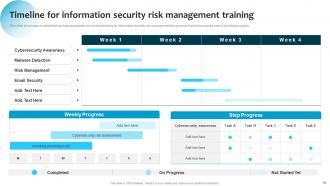
Slide 42: This slide represents Timeline for Information Security Risk Management Training.
Slide 43: This slide highlights title for topics that are to be covered next in the template.
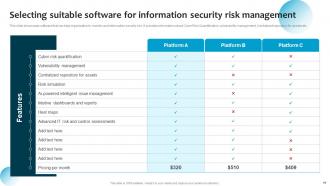
Slide 44: This slide showcases Selecting Suitable Software for Information Security Risk Management.
Slide 45: This slide highlights title for topics that are to be covered next in the template.
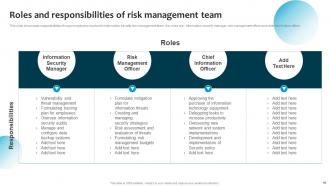
Slide 46: This slide shows Roles and Responsibilities of Risk Management Team.
Slide 47: This slide highlights title for topics that are to be covered next in the template.
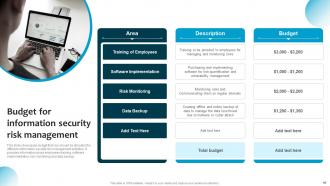
Slide 48: This slide presents Budget for Information Security Risk Management.
Slide 49: This slide highlights title for topics that are to be covered next in the template.
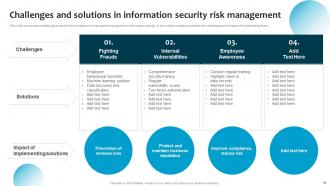
Slide 50: This slide displays Challenges and Solutions in Information Security Risk Management.
Slide 51: This slide highlights title for topics that are to be covered next in the template.
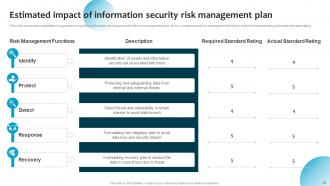
Slide 52: This slide represents Estimated Impact of Information Security Risk Management Plan.
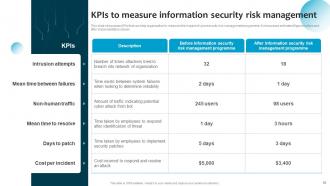
Slide 53: This slide showcases KPIs to Measure Information Security Risk Management.
Slide 54: This slide highlights title for topics that are to be covered next in the template.
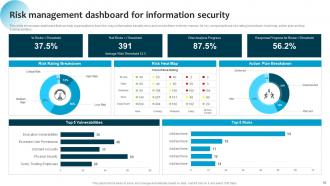
Slide 55: This slide shows Risk Management Dashboard for Information Security.
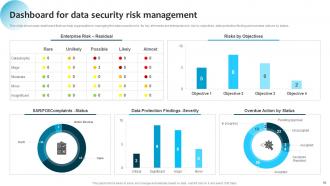
Slide 56: This slide presents Dashboard for Data Security Risk Management.
Slide 57: This slide contains all the icons used in this presentation.
Slide 58: This slide is titled as Additional Slides for moving forward.
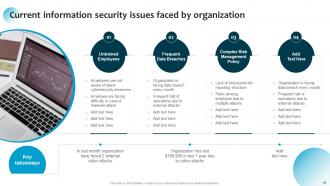
Slide 59: This slide presents Current information security issues faced by organization.
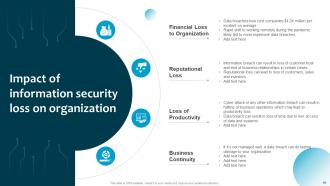
Slide 60: This slide displays Impact of information security loss on organization.
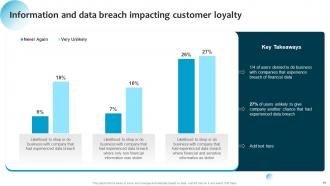
Slide 61: This slide represents Information and data breach impacting customer loyalty.
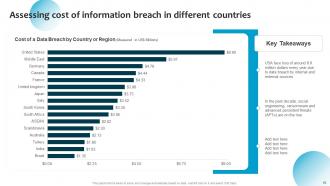
Slide 62: This slide showcases Assessing cost of information breach in different countries.
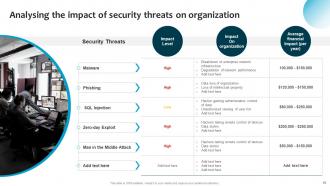
Slide 63: This slide shows Analysing the impact of security threats on organization.
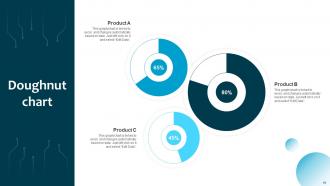
Slide 64: This slide displays Doughnut chart with two products comparison.
Slide 65: This slide provides 30 60 90 Days Plan with text boxes.
Slide 66: This is Our Mission slide with related imagery and text.
Slide 67: This is About Us slide to show company specifications etc.
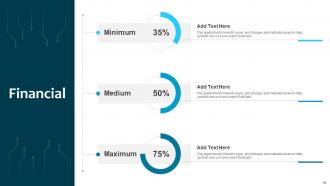
Slide 68: This is a Financial slide. Show your finance related stuff here.
Slide 69: This is Our Team slide with names and designation.
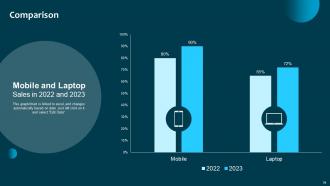
Slide 70: This is a Comparison slide to state comparison between commodities, entities etc.
Slide 71: This slide presents Roadmap with additional textboxes.
Slide 72: This slide depicts Venn diagram with text boxes.
Slide 73: This is a Timeline slide. Show data related to time intervals here.
Slide 74: This slide shows Post It Notes. Post your important notes here.
Slide 75: This is a Quotes slide to convey message, beliefs etc.
Slide 76: This slide shows SWOT describing- Strength, Weakness, Opportunity, and Threat.
Slide 77: This is Our Target slide. State your targets here.
Slide 78: This is a Thank You slide with address, contact numbers and email address.
Information System Security And Risk Administration Plan Powerpoint Presentation Slides with all 83 slides:
Use our Information System Security And Risk Administration Plan Powerpoint Presentation Slides to effectively help you save your valuable time. They are readymade to fit into any presentation structure.







FAQs for Information System Security And Risk Administration Plan
Primary components include access controls, network security protocols, data encryption methods, threat detection systems, and incident response procedures. These technologies streamline organizational security by preventing unauthorized access, monitoring suspicious activities, and ensuring rapid threat mitigation, with many enterprises finding that integrated frameworks ultimately deliver enhanced operational resilience and regulatory compliance.
Access control models differ through their authorization approaches, including role-based access control (RBAC), mandatory access control (MAC), discretionary access control (DAC), and attribute-based access control (ABAC). These models enhance organizational security by restricting data access based on user roles, security clearances, and business requirements, with many financial institutions and healthcare organizations finding that strategic implementation ultimately delivers reduced breach risks and regulatory compliance.
Encryption serves as a critical safeguard by converting data into unreadable code using complex algorithms, protecting information both when stored on servers and while moving between systems. Through advanced encryption protocols, organizations in banking, healthcare, and retail can secure sensitive customer data, financial records, and personal information, ultimately delivering enhanced trust and regulatory compliance while minimizing breach risks.
Organizations can effectively implement security awareness training through regular interactive sessions, phishing simulations, role-specific modules, gamified learning platforms, and clear incident reporting procedures. Companies across sectors like banking and healthcare find that combining mandatory quarterly training with real-time threat alerts and practical scenarios significantly reduces security breaches, while fostering a security-conscious culture that ultimately strengthens organizational resilience.
Common information system vulnerabilities include weak passwords, unpatched software, phishing attacks, inadequate access controls, and misconfigured security settings. Organizations mitigate these through multi-factor authentication, regular patch management, employee security training, and comprehensive monitoring systems, with many enterprises finding that layered security approaches significantly reduce breach risks while enhancing operational resilience.
Compliance with GDPR and HIPAA significantly strengthens information system security strategies by mandating robust data protection frameworks, encryption standards, access controls, and breach notification protocols. These regulations drive organizations across healthcare, financial services, and retail sectors to implement comprehensive security measures, ultimately delivering enhanced customer trust, reduced liability exposure, and competitive advantage through demonstrated data stewardship excellence.
Best practices for incident response planning include establishing clear escalation procedures, maintaining updated contact lists, conducting regular tabletop exercises, defining roles and responsibilities, and creating comprehensive documentation protocols. These frameworks enable organizations to minimize downtime, contain threats rapidly, and restore operations efficiently, with many financial institutions and healthcare systems finding that structured response plans reduce recovery time by 60-70%.
AI and machine learning significantly enhance information system security by enabling real-time threat detection, predictive analytics for vulnerability assessment, automated incident response, and behavioral pattern recognition. These technologies streamline security operations in banks, healthcare systems, and enterprises by identifying anomalies faster than traditional methods, reducing response times, and ultimately delivering proactive protection with adaptive defenses against evolving cyber threats.
Cloud computing presents both enhanced security capabilities and new vulnerability considerations for information systems, including shared responsibility models, data location concerns, compliance complexities, and dependency on provider security measures. While organizations benefit from enterprise-grade security infrastructure and automatic updates they might not afford independently, they must carefully evaluate provider certifications, data sovereignty requirements, and integration protocols, with many financial services and healthcare institutions finding that strategic cloud adoption ultimately delivers improved threat detection and cost-effective protection.
Organizations assess information system risk levels by conducting comprehensive security audits, vulnerability assessments, penetration testing, compliance evaluations, and threat modeling exercises. These systematic approaches enable businesses to identify potential weaknesses, quantify exposure levels, and prioritize remediation efforts, with many financial institutions and healthcare organizations finding that regular risk assessments ultimately enhance security posture and regulatory compliance.
Securing remote end-user devices involves implementing multi-factor authentication, endpoint detection and response software, regular security updates, VPN connections, and device encryption. These security layers streamline protection by preventing unauthorized access, monitoring threats in real-time, and safeguarding sensitive data, with many organizations finding that comprehensive endpoint security ultimately delivers reduced breach risks and enhanced operational confidence.
Threat modeling and vulnerability assessment enhance proactive security by systematically identifying potential attack vectors, evaluating system weaknesses, and prioritizing security investments before incidents occur. These methodologies enable organizations to implement targeted defenses, streamline risk mitigation strategies, and maintain robust security frameworks, with many financial institutions and healthcare providers finding that proactive assessments significantly reduce breach likelihood and compliance costs.
Regular security audits and assessments are crucial for identifying vulnerabilities, ensuring compliance with regulations, validating security controls, and maintaining operational resilience against evolving threats. These systematic evaluations enable organizations across sectors like banking, healthcare, and retail to proactively address weaknesses, streamline risk management processes, and ultimately deliver enhanced data protection while maintaining competitive advantage in an increasingly complex digital landscape.
Information system security integrates into software development life cycles through secure coding practices, threat modeling, vulnerability assessments, penetration testing, and continuous security monitoring. These approaches enable organizations to identify risks early, reduce remediation costs, and deliver more robust applications, with many development teams finding that embedding security throughout the SDLC ultimately enhances both product quality and customer trust.
Physical security measures serve as the foundational layer protecting information systems through access controls, surveillance systems, environmental protections, secure facility design, and backup power solutions. These measures work alongside cybersecurity protocols to create comprehensive defense, with many organizations finding that robust physical security significantly reduces data breach risks while ensuring operational continuity and regulatory compliance.
-
The designs are super attractive. Me and my team love using SlideTeam’s presentations.
-
Much better than the original! Thanks for the quick turnaround.