


Infrastructure As Code Powerpoint Ppt Template Bundles




Try Before you Buy Download Free Sample Product
 Impress Your
 Audience
 100%
100% Editable
 Save Hours
 of Time


Our Infrastructure As Code Powerpoint Ppt Template Bundles are topically designed to provide an attractive backdrop to any subject. Use them to look like a presentation pro.
People who downloaded this PowerPoint presentation also viewed the following :
Infrastructure As Code Powerpoint Ppt Template Bundles with all 22 slides:
Use our Infrastructure As Code Powerpoint Ppt Template Bundles to effectively help you save your valuable time. They are readymade to fit into any presentation structure.







FAQs for Infrastructure As Code Powerpoint
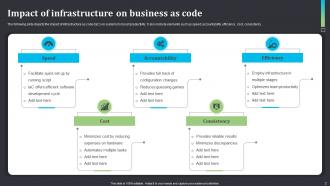
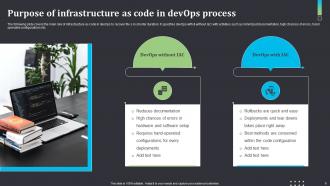
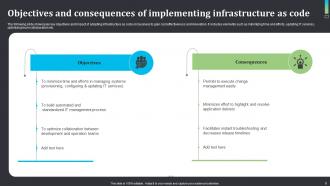
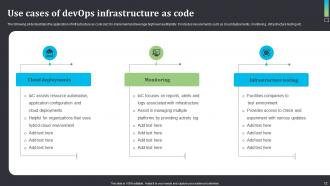
Infrastructure as Code (IaC) delivers automation, version control, and increased speed for infrastructure provisioning, alongside enhanced consistency and reduced errors. These technologies streamline deployments by automating resource creation, configuration, and management, with many organizations finding that IaC significantly accelerates release cycles and minimizes downtime. Ultimately delivering improved operational efficiency and a competitive advantage in increasingly dynamic environments.
Infrastructure as Code (IaC) improves consistency and reduces configuration drift by automating infrastructure provisioning through code, version control, and automated testing. Through tools like Terraform and Ansible, organizations standardize environments, eliminate manual errors, and ensure repeatable deployments across cloud platforms. This streamlines operations, minimizes downtime, and ultimately delivers enhanced reliability and faster service delivery with many DevOps teams finding that automated infrastructure significantly accelerates release cycles.
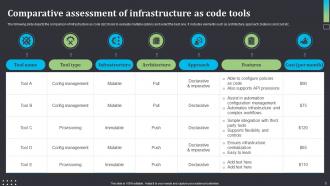
Infrastructure as Code (IaC) tools include Terraform, Ansible, Chef, Puppet, and AWS CloudFormation, each offering distinct capabilities. These technologies streamline provisioning by automating infrastructure creation, modification, and management, with many organizations finding that Terraform excels at multi-cloud deployments, while Ansible prioritizes simplicity and agentless automation, ultimately delivering enhanced efficiency and reduced operational costs.
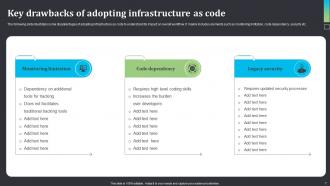
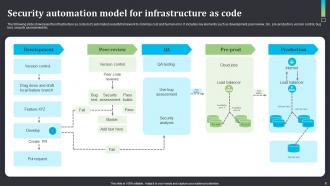
Infrastructure as Code (IaC) enhances security by automating consistent configurations, reducing manual errors, and enabling rapid vulnerability patching across environments. While offering significant advantages, it also presents both challenges and opportunities regarding access control and code review. Teams can mitigate risks through version control, automated scanning, and policy enforcement, with many financial services institutions finding that robust governance delivers enhanced compliance and minimized exposure.
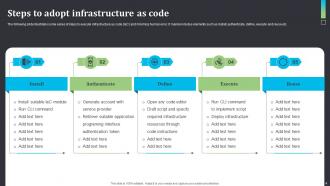
Version control systems, including Git, are central to Infrastructure as Code (IaC) management, enabling tracking of changes, collaboration, and rollback capabilities. These technologies streamline deployments by facilitating automated testing, continuous integration, and disaster recovery, with many DevOps teams finding that code-based infrastructure significantly reduces errors. Ultimately delivering enhanced operational efficiency and faster release cycles across organizations, while presenting both challenges and opportunities for team workflow adaptation.
Infrastructure as Code (IaC) enhances collaboration between development and operations teams by automating infrastructure provisioning, configuration, and management through code repositories. While traditionally siloed, these teams now leverage shared code, version control, and automated pipelines, streamlining workflows and reducing manual errors. With many organizations finding that this strategic combination accelerates release cycles, minimizes conflicts, and ultimately delivers faster services and improved operational efficiency.
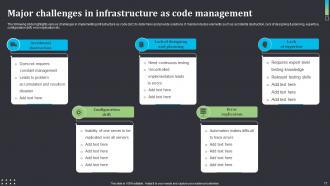
Infrastructure as Code (IaC) migration presents both challenges and opportunities, including initial script development, version control complexities, and the need for skilled personnel. While automating infrastructure delivers significant efficiency gains, it also requires careful planning, thorough testing, and robust security protocols. With many organizations finding that phased rollouts, coupled with comprehensive documentation, streamline this transition, ultimately delivering faster deployments and reduced operational costs.
Infrastructure as Code (IaC) accelerates deployments and boosts productivity by automating provisioning, configuration, and management through code, rather than manual processes. These technologies streamline workflows by enabling version control, automated testing, and repeatable deployments, with many DevOps teams finding that release cycles are shortened by as much as 70%. Ultimately delivering faster time-to-market and enhanced operational efficiency, IaC enables organizations to respond quickly in an increasingly competitive landscape.
Infrastructure as Code (IaC) significantly enhances disaster recovery and backup strategies by automating infrastructure provisioning, configuration, and deployment. Through version control and automated testing, IaC enables faster recovery times, reduced errors, and consistent environments across regions. With many financial services and healthcare institutions finding that automated backups streamline data protection, ultimately delivering business continuity and minimized downtime.
Infrastructure as Code scripting commonly utilizes languages like Python, YAML, and HashiCorp Configuration Language (HCL), alongside JSON and Go. These technologies streamline provisioning by automating infrastructure creation, configuration, and management, ultimately delivering faster deployments and reduced errors. With many DevOps teams finding that Python’s versatility and HCL’s readability enhance collaboration and scalability across organizations.
Infrastructure as Code (IaC) delivers ROI by automating infrastructure provisioning, reducing manual errors, and accelerating deployment cycles, ultimately lowering operational costs. While initial setup requires investment in tooling and training, organizations find that IaC streamlines resource allocation, enhances scalability, and minimizes downtime across sectors like finance and healthcare. These efficiencies translate to faster time-to-market, improved resource utilization, and ultimately delivering a significant competitive advantage.
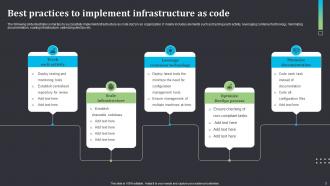
Infrastructure as Code best practices include version control, modularity, automation, and thorough testing, alongside consistent documentation. These technologies streamline deployments by enabling repeatable processes, reducing errors, and enhancing collaboration, with many DevOps teams finding that smaller, focused code modules improve readability and accelerate updates. Ultimately delivering enhanced operational efficiency and faster time-to-market through automated resource provisioning.
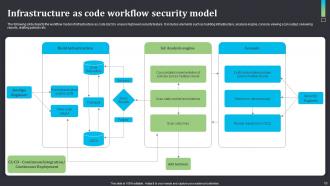
Infrastructure as Code (IaC) facilitates automated testing and CI/CD processes by enabling version control, repeatable builds, and automated deployments through tools like Terraform and Ansible. While streamlining infrastructure provisioning, it also allows for pre-production testing, with banks and financial services finding that automated validation minimizes errors and accelerates release cycles. Ultimately delivering faster services, reduced downtime, and enhanced operational efficiency, IaC presents both challenges and opportunities for organizations embracing DevOps.
Cloud provider-specific Infrastructure as Code (IaC) solutions, like AWS CloudFormation or Azure Resource Manager, offer seamless integration within their ecosystems, yet multi-cloud or open-source options—such as Terraform or Ansible—present both challenges and opportunities. While provider-specific tools streamline deployments within a single cloud, these technologies enhance portability, reduce vendor lock-in, and enable strategic combination of services, with many institutions finding that a hybrid approach delivers operational efficiency and ultimately fosters competitive advantage.
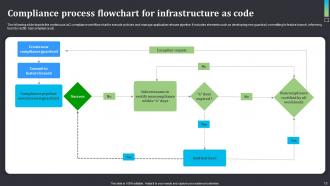
Infrastructure as Code (IaC) presents both challenges and opportunities for compliance, demanding meticulous version control, automated testing, and detailed audit trails. While automating infrastructure provisioning enhances speed and consistency, it also requires robust governance frameworks to meet regulations like GDPR and HIPAA. These technologies streamline compliance by enabling repeatable, auditable deployments, with many financial services institutions finding that automated configurations significantly reduce audit preparation time, ultimately delivering enhanced transparency and minimized risk of non-compliance.
-
“I've always gotten excellent slides from them and the customer service is up to the mark.”
-
The quality of PowerPoint templates I found here is unique and unbeatable. Keep up the good work and continue providing us with the best slides!