

Ingress And Egress Traffic Flow Of Fwaas Firewall Virtualization





Try Before you Buy Download Free Sample Product
 Impress Your
Audience
 100%
Editable
 Save Hours
of Time


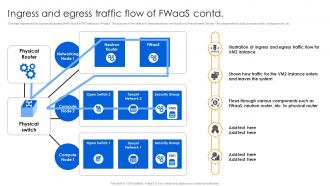
This slide represents the ingress and egress traffic flow of FWaaS. The purpose of the slide is to demonstrate the working flow of Firewall-as-a-Service by explaining the purpose of ingress and egress. The key components are private network, internet, etc.
People who downloaded this PowerPoint presentation also viewed the following :
Ingress And Egress Traffic Flow Of Fwaas Firewall Virtualization with all 10 slides:
Use our Ingress And Egress Traffic Flow Of Fwaas Firewall Virtualization to effectively help you save your valuable time. They are readymade to fit into any presentation structure.









FAQs for Ingress And Egress Traffic Flow Of
Firewall virtualization delivers enhanced scalability, centralized management, cost reduction, improved resource utilization, and simplified policy enforcement across enterprise networks. Through virtualized security architectures, organizations streamline network segmentation, accelerate deployment of security services, and optimize hardware investments, with many enterprises finding that consolidated firewall management significantly reduces operational complexity while maintaining robust protection.
Firewall virtualization enhances flexibility and scalability by enabling dynamic resource allocation, centralized management across multiple environments, and rapid deployment of security policies without hardware constraints. Through software-defined approaches, organizations streamline network segmentation, reduce infrastructure costs, and adapt security measures instantly to changing business needs, ultimately delivering greater operational efficiency and competitive advantage in increasingly complex digital landscapes.
Primary challenges include legacy system compatibility, network performance optimization, staff training requirements, security policy translation, and initial configuration complexity. While virtual firewalls offer enhanced scalability and cost efficiency, many organizations find that careful planning around bandwidth allocation, rule migration, and team upskilling ultimately delivers smoother transitions and stronger network protection.
Virtual firewalls integrate with existing network architectures through hypervisor deployment, software-defined networking protocols, and API-based management systems. These solutions seamlessly connect with traditional hardware firewalls, cloud platforms, and hybrid environments, enabling organizations in banking, healthcare, and retail to maintain consistent security policies across physical and virtual infrastructures while reducing operational complexity.
Hardware-based firewalls typically deliver higher throughput and lower latency through dedicated processing power, while virtualized firewalls offer greater flexibility and scalability by sharing computing resources. While hardware firewalls excel in high-traffic environments like data centers and enterprise networks, virtualized solutions enable dynamic resource allocation and cost-effective deployment, with many organizations finding that virtual firewalls streamline network management while reducing infrastructure costs.
Firewall virtualization improves operational efficiency by centralizing security policy management, reducing hardware dependencies, enabling automated rule deployment, and streamlining network segmentation across multiple environments. Through virtualized firewalls, IT teams can rapidly scale security services, minimize manual configuration errors, and achieve consistent protection across cloud and on-premises infrastructure, ultimately delivering faster threat response and reduced operational overhead.
Virtual firewall technology supports multi-tenancy by creating isolated security zones for each tenant, implementing granular access controls, and enabling centralized policy management across shared infrastructure. Through software-defined networking, cloud providers deliver tenant-specific firewall rules, traffic segmentation, and compliance monitoring, while reducing hardware costs and enabling rapid scaling, ultimately delivering secure multi-tenant environments with enterprise-grade protection.
Automation streamlines virtual firewall management by enabling policy deployment, configuration updates, threat response, and compliance monitoring without manual intervention. Through automated orchestration platforms, organizations accelerate security responses, minimize human errors, and ensure consistent policy enforcement across distributed environments, ultimately delivering enhanced security posture and operational efficiency.
Organizations ensure compliance and security with virtual firewalls through centralized policy management, continuous monitoring, automated compliance reporting, and regular security audits. These approaches enable consistent rule enforcement across distributed environments, real-time threat detection, and streamlined regulatory compliance, with many financial services and healthcare institutions finding that virtualized security frameworks significantly reduce administrative overhead while maintaining stringent protection standards.
Best practices for configuring virtual firewall environments include implementing network segmentation, establishing comprehensive policy templates, enabling centralized management systems, conducting regular security audits, and maintaining automated backup procedures. These practices enhance operational efficiency by streamlining policy deployment, reducing configuration errors, and ensuring consistent security postures across virtualized infrastructure, with many organizations finding that centralized approaches significantly minimize administrative overhead while strengthening overall network protection.
Virtual firewalls enhance disaster recovery and business continuity by enabling rapid deployment across backup sites, automated policy replication, and seamless failover capabilities without hardware dependencies. These virtualized security solutions streamline recovery processes through centralized management, instant configuration restoration, and distributed protection across multiple locations, with many organizations finding significantly reduced downtime and faster service restoration during critical incidents.
Organizations should monitor throughput, latency, CPU and memory utilization, connection rates, rule processing times, and threat detection accuracy. These metrics enable IT teams to optimize resource allocation, identify bottlenecks, and ensure security effectiveness, with many enterprises finding that continuous monitoring delivers enhanced network performance and proactive threat mitigation.
Virtual firewalls enable Zero Trust implementation by providing granular network segmentation, continuous traffic inspection, and policy enforcement at every network junction, ensuring no implicit trust regardless of location. These distributed security controls create micro-perimeters around applications and data, with organizations in finance and healthcare finding that virtual firewalls streamline identity verification and access controls while reducing infrastructure complexity.
**INPUT**: What trends are shaping the future of firewall virtualization in cybersecurity? **OUTPUT**: Key trends include cloud-native security architectures, AI-powered threat detection, zero-trust network models, micro-segmentation capabilities, and software-defined perimeter solutions. These advancements enable organizations to streamline security management, enhance scalability across hybrid environments, and deliver faster threat response, with many enterprises finding that virtualized firewalls ultimately provide superior flexibility and cost-effectiveness in increasingly complex digital infrastructures. [Word count: 60 words]
Open-source virtual firewall solutions offer cost savings, customization flexibility, and community-driven development, while commercial offerings provide dedicated support, compliance certifications, and integrated security features. Organizations must balance budget constraints with operational requirements, with many financial institutions and healthcare providers finding that commercial solutions deliver enhanced liability protection and regulatory compliance, while tech companies and startups often leverage open-source alternatives for greater control.
-
Wide collection of templates available. SlideTeam has made it easier to create presentations in just a few minutes.
-
Nice and innovative design.