


Innovative time management business template ppt sample




Try Before you Buy Download Free Sample Product
 Impress Your
 Audience
 100%
100% Editable
 Save Hours
 of Time


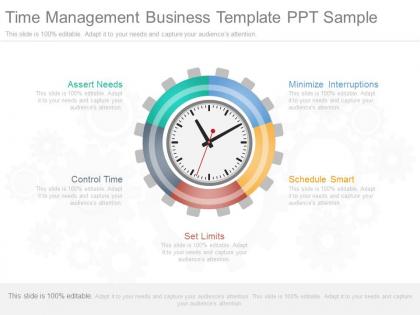
Save your time and efforts with our beautifully designed, thought provoking and intellectually developed innovative time management business template PPT sample. Let your seniors revise and colleagues learn the significance of time especially in business. All the managerial strategies and implications might fail if time element is not kept into consideration. It’s always about the proper balance between right products at right time at right place. Highlight how to manage time with minimize interruptions, schedule smart, set limits, control time and assert needs. Make use of our business time management PowerPoint presentation to cover the topics of benefits, methods, modes and obstacles in time management. Use the time management presentation ideas to mould the minds of the audience towards increasing the efficiency and productivity of company by scheduling and streamlining every feature and attributes. Lead the army of change in an innovative manner with our time management skills PPT visuals, within your periphery. Even students can make use of the time management PowerPoint infographic to manage their time with studies and other activities.Put your best face forward with our Innovative Time Management Business Template Ppt Sample. Give your appearance an elegant boost.
People who downloaded this PowerPoint presentation also viewed the following :
Innovative time management business template ppt sample with all 7 slides:
Build capability to cater to customer fancies with our Innovative Time Management Business Template Ppt Sample. Be able to adapt to constantly changing demands.
FAQs for Innovative time management business
Effective time management principles include prioritization through methods like the Eisenhower Matrix, time blocking for focused work sessions, setting SMART goals, minimizing distractions, and regular schedule reviews. These strategies streamline workflow by enhancing focus, reducing decision fatigue, and optimizing resource allocation, with many professionals finding that structured approaches deliver significantly improved productivity and better work-life balance across various industries.
Presentation templates streamline creation by providing pre-designed layouts, consistent formatting, professional color schemes, and structured content frameworks that eliminate starting from scratch. These templates enable faster development, reduce design decisions, and ensure brand consistency across presentations, with many organizations finding that template libraries can reduce preparation time by 60-70% while maintaining visual impact.
Prioritization serves as the foundation of effective time management by helping individuals identify high-impact tasks, allocate resources strategically, and focus energy on activities that deliver maximum value. Through structured templates, professionals can systematically evaluate task urgency and importance, streamline decision-making processes, and maintain consistent workflows, with many organizations finding that standardized prioritization frameworks ultimately enhance productivity and reduce decision fatigue across teams.
Individuals can assess their time management skills through time audits, productivity tracking, goal completion rates, deadline adherence, and stress level evaluations. Through digital tools and self-reflection journals, professionals can identify productivity patterns, eliminate time-wasting activities, and optimize workflow efficiency, with many organizations finding that structured assessment ultimately delivers improved performance and better work-life balance.
Technology and time management tools complement presentation templates by streamlining creation workflows, automating design consistency, enabling collaborative editing, and providing scheduling integration for seamless delivery planning. These digital solutions enhance template effectiveness by reducing manual formatting time, facilitating real-time team collaboration, and synchronizing presentation deadlines with project timelines, ultimately delivering faster turnaround times and improved productivity for organizations managing multiple stakeholder communications.
The Pomodoro Technique enhances presentation development by breaking complex tasks into focused 25-minute intervals, enabling systematic progress through research, content creation, design, and revision phases. This structured approach streamlines workflow management, reduces procrastination, and maintains creative momentum, with many professionals finding that dedicated time blocks ultimately deliver higher-quality presentations while minimizing stress and last-minute rushes.
Common presentation time management pitfalls include underestimating research time, procrastinating on content creation, perfectionism in design details, inadequate rehearsal scheduling, and poor deadline buffer planning. These challenges often compound in fast-paced business environments, with many professionals finding that starting earlier, setting interim milestones, and allocating specific time blocks for each presentation phase ultimately delivers more polished results and reduced stress.
Creating a structured timeline with templates improves project presentations by establishing clear milestones, standardizing deliverable formats, and ensuring consistent progress tracking across team members. These frameworks enable presenters to demonstrate measurable outcomes, anticipate stakeholder questions, and maintain professional credibility, with many organizations finding that structured approaches reduce preparation time while delivering more compelling, data-driven presentations.
Effective strategies include turning off notifications, using website blockers, scheduling dedicated presentation blocks, creating distraction-free workspaces, and applying time-blocking techniques. These approaches streamline focus by eliminating digital interruptions, establishing clear boundaries, and creating structured work periods, with many professionals finding that combining environment control with scheduled deep work sessions ultimately delivers higher-quality presentations and improved productivity.
Team collaboration enhances significantly through shared templates by standardizing workflows, ensuring consistent formatting, reducing duplicate work, and enabling seamless knowledge transfer across departments. These strategic tools streamline project timelines, minimize revision cycles, and accelerate onboarding processes, with many organizations finding that centralized template libraries ultimately deliver 30-40% faster project completion and improved cross-functional efficiency.
Goal setting and time management form a strategic combination that streamlines presentation preparation by establishing clear objectives, defining deliverable milestones, and allocating resources efficiently across research, design, and practice phases. This approach enables presenters to prioritize high-impact content, minimize last-minute revisions, and ultimately deliver more focused presentations, with many professionals finding that structured goal-setting reduces preparation time while enhancing presentation quality and audience engagement.
Time audits reveal inefficiencies in presentation preparation by tracking time spent on research, content creation, design, and rehearsal phases. By analyzing these patterns, professionals can identify bottlenecks like excessive research or poor template organization, ultimately streamlining workflows, reducing preparation time, and enhancing presentation quality through strategic resource allocation.
Effective techniques include time-blocking for creative brainstorming, using structured templates as starting points, alternating between free-form ideation and organized content development, setting specific deadlines for each phase, and leveraging design systems for consistency. These approaches enable designers to maintain creative flow while meeting project timelines, with many agencies finding that structured creative processes ultimately deliver more innovative presentations and improved client satisfaction.
Time-blocking enhances presentation workflows by allocating dedicated periods for research, content creation, design development, and rehearsal phases. This structured approach prevents last-minute rushes while ensuring thorough preparation, with many professionals finding that segmented focus delivers higher-quality presentations, reduces stress, and ultimately creates more compelling, well-rehearsed deliverables for stakeholder meetings.
Feedback on time management practices enhances future presentations by identifying pacing issues, content prioritization gaps, and audience engagement patterns that inform strategic adjustments. Through detailed analysis of timing effectiveness, presenters streamline content flow, optimize slide transitions, and balance information density, with many organizations finding that systematic feedback loops ultimately deliver more impactful presentations and improved audience retention rates.
-
Excellent work done on template design and graphics.
-
Thanks for all your great templates they have saved me lots of time and accelerate my presentations. Great product, keep them up!