


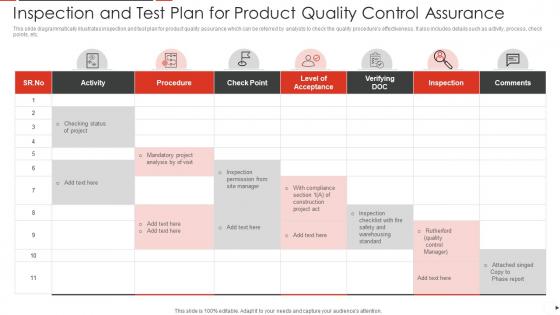
Inspection And Test Plan For Product Quality Control Assurance




Try Before you Buy Download Free Sample Product
 Impress Your
 Audience
 100%
100% Editable
 Save Hours
 of Time


This slide diagrammatically illustrates inspection and test plan for product quality assurance which can be referred by analysts to check the quality procedures effectiveness. It also includes details such as activity, process, check points, etc.
People who downloaded this PowerPoint presentation also viewed the following :
Inspection And Test Plan For Product Quality Control Assurance with all 6 slides:
Use our Inspection And Test Plan For Product Quality Control Assurance to effectively help you save your valuable time. They are readymade to fit into any presentation structure.





FAQs for Inspection And Test Plan For Product
Key components of an effective Inspection and Test Plan include inspection points, acceptance criteria, testing methodologies, responsible parties, and documentation requirements. These elements work together by establishing clear quality checkpoints, defining measurable standards, and assigning accountability throughout project phases, with many manufacturing and construction organizations finding that comprehensive ITPs ultimately streamline operations while ensuring regulatory compliance and customer satisfaction.
Determining appropriate inspection criteria involves analyzing project requirements, regulatory standards, quality objectives, risk assessments, and stakeholder expectations to establish measurable benchmarks. Through systematic evaluation of technical specifications, compliance mandates, and performance targets, organizations streamline quality assurance processes, minimize defects, and ensure deliverable integrity, ultimately enhancing project success rates and client satisfaction.
Risk assessment serves as the foundation for developing an effective ITP by identifying potential failure points, determining inspection frequencies, and establishing appropriate test methods based on criticality levels. Through systematic risk evaluation, organizations prioritize high-risk components requiring intensive monitoring, allocate resources efficiently, and establish contingency protocols, with many manufacturing and construction companies finding that risk-driven ITPs significantly reduce defects, minimize costly rework, and enhance overall project success rates.
Technology enhances ITP efficiency through automated inspection systems, IoT sensors, digital documentation platforms, AI-powered defect detection, and real-time data analytics. These solutions streamline quality control by reducing manual oversight, accelerating data collection, and enabling predictive maintenance protocols, with manufacturing and construction companies finding that automated systems deliver faster approvals and improved compliance tracking.
Common implementation challenges include inadequate resource allocation, insufficient staff training, unclear documentation standards, resistance to procedural changes, and integration difficulties with existing systems. These obstacles often arise in manufacturing and healthcare organizations, where teams struggle with balancing thorough quality assurance against operational timelines, ultimately requiring strategic planning and stakeholder buy-in to ensure successful adoption.
An effective ITP should be structured with clear scope definition, detailed inspection points, acceptance criteria, responsible parties, and documentation requirements aligned with relevant industry standards like ISO, ASME, or API. This systematic approach enables organizations to maintain consistent quality control, streamline regulatory compliance, and minimize project risks, with many manufacturing and construction companies finding that well-structured ITPs significantly reduce rework costs while enhancing client confidence.
An ITP enhances quality assurance by establishing clear inspection criteria, defining accountability at each project phase, standardizing testing procedures, and creating documented evidence trails. Through systematic checkpoints and predefined acceptance standards, project teams can identify defects early, reduce rework costs, and ensure consistent deliverable quality, ultimately minimizing risks while delivering superior project outcomes.
Essential ITP documentation includes inspection checklists, test procedures, quality control forms, acceptance criteria matrices, and non-conformance reporting templates. These documents work together by standardizing evaluation processes, ensuring consistent quality measurements, and maintaining regulatory compliance, with manufacturing and construction organizations finding that comprehensive documentation ultimately streamlines project delivery and reduces costly rework.
ITP reviews should occur at key project milestones, including design finalization, procurement completion, construction phases, and scope changes. The frequency typically ranges from monthly for complex projects to quarterly for standard developments, with many construction teams finding that proactive updates during critical phases streamline quality assurance, reduce rework costs, and ultimately deliver enhanced project outcomes.
**INPUT**: What metrics can be used to evaluate the effectiveness of an Inspection and Test Plan? **OUTPUT**: Effectiveness metrics include defect detection rates, inspection coverage percentages, test completion times, cost per defect found, and rework reduction ratios. These measurements enable organizations to streamline quality processes, minimize post-delivery issues, and enhance operational efficiency, with many manufacturing and software development teams finding that comprehensive tracking ultimately delivers improved product reliability and reduced overall project costs.
Stakeholder engagement significantly influences ITP success by ensuring comprehensive requirement gathering, facilitating clear communication channels, and establishing realistic quality benchmarks that align with project objectives. When project managers, quality teams, contractors, and clients collaborate effectively during ITP development, organizations achieve higher compliance rates, reduced rework costs, and streamlined approval processes, ultimately delivering projects that meet stringent quality standards while maintaining stakeholder satisfaction.
Personnel executing an ITP require formal training in quality management systems, inspection methodologies, relevant industry standards, and specific technical skills for their testing domains. Many organizations find that certified quality professionals, engineers with specialized equipment training, and technicians with hands-on measurement experience deliver the most reliable results, ultimately ensuring compliance and minimizing costly rework.
Regulatory variations significantly impact ITP creation by requiring industry-specific compliance protocols, documentation standards, testing frequencies, and approval processes tailored to each sector's governing bodies. Manufacturing industries focus on quality control checkpoints, while healthcare emphasizes sterility and safety protocols, and construction prioritizes structural integrity assessments, with organizations increasingly finding that customizable ITP templates streamline multi-regulatory compliance.
**INPUT**: What are the best practices for documenting inspection results in an ITP? **OUTPUT**: Best practices include recording detailed measurements with clear pass/fail criteria, maintaining photographic evidence, documenting inspector credentials, capturing environmental conditions, and ensuring real-time data entry with digital signatures. These practices streamline quality assurance by enhancing traceability, reducing disputes, and accelerating approvals, with manufacturing and construction organizations finding that comprehensive documentation ultimately delivers faster project completion and improved regulatory compliance. [Word count: 60 words]
Continuous improvement principles refine Inspection and Test Plans through regular data analysis, stakeholder feedback collection, and systematic process evaluation to identify inefficiencies and gaps. Organizations leverage performance metrics, root cause analysis, and cross-functional reviews to streamline testing protocols, reduce inspection cycle times, and enhance defect detection rates, ultimately delivering higher quality outcomes and operational efficiency.
-
Enough space for editing and adding your own content.
-
The Designed Graphic are very professional and classic.