


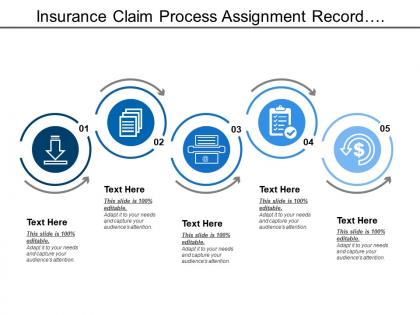
Insurance claim process assignment record investigation pay




Try Before you Buy Download Free Sample Product
 Impress Your
 Audience
 100%
100% Editable
 Save Hours
 of Time


The aim of your thoughts and our Insurance Claim Process Assignment Record Investigation Pay will always coincide. They have the same aspirations.
People who downloaded this PowerPoint presentation also viewed the following :
Insurance claim process assignment record investigation pay with all 5 slides:
Address any grievance folks may have with our Insurance Claim Process Assignment Record Investigation Pay. It helps handle bruised egos.




FAQs for Insurance claim process assignment
Essential steps to initiate an insurance claim include notifying your insurer immediately, documenting the incident with photos and detailed records, completing claim forms accurately, providing required documentation like police reports or medical records, and cooperating with the claims adjuster's investigation. These steps streamline the process by establishing clear communication, preserving evidence, and ensuring compliance with policy requirements, ultimately delivering faster claim resolution and better outcomes for policyholders navigating coverage disputes.
Document requirements vary by claim type, policy coverage, and insurer guidelines, typically including the claim form, proof of loss, supporting evidence, policy documentation, and incident reports. Contact your insurance agent or review your policy's claim section for specific requirements, as auto accidents require police reports while property damage needs repair estimates, ultimately streamlining your claim processing and reducing approval delays.
Insurance adjusters investigate, evaluate, and determine settlement amounts for claims by reviewing policy coverage, assessing damages, interviewing parties, and analyzing evidence. These professionals serve as intermediaries between insurers and policyholders, ensuring fair settlements while protecting company interests, with many finding that experienced adjusters significantly streamline claim resolution and enhance customer satisfaction.
Effective communication with your insurance company requires maintaining detailed documentation, responding promptly to requests, and asking specific questions about timelines and requirements. Keep records of all conversations, reference your policy number in every interaction, and request written confirmation of important decisions, with many policyholders finding that proactive communication significantly accelerates claim resolution and reduces potential disputes.
If your insurance claim is denied initially, review the denial letter carefully, gather additional supporting documentation, contact your insurance agent or company directly to discuss the decision, and consider filing a formal appeal within the specified timeframe. Many policyholders find that providing clearer evidence, medical records, or expert opinions can overturn initial denials, ultimately securing the coverage they deserve.
Insurance claim processing typically takes 15-30 days for standard claims, though complex cases can extend to 60-90 days, with factors including claim complexity, documentation completeness, investigation requirements, and insurer workload influencing timelines. Through automated systems and digital documentation, many insurers now streamline straightforward claims within 7-14 days, while complex cases involving fraud detection or extensive damage assessments require longer processing periods, ultimately delivering faster settlements and improved customer experiences.
Common delays in insurance claims include incomplete documentation, complex investigations requiring additional evidence, high claim volumes during peak periods, disputes over coverage interpretations, and coordination challenges with multiple parties like adjusters and healthcare providers. These bottlenecks often stem from manual processing inefficiencies, with many insurers finding that streamlined digital workflows and automated verification systems significantly reduce processing times while improving customer satisfaction.
To ensure fair claim settlements, thoroughly document all damages with photos and receipts, promptly report incidents to your insurer, and maintain detailed records of all communications. Consider hiring independent adjusters or contractors for damage assessments, review your policy coverage limits carefully, and don't hesitate to negotiate or seek legal counsel if initial offers seem inadequate, ultimately protecting your financial interests.
Insurance claim appeals processes typically involve filing written appeals within specified timeframes, providing additional documentation or evidence, and following your insurer's formal review procedures. Many policyholders find that appealing to state insurance commissioners or utilizing independent review organizations can significantly enhance their chances of overturning denials, ultimately securing deserved coverage and faster claim resolutions.
Policy limits directly determine the maximum amount an insurer will pay for covered losses, creating a ceiling on claim payouts regardless of actual damages incurred. When claims exceed these limits, policyholders become responsible for the difference, with many finding that adequate coverage assessment and regular policy reviews help minimize potential gaps between coverage limits and replacement costs.
First-party claims involve policyholders filing directly with their own insurance company for covered losses, while third-party claims are filed against someone else's insurer for damages they caused. These distinctions streamline the claims process by determining liability, coverage scope, and settlement procedures, with many insurance companies finding that clear claim categorization enhances customer service efficiency and reduces processing delays.
You can track your insurance claim progress through online portals, mobile apps, phone hotlines, email updates, and direct communication with your assigned adjuster. These tracking methods streamline the process by providing real-time status updates, documentation access, and milestone notifications, ultimately delivering transparency and peace of mind while ensuring faster claim resolution.
Filing multiple claims typically results in higher premiums, as insurers view frequent claimants as higher-risk customers, potentially leading to rate increases of 20-40% or policy non-renewal. However, the impact varies by claim type, with comprehensive claims affecting rates less than at-fault accidents, and many insurers offering claim forgiveness programs for long-term customers with good driving records.
Prepare for insurance claim meetings by organizing all relevant documentation, including policy details, incident reports, receipts, photos, and correspondence with your insurer. Review your policy coverage thoroughly, practice clearly explaining the incident timeline, and bring a list of questions about next steps, ensuring you present a comprehensive case that facilitates faster claim processing and resolution.
Insurance companies provide dedicated claims representatives, online portals, mobile apps, 24/7 helplines, and local agent networks to support policyholders throughout the claims process. These resources streamline documentation, enable real-time tracking, and offer personalized guidance, with many insurers finding that comprehensive support systems significantly reduce processing times and enhance customer satisfaction, ultimately delivering faster resolutions and improved policyholder experiences.
-
Unique design & color.
-
Really like the color and design of the presentation.