


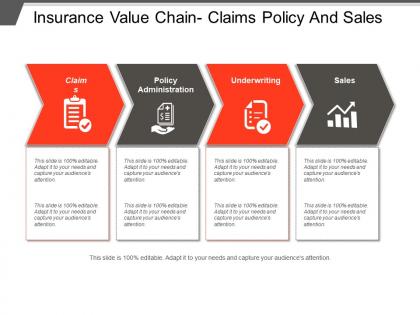
Insurance value chain claims policy and sales




Try Before you Buy Download Free Sample Product
 Impress Your
 Audience
 100%
100% Editable
 Save Hours
 of Time


Blunt their advantage with our Insurance Value Chain Claims Policy And Sales. They help bridge existing gaps.
People who downloaded this PowerPoint presentation also viewed the following :
Insurance value chain claims policy and sales with all 5 slides:
Folks invest in you due to our Insurance Value Chain Claims Policy And Sales. They believe that you will further their interest.




FAQs for Insurance value chain claims
The insurance value chain includes product development, underwriting, sales and distribution, policy administration, claims processing, and customer service. These components work together by streamlining risk assessment, automating policy management, and enhancing customer experiences, with many insurers finding that integrated digital platforms across these stages ultimately deliver faster claim settlements, reduced operational costs, and improved competitive positioning.
Digital transformation revolutionizes the insurance value chain by automating underwriting processes, enabling real-time claims processing, and personalizing customer interactions through AI and data analytics. Banks and insurers streamline operations from policy origination to claims settlement, with many organizations finding that digital tools reduce processing times, enhance risk assessment accuracy, and ultimately deliver superior customer experiences while maintaining competitive advantage.
Customer data enhances the insurance value chain by enabling personalized pricing, streamlined underwriting, proactive risk management, and faster claims processing through predictive analytics and behavioral insights. Through comprehensive data analysis, insurers can deliver more accurate risk assessments, targeted product offerings, and improved customer experiences, while reducing operational costs and ultimately gaining competitive advantage in an increasingly data-driven marketplace.
Insurance companies can leverage artificial intelligence, machine learning algorithms, predictive analytics, automated data collection systems, and real-time risk assessment tools to enhance underwriting accuracy and speed. These technologies streamline risk evaluation by analyzing vast datasets, reducing manual processing time, and improving decision consistency, with many insurers finding significantly faster policy approvals, lower operational costs, and more competitive premium pricing in an increasingly data-driven marketplace.
Effective claims processing improves customer satisfaction by reducing settlement times, providing transparent communication throughout the process, offering multiple digital channels for claim submission, and ensuring accurate damage assessments. These streamlined approaches enable insurers to deliver faster payouts, minimize customer stress during difficult periods, and build long-term trust, with many insurance companies finding that efficient claims handling significantly reduces customer churn and enhances brand loyalty.
Collaboration with insurtech start-ups transforms the traditional insurance value chain by introducing advanced analytics, automated underwriting processes, and digital customer interfaces that streamline operations from policy creation to claims settlement. These partnerships enable established insurers to accelerate digital transformation, reduce processing times, and enhance customer experiences, while maintaining regulatory compliance and leveraging their existing market presence for competitive advantage.
Regulatory compliance significantly impacts insurance value chain efficiency by requiring extensive documentation, mandatory reporting protocols, and standardized risk assessment procedures. While compliance costs can initially slow operations, many insurers find that automated compliance systems ultimately streamline processes, reduce manual errors, and enhance customer trust, delivering competitive advantages in increasingly regulated markets.
Predictive analytics enhances insurance risk assessment by analyzing historical data, identifying patterns, and forecasting potential claims with greater accuracy than traditional methods. Through machine learning algorithms, insurers can evaluate customer behavior, environmental factors, and market trends more precisely, enabling better pricing strategies, reduced underwriting costs, and improved policy customization, ultimately delivering competitive advantage in an increasingly data-driven marketplace.
Insurance firms can optimize distribution channels through digital transformation initiatives, multi-channel integration strategies, agent training programs, customer data analytics, and strategic partnership development. These approaches streamline customer acquisition by enhancing online platforms, improving agent productivity, and leveraging data insights, with many insurers finding that hybrid distribution models ultimately deliver broader market reach and improved customer experiences.
Customer experience initiatives transform insurance interactions by implementing omnichannel communication platforms, AI-powered chatbots, self-service portals, personalized policy recommendations, and streamlined claims processing systems. These technologies enhance engagement by reducing response times, automating routine inquiries, and delivering proactive support, with many insurers finding that digital-first approaches ultimately increase customer satisfaction while reducing operational costs.
**INPUT**: What are the challenges faced by insurers in integrating AI solutions into the value chain? **OUTPUT**: Insurers face integration challenges including legacy system compatibility, regulatory compliance complexities, data quality inconsistencies, talent acquisition difficulties, and customer trust concerns. While these obstacles require strategic planning and investment, many financial institutions find that phased implementation approaches streamline adoption, ultimately delivering enhanced operational efficiency and competitive advantage. **Word count: 50**
Market trends significantly influence insurance value chain functions by driving digital transformation in underwriting, claims processing, and customer service, while reshaping product development and distribution strategies. Insurtech innovations, regulatory changes, and evolving customer expectations compel insurers to enhance operational efficiency, streamline risk assessment processes, and deliver personalized experiences, with many organizations finding that agile adaptation to these trends creates sustainable competitive advantage.
Best practices for managing insurance value chain partnerships include establishing clear performance metrics, implementing robust data sharing protocols, maintaining regular communication channels, creating aligned incentive structures, and developing comprehensive risk management frameworks. These approaches streamline operations by enhancing transparency, reducing operational friction, and ensuring consistent service delivery, with many insurers finding that strategic partnerships ultimately deliver improved customer experiences and competitive advantage.
Life insurance emphasizes long-term actuarial modeling and investment management, health insurance prioritizes real-time claims processing and provider network coordination, while property insurance focuses on rapid damage assessment and risk evaluation. These sector-specific approaches streamline underwriting processes, enhance customer experiences, and optimize claims resolution, with many insurers finding that specialized value chain configurations ultimately deliver faster services and improved operational efficiency across their portfolios.
Claims fraud detection is crucial within the insurance value chain as it protects profitability, maintains premium affordability, and ensures legitimate claims processing. Advanced analytics and AI-powered systems enable insurers to identify suspicious patterns, reduce investigation costs, and accelerate genuine claim settlements, with many companies finding that effective fraud detection ultimately delivers competitive pricing advantages and enhanced customer trust.
-
Easily Understandable slides.
-
Use of different colors is good. It's simple and attractive.