


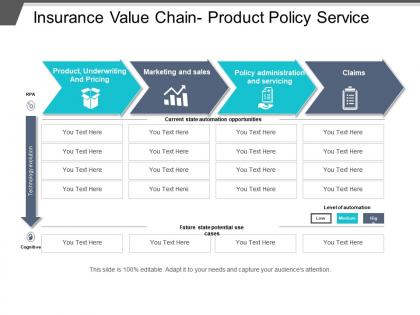
Insurance value chain product policy service




Try Before you Buy Download Free Sample Product
 Impress Your
 Audience
 100%
100% Editable
 Save Hours
 of Time


Highlight impressive accomplishments with our Insurance Value Chain Product Policy Service. Appreciate a good job done.
People who downloaded this PowerPoint presentation also viewed the following :
Insurance value chain product policy service with all 5 slides:
Drive home the importance of ensuring cleanliness with our Insurance Value Chain Product Policy Service. Be an advocate of good hygiene.


FAQs for Insurance value chain
The insurance value chain comprises product development, underwriting, policy administration, claims management, and customer service stages, each interconnected through data flows and feedback loops. Through digital integration, insurers streamline these interactions by automating risk assessments, accelerating claims processing, and enhancing customer touchpoints, ultimately delivering faster policy issuance and improved operational efficiency.
Technology significantly enhances underwriting efficiency by automating risk assessment, enabling real-time data analysis, and streamlining decision-making processes through AI and machine learning algorithms. These digital tools reduce manual review time, improve accuracy in risk evaluation, and accelerate policy approvals, with many insurers finding faster processing times and enhanced competitive advantage.
Data analytics transforms customer experience across the insurance value chain by enabling personalized policy recommendations, streamlined claims processing, proactive risk assessment, and predictive customer service interventions. Through advanced analytics platforms, insurers deliver faster claim settlements, customized coverage options, and anticipatory support communications, while reducing friction points throughout the customer journey, ultimately enhancing satisfaction and retention rates.
Insurers can leverage customer feedback to optimize products by integrating insights into underwriting processes, refining risk assessment models, personalizing coverage options, and streamlining claims handling procedures. Through advanced analytics and feedback loops, insurance companies enhance customer satisfaction, reduce processing times, and develop more competitive products, with many insurers finding that data-driven optimization ultimately delivers improved retention rates and operational efficiency.
Regulation impacts the insurance value chain through capital requirements and solvency standards for underwriting, consumer protection and claims handling protocols for policy servicing, and distribution licensing requirements for sales channels. These regulatory frameworks enhance market stability, transparency, and consumer confidence across insurers, brokers, and reinsurers, while compliance costs drive operational efficiency improvements and digital transformation initiatives throughout the industry.
Distribution challenges include limited agent reach, high acquisition costs, complex product explanations, regulatory compliance burdens, and increasing customer expectations for digital experiences. Many insurers find that traditional broker networks struggle with scalability while direct digital channels face trust-building obstacles, ultimately requiring hybrid approaches that balance personal relationships with technological efficiency to remain competitive.
Emerging insurtech companies disrupt traditional insurance value chains by leveraging advanced analytics, digital platforms, and automated underwriting to streamline processes, reduce operational costs, and enhance customer experiences. These technologies enable faster claim processing, personalized policy pricing, and direct-to-consumer distribution models, with many insurtech startups finding that bypassing traditional brokers ultimately delivers competitive advantages and improved market responsiveness.
Best practices for claims management include automated claim processing, real-time fraud detection, mobile claim reporting, predictive analytics for assessment, and integrated customer communication systems. These technologies streamline operations by reducing processing time, minimizing fraudulent claims, and enhancing customer satisfaction, with many insurers finding that digital-first approaches ultimately deliver faster settlements and significantly lower operational costs.
Insurers can effectively measure value chain performance through key performance indicators like claims processing time, underwriting accuracy rates, customer acquisition costs, policy renewal percentages, and digital engagement metrics. By implementing real-time analytics dashboards and automated reporting systems, insurance companies streamline performance tracking across departments, ultimately delivering faster customer service and improved operational efficiency.
**INPUT**: What strategies can be used to enhance collaboration among stakeholders in the insurance value chain? **OUTPUT**: Effective collaboration strategies include integrated digital platforms, standardized data protocols, cross-functional partnerships, real-time communication systems, and shared performance metrics. These approaches streamline interactions between insurers, brokers, reinsurers, and service providers by eliminating silos, accelerating claims processing, and enhancing customer experiences, with many organizations finding that strategic collaboration ultimately delivers competitive advantage and operational efficiency. [Word count: 58 words]
The customer journey directly shapes insurance value chain design by identifying critical touchpoints, pain points, and service expectations across acquisition, underwriting, claims, and renewal phases. Insurance companies increasingly restructure their operations around customer needs, integrating digital platforms, streamlining claims processing, and enhancing customer service capabilities, ultimately delivering faster resolutions and improved experiences.
Reinsurance enhances sustainability by transferring catastrophic risks, stabilizing capital reserves, and enabling insurers to expand coverage capacity while maintaining solvency. Through risk pooling and geographic diversification, reinsurers help primary insurers weather major claims events, ultimately delivering greater market stability, competitive pricing, and consistent policyholder protection across economic cycles.
Telematics improves risk assessment by providing real-time driving behavior data, vehicle performance metrics, and location-based analytics that enable more accurate premium calculations. Through IoT sensors and connected devices, insurers can evaluate individual risk profiles, reduce fraudulent claims, and offer personalized policies, ultimately delivering more competitive pricing and enhanced customer experiences across automotive insurance segments.
Digital transformation presents both challenges and opportunities for traditional insurance intermediaries, requiring them to adapt through enhanced digital capabilities, automated processes, personalized customer experiences, and strategic partnerships with insurtech companies. While some intermediaries face disintermediation risks, many are finding that embracing technologies like AI-driven analytics, digital platforms, and omnichannel solutions ultimately delivers competitive advantages, streamlined operations, and deeper customer relationships in an increasingly digital insurance landscape.
B2C insurance models emphasize direct customer engagement, streamlined digital experiences, and mass market distribution channels, while B2B models focus on relationship management, customized coverage solutions, and longer sales cycles with specialized underwriting. These different approaches reshape value chain components significantly, with B2C insurers investing heavily in consumer-facing technology and automated claims processing, whereas B2B insurers prioritize account management expertise and complex risk assessment capabilities, ultimately delivering tailored experiences that match distinct market demands.
-
Qualitative and comprehensive slides.
-
Unique and attractive product design.