


Insurance value chain product pricing and claims




Try Before you Buy Download Free Sample Product
 Impress Your
 Audience
 100%
100% Editable
 Save Hours
 of Time


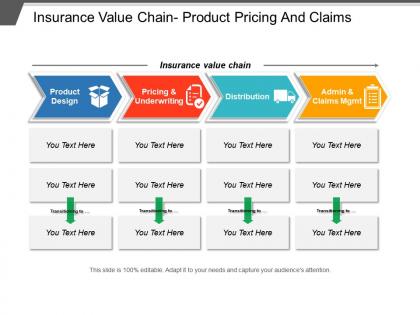
Utilize the Insurance Value Chain Product Pricing And Claims PowerPoint presentation. With this insurance lifecycle PPT layout, you can illustrate effectively the business model comprising of all the activities required. Using this financial PowerPoint theme, you can evaluate the series of steps involved and identify the problem areas. The key steps like product design, pricing, and underwriting, distribution and admin and claims management can be discussed using this security value chain PPT theme. The strategic alliance between the different departments can be expressed using the insurance process flow diagram PowerPoint layout. This pricing and claims PPT template can be used to demonstrate the role of value chain governance in your organization. The financial gap in achieving the company’s objectives can be discussed within your team using this insurance chain PowerPoint theme. Download this PowerPoint template to increase the competitiveness of the entire financial value chain of your enterprise.
People who downloaded this PowerPoint presentation also viewed the following :
Insurance value chain product pricing and claims with all 5 slides:
Facilitate career change with our Insurance Value Chain Product Pricing And Claims. Introduce folks to innovative enterprises.




FAQs for Insurance value chain product
The insurance value chain includes product development, underwriting, distribution, policy administration, claims management, and customer service. These interconnected components enhance operational efficiency by streamlining risk assessment, automating policy processing, and accelerating claims resolution, with many insurers finding that integrated digital platforms ultimately deliver faster customer experiences and significant cost reductions.
Technology revolutionizes insurance operations by automating underwriting processes, enabling real-time risk assessment through IoT sensors, streamlining claims processing with AI-powered verification, and enhancing customer experiences via digital platforms. These innovations significantly reduce operational costs, accelerate policy approvals, and minimize fraudulent claims, with many insurers finding that integrated technological solutions ultimately deliver competitive advantages and improved profitability.
Customer data enhances the insurance value chain by enabling personalized pricing, streamlined underwriting, predictive risk modeling, targeted product development, and proactive claims management. Through advanced analytics and AI, insurers can assess risks more accurately, automate policy approvals, and deliver tailored customer experiences, ultimately reducing operational costs while improving service efficiency and competitive positioning.
Insurers can improve operational efficiency by implementing digital automation, streamlining claims processing, integrating AI-powered underwriting systems, and enhancing customer self-service platforms. These technologies reduce manual workflows, accelerate policy approvals, and minimize processing times, with many insurers finding that automated claims handling and predictive analytics ultimately deliver faster customer service and significantly lower operational costs.
Insurers face challenges including legacy system integration, regulatory compliance complexities, data security concerns, workforce digital skills gaps, and customer experience standardization across multiple touchpoints. While these present significant operational hurdles, many insurance companies find that strategic technology investments and phased digital transformation approaches ultimately streamline processes, reduce costs, and enhance competitive positioning in an increasingly digital marketplace.
Regulatory compliance impacts the insurance value chain by mandating stricter data governance, enhanced risk assessment protocols, and transparent reporting mechanisms throughout underwriting, claims processing, and customer interactions. These requirements streamline operational efficiency while building customer trust, with many insurers finding that compliance-driven digital transformations ultimately deliver faster claim settlements, reduced operational costs, and stronger competitive positioning.
**INPUT**: What strategies can be employed to reduce claims processing time in the value chain? **OUTPUT**: Strategies to reduce claims processing time include automation technologies, digital document management, AI-powered fraud detection, streamlined approval workflows, and real-time data integration across systems. These approaches streamline operations by eliminating manual reviews, accelerating verification processes, and enabling instant claim approvals, with many insurance companies finding that automated systems reduce processing time from weeks to hours while enhancing customer satisfaction.
Partnerships within the insurance ecosystem enhance value chain effectiveness by enabling data sharing, streamlining claims processing, and expanding distribution channels through strategic collaborations. These alliances allow insurers to leverage specialized expertise from InsurTech firms, healthcare providers, and financial institutions, ultimately delivering faster underwriting, reduced operational costs, and improved customer experiences while maintaining competitive advantage.
Underwriting serves as the critical risk assessment foundation of the insurance value chain, determining policy pricing, coverage terms, and profitability through detailed analysis of applicant data, market conditions, and regulatory requirements. This process enables insurers to maintain competitive pricing while minimizing losses, with many financial institutions finding that advanced underwriting technologies streamline decision-making and enhance operational efficiency.
Analytics optimize insurance pricing strategies by analyzing historical claims data, customer risk profiles, market trends, and competitor positioning to develop more accurate premium calculations. Through predictive modeling and real-time data processing, insurers can implement dynamic pricing that reflects individual risk levels while maintaining competitive positioning, ultimately delivering improved profitability and more personalized customer experiences.
Customer experience fundamentally shapes the insurance value chain by driving digital transformation, personalized service delivery, and streamlined claims processing throughout acquisition, underwriting, and retention phases. Insurers increasingly leverage customer feedback, omnichannel platforms, and predictive analytics to enhance touchpoints, reduce friction, and build loyalty, ultimately delivering competitive differentiation and sustainable growth in an increasingly customer-centric marketplace.
Innovation disrupts traditional insurance practices by introducing AI-driven underwriting, blockchain-based claims processing, IoT sensors for real-time risk assessment, and digital-first customer platforms. These technologies streamline operations by automating manual processes, enhancing fraud detection, and enabling personalized policies, with many insurers finding that digital transformation significantly reduces processing times while delivering superior customer experiences and operational efficiency.
InsurTech startups present both challenges and opportunities across the traditional insurance value chain, revolutionizing underwriting, claims processing, customer acquisition, and risk assessment through AI, blockchain, and digital platforms. While established insurers face increased competition, many are finding that strategic partnerships with InsurTech companies streamline operations, enhance customer experiences, and deliver significantly faster services, ultimately creating competitive advantage in an increasingly digital marketplace.
Distribution channels significantly impact insurance value chain performance by determining market reach, customer acquisition costs, and service delivery efficiency. Traditional agents offer personalized guidance but higher costs, while digital channels streamline processes and reduce expenses, with many insurers finding that multi-channel strategies optimize both customer experience and operational profitability.
Insurers can mitigate value chain risks through comprehensive risk assessment frameworks, robust data analytics, strategic vendor diversification, enhanced cybersecurity protocols, and regular compliance audits. These practices enable organizations to identify vulnerabilities early, streamline operational processes, and maintain regulatory compliance, with many financial institutions finding that proactive risk management ultimately delivers improved customer trust and competitive advantage.
-
Great quality product.
-
Designs have enough space to add content.