

Intel corporation company profile overview financials and statistics from 2014-2018




Try Before you Buy Download Free Sample Product
 Impress Your
 Audience
 100%
100% Editable
 Save Hours
 of Time


This report is an extensively researched profile on company Intel Corporation Company Profile Overview Financials And Statistics From 2014 to 2018 in industry Consumer Goods and FMCG and Retail and Trade and E-Commerce and has been prepared by SlideTeam industry experts after extensively researching through hundreds of data sources.
People who downloaded this PowerPoint presentation also viewed the following :
Intel corporation company profile overview financials and statistics from 2014-2018 with all 79 slides:
Highlight integral elements with our Intel Corporation Company Profile Overview Financials And Statistics From 2014-2018. Elaborate on what forms the backbone.





FAQs for Intel corporation company profile overview financials and
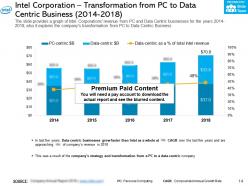
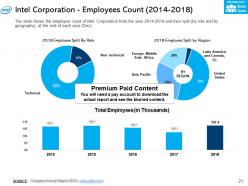
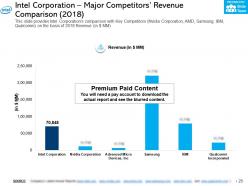
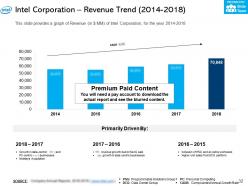
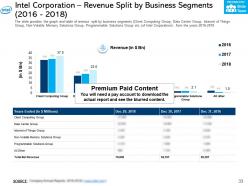
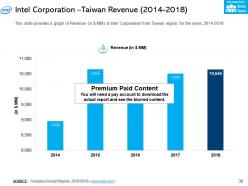
Intel Corporation's annual revenues from 2014 to 2018 demonstrated steady growth, rising from approximately $55.9 billion in 2014 to $70.8 billion in 2018, with peak performance in 2017 at $62.8 billion. This upward trajectory reflected Intel's strategic diversification beyond traditional processors into data centers, IoT solutions, and memory technologies, ultimately delivering enhanced market positioning and competitive advantage across multiple high-growth sectors.
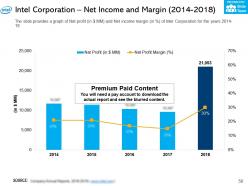
Intel's net income demonstrated significant volatility from 2014 to 2018, ranging from approximately $11.4 billion in 2014 to peaks of $21.0 billion in 2017, with notable fluctuations driven by market conditions, competitive pressures, and strategic investments. These financial variations reflect Intel's adaptation to evolving semiconductor demands, data center growth, and mobile computing shifts, ultimately positioning the company for strategic diversification beyond traditional PC markets while maintaining strong profitability fundamentals.
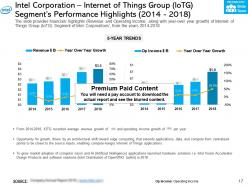
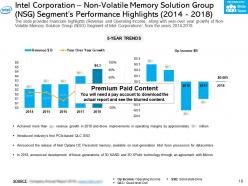
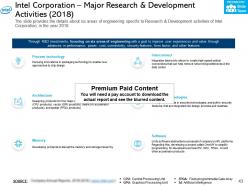
Intel's revenue growth from 2014-2018 was primarily driven by strong data center demand, cloud computing expansion, Internet of Things adoption, and memory solutions advancement. These market shifts enabled Intel to diversify beyond traditional PC processors, with enterprise customers increasingly requiring high-performance computing capabilities, ultimately delivering enhanced market positioning and revenue streams across multiple technology sectors.
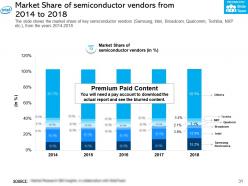
Semiconductor market shifts significantly impacted Intel's performance through declining PC demand, mobile market challenges, and increased competition from AMD and specialized chipmakers. While Intel maintained strong data center growth and diversified into IoT and autonomous vehicles, traditional CPU revenue pressures, manufacturing delays, and market share erosion in key segments ultimately constrained overall financial growth despite strategic pivots.
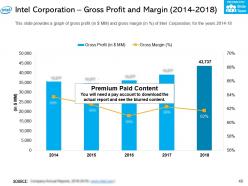
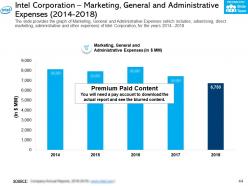
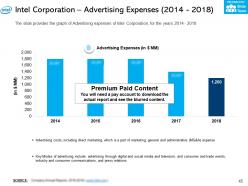
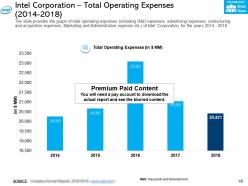
Intel's major expenses from 2014-2018 included research and development costs, manufacturing and production expenses, sales and marketing investments, and administrative overhead, with R&D consistently representing their largest expenditure category. These substantial operational costs, while necessary for maintaining competitive advantage in semiconductor innovation, compressed profit margins during periods of intense market competition, though Intel's diversification into data center solutions and IoT technologies ultimately delivered improved profitability.
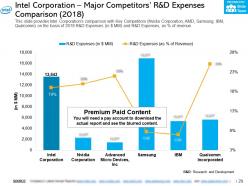
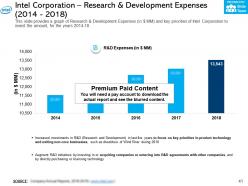
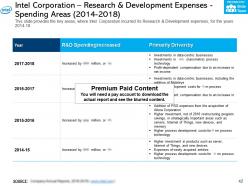
Intel's R&D spending increased from $11.5 billion in 2014 to $13.5 billion in 2018, consistently representing approximately 20-22% of revenue, demonstrating sustained innovation commitment. This strategic investment enabled breakthrough developments in processors, artificial intelligence, and autonomous vehicle technologies, while strengthening Intel's competitive positioning in emerging markets like IoT and data centers, ultimately delivering enhanced product portfolios.
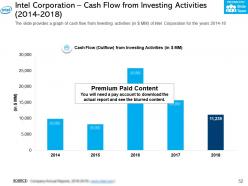
Intel's capital expenditures during 2014-2018 primarily focused on semiconductor manufacturing facilities, research and development infrastructure, and advanced fabrication technologies to maintain competitive positioning. These strategic investments enabled Intel to enhance production capacity, accelerate innovation cycles, and strengthen market leadership in processors, while the substantial expenditure levels initially impacted short-term profitability but ultimately delivered long-term technological advantages and operational efficiency.
Foreign exchange fluctuations significantly impacted Intel's financial performance during 2014-2018, with currency headwinds reducing revenue growth in multiple quarters, particularly affecting international sales from Asia-Pacific and European markets. These currency challenges compelled Intel to implement strategic hedging programs and operational adjustments, ultimately enabling the company to minimize FX volatility while maintaining competitive positioning in global semiconductor markets.
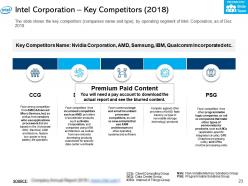
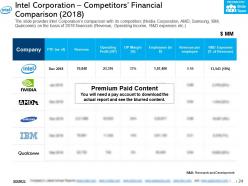
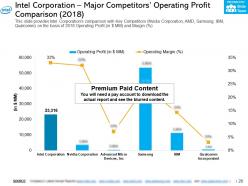
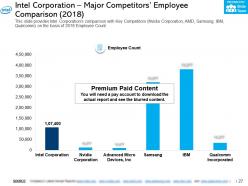
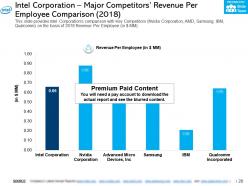
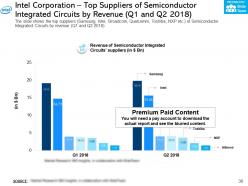
Competitive pressures from AMD, Qualcomm, and other rivals significantly impacted Intel's market dominance by eroding margins in traditional CPU markets, forcing increased R&D spending, and challenging Intel's positioning in mobile and graphics segments. While Intel maintained leadership in data center and enterprise markets, these competitive dynamics ultimately accelerated innovation investments and strategic diversification efforts, with the company increasingly focusing on AI, autonomous vehicles, and emerging technologies to sustain long-term growth.
Intel's stock performance from 2014 to 2018 generally correlated positively with strong financial fundamentals, including consistent revenue growth, robust data center expansion, and steady dividend increases. While experiencing typical market volatility, Intel's shares benefited from strategic diversification beyond traditional PC markets into cloud computing and IoT sectors, ultimately delivering solid returns for investors despite broader semiconductor industry challenges.
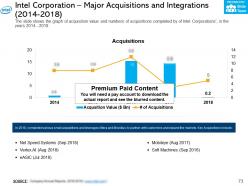
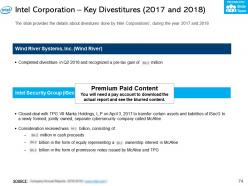
Intel pursued strategic acquisitions including Altera ($16.7 billion in 2015), Mobileye ($15.3 billion in 2017), and McAfee's security division, alongside partnerships in AI and autonomous vehicles. These investments significantly expanded Intel's capabilities in programmable chips, autonomous driving technology, and cybersecurity, while initially impacting short-term profitability but ultimately positioning the company for diversified revenue growth beyond traditional processor markets.
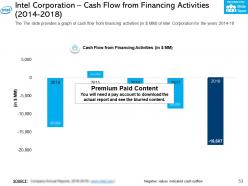
Intel's dividend policy during 2014-2018 evolved from quarterly increases to more measured adjustments, reflecting the company's strategic shift toward data center growth and emerging technologies while maintaining shareholder returns. The reasoning centered on balancing consistent income distribution with increased capital allocation for R&D investments, acquisitions, and manufacturing capacity expansion, ultimately positioning Intel for long-term competitive advantage in cloud computing and artificial intelligence markets.
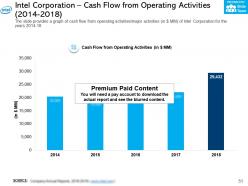
Intel's financial metrics from 2014 to 2018 significantly influenced investor sentiment through fluctuating revenue growth, margin pressures from mobile market struggles, and strategic pivots toward data centers and AI technologies. While traditional PC market headwinds created initial concerns, Intel's consistent dividend payments, strong cash flow generation, and successful transformation initiatives in cloud computing and enterprise solutions ultimately maintained investor confidence, with many institutional investors recognizing the company's strategic positioning for future growth opportunities.
Macroeconomic factors significantly impacted Intel's financial performance through trade tensions with China affecting semiconductor exports, global economic slowdowns reducing enterprise IT spending, and currency fluctuations influencing international revenue. These challenges, combined with memory market volatility and geopolitical uncertainties, created headwinds for growth, while Intel adapted by diversifying product portfolios and geographic markets, ultimately maintaining competitive positioning despite external pressures.
Intel's 2014-2018 financial analysis reveals crucial lessons about diversification strategy, R&D investment timing, and market positioning during technological transitions. Companies can learn that sustained revenue growth requires strategic pivots beyond core competencies, balanced capital allocation between innovation and shareholder returns, and proactive adaptation to emerging markets like cloud computing and IoT, ultimately demonstrating how established technology leaders maintain competitive advantage.
No Reviews