

Introduction To Know Your Customer KYC In Finance Training Ppt




Try Before you Buy Download Free Sample Product
 Impress Your
 Audience
 100%
100% Editable
 Save Hours
 of Time


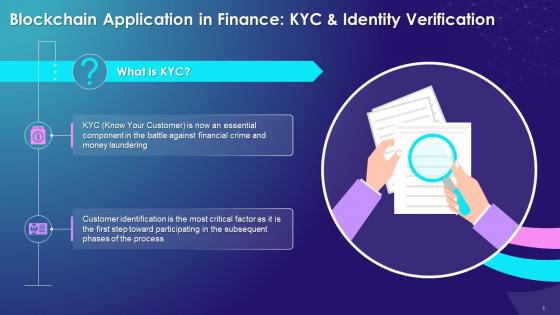
This slide provides an overview of KYC which an essential component in the battle against financial crime and money laundering. Customer identification is critical as it is the first step in participating in the subsequent phases of the process
People who downloaded this PowerPoint presentation also viewed the following :
Introduction To Know Your Customer KYC In Finance Training Ppt with all 16 slides:
Use our Introduction To Know Your Customer KYC In Finance Training Ppt to effectively help you save your valuable time. They are readymade to fit into any presentation structure.













FAQs for Introduction To Know Your Customer KYC In
Key KYC components include customer identification and verification, risk assessment and profiling, ongoing monitoring and screening, document authentication, and regulatory compliance reporting. These elements work together by streamlining identity verification, automating risk scoring, and enhancing transaction monitoring, with many financial institutions finding that comprehensive KYC frameworks ultimately deliver faster onboarding and stronger fraud prevention capabilities.
KYC regulatory requirements vary significantly across jurisdictions, with the US emphasizing BSA and Patriot Act compliance, the EU focusing on AML directives and GDPR integration, and Asia-Pacific countries implementing region-specific frameworks. These variations create compliance challenges for multinational financial institutions, requiring adaptive technology platforms and localized procedures, while many organizations find that standardized digital KYC solutions help streamline multi-jurisdictional compliance efficiently.
Technology revolutionizes KYC processes through automated document verification, AI-powered identity validation, biometric authentication, digital onboarding platforms, and real-time risk assessment tools. These innovations streamline compliance by reducing manual processing time, minimizing human error, and enhancing accuracy, with many financial institutions finding that automated KYC delivers faster customer onboarding and significantly lower operational costs.
Organizations balance privacy concerns with KYC compliance by implementing data minimization practices, encryption protocols, and purpose limitation frameworks that collect only necessary information. Through privacy-by-design approaches, financial institutions streamline verification processes while maintaining regulatory adherence, with many banks finding that automated systems enhance both customer trust and operational efficiency, ultimately delivering competitive advantage in an increasingly regulated landscape.
Common KYC implementation challenges include regulatory complexity, data integration difficulties, manual verification processes, customer onboarding delays, and compliance cost management. Financial institutions often struggle with fragmented systems, inconsistent data quality, and balancing thorough verification with customer experience expectations, while many banks finding that strategic automation and centralized platforms ultimately streamline operations and enhance regulatory adherence.
Customer onboarding significantly impacts KYC efficiency by establishing streamlined data collection processes, automated verification workflows, and standardized documentation requirements from the initial client interaction. Well-designed onboarding systems enable financial institutions to reduce processing times, minimize manual interventions, and enhance compliance accuracy, with many banks finding that integrated digital onboarding ultimately delivers faster account approvals and improved customer experiences.
**INPUT**: What best practices can be adopted to enhance KYC data accuracy? **OUTPUT**: KYC data accuracy best practices include automated verification systems, regular data validation checks, multi-source cross-referencing, standardized data collection formats, and continuous monitoring protocols. These approaches streamline compliance by minimizing manual errors, accelerating verification processes, and ensuring real-time data integrity, with many financial institutions finding that integrated automation ultimately delivers enhanced regulatory compliance and improved customer onboarding experiences.
Machine learning and AI enhance KYC risk assessment by analyzing vast datasets, detecting complex patterns, and automating suspicious activity identification with unprecedented accuracy. These technologies enable financial institutions to process customer data more efficiently, reduce false positives significantly, and identify emerging fraud patterns in real-time, ultimately delivering faster onboarding and enhanced compliance oversight.
Non-compliance with KYC regulations exposes businesses to substantial financial penalties, regulatory sanctions, reputational damage, and potential criminal liability. Financial institutions face particularly severe consequences, including hefty fines, operational restrictions, and loss of banking licenses, while also experiencing decreased customer trust and competitive disadvantage in an increasingly regulated financial landscape.
Firms can integrate KYC checks with CRM systems through API connections, automated data synchronization, and workflow automation that embeds compliance directly into customer onboarding processes. This integration enables banks and financial institutions to streamline account openings, maintain real-time compliance updates, and enhance customer experiences, while reducing manual processing time and ultimately delivering operational efficiency across all client touchpoints.
Emerging KYC trends include AI-powered identity verification, blockchain-based credential storage, biometric authentication, real-time risk monitoring, and automated compliance reporting. These technologies streamline onboarding by reducing verification times, enhancing fraud detection accuracy, and minimizing manual processes, with many financial institutions finding that strategic automation delivers faster customer experiences while significantly reducing operational costs.
Customer demographics significantly influence KYC requirements through varying risk profiles, regulatory frameworks, and verification methods based on age, location, income levels, and transaction patterns. Financial institutions adapt their KYC processes accordingly, with younger customers often requiring digital-first verification approaches, while high-net-worth individuals face enhanced due diligence, ultimately enabling more targeted compliance and improved customer experiences.
**INPUT**: What metrics should be used to measure the effectiveness of a KYC program? **OUTPUT**: KYC program effectiveness metrics include customer onboarding time, compliance audit scores, false positive rates, regulatory penalty costs, and customer abandonment rates during verification processes. These measurements enable financial institutions to streamline compliance workflows, reduce operational costs, and enhance customer experiences, with many banks finding that comprehensive metric tracking ultimately delivers faster account approvals and stronger regulatory positioning. **Word count: 59 words**
Organizations ensure ongoing KYC compliance through automated monitoring systems, regular regulatory updates, continuous staff training, periodic customer data reviews, and robust audit trails. These technologies streamline compliance by tracking regulatory changes, automating customer screening, and maintaining real-time documentation, with many financial institutions finding that proactive compliance management ultimately delivers reduced regulatory risk and enhanced operational efficiency.
KYC serves as the first line of defense against financial crimes by verifying customer identities, assessing risk profiles, monitoring transaction patterns, and ensuring regulatory compliance throughout the customer relationship. Through advanced identity verification and continuous monitoring systems, financial institutions can detect suspicious activities, prevent fraudulent account openings, and report potential money laundering schemes, ultimately protecting both institutional integrity and regulatory standing.
-
Understandable and informative presentation.
-
Every time I ask for something out-of-the-box from them and they never fail in delivering that. No words for their excellence!