


Inventory Control Techniques In Lean Production Implementing Lean Production




Try Before you Buy Download Free Sample Product
 Impress Your
 Audience
 100%
100% Editable
 Save Hours
 of Time


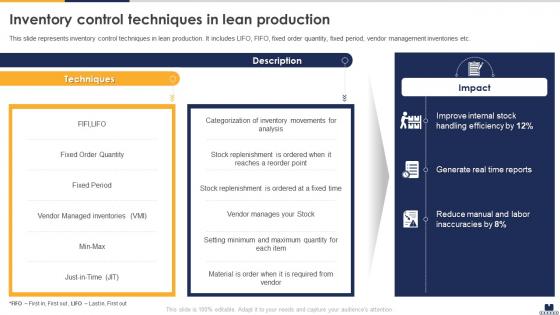
This slide represents inventory control techniques in lean production. It includes LIFO, FIFO, fixed order quantity, fixed period, vendor management inventories etc.
People who downloaded this PowerPoint presentation also viewed the following :
Inventory Control Techniques In Lean Production Implementing Lean Production with all 6 slides:
Use our Inventory Control Techniques In Lean Production Implementing Lean Production to effectively help you save your valuable time. They are readymade to fit into any presentation structure.





FAQs for Inventory Control Techniques In Lean Production
Perpetual inventory systems provide real-time tracking through continuous updates with each transaction, while periodic systems rely on physical counts at set intervals to determine inventory levels. Perpetual systems enable immediate decision-making and better stock management for retailers and manufacturers, whereas periodic systems offer cost-effective solutions for smaller businesses, with many organizations finding that perpetual systems ultimately deliver enhanced accuracy and operational efficiency.
Businesses implement JIT inventory management by establishing strong supplier partnerships, implementing demand forecasting systems, streamlining production processes, and maintaining minimal safety stock levels. Through careful coordination with reliable vendors, manufacturers like Toyota and electronics companies reduce carrying costs, minimize waste, and improve cash flow, while ensuring continuous production schedules meet customer demand efficiently.
Demand forecasting enables businesses to predict customer needs accurately, optimize stock levels, reduce carrying costs, and minimize stockouts through data-driven insights. By analyzing historical sales patterns, market trends, and seasonal fluctuations, retailers and manufacturers can streamline procurement decisions, enhance supply chain efficiency, and ultimately deliver better customer satisfaction while maintaining competitive advantage.
ABC analysis helps prioritize inventory management by categorizing items based on their value and impact, with A items requiring tight control and frequent monitoring, B items needing moderate oversight, and C items allowing basic management approaches. This strategic segmentation enables businesses to allocate resources efficiently, optimize stock levels for high-value products, and streamline operations, ultimately delivering cost reduction and improved inventory turnover across retail, manufacturing, and distribution sectors.
Automated inventory management systems deliver enhanced accuracy, real-time tracking, reduced labor costs, improved demand forecasting, and seamless integration with existing business processes. While these systems require significant upfront investment and staff training, many retail and manufacturing organizations find that automation ultimately streamlines operations, minimizes human error, and enables faster decision-making for competitive advantage.
Inventory turnover ratio significantly impacts business performance by indicating how efficiently companies convert stock into sales, optimize cash flow, and minimize carrying costs. Higher turnover ratios enable businesses to reduce storage expenses, improve working capital management, and respond faster to market demands, with many retail and manufacturing organizations finding that optimized inventory cycles ultimately deliver enhanced profitability and competitive positioning.
Small businesses can optimize inventory levels through ABC analysis, just-in-time ordering, economic order quantity calculations, safety stock planning, and regular cycle counting. These techniques help retailers and service companies minimize carrying costs, reduce stockouts, and improve cash flow, with many small manufacturers and distributors finding that strategic inventory management delivers competitive advantage and operational efficiency.
Businesses reduce excess inventory through demand forecasting analytics, just-in-time ordering systems, automated reorder points, supplier relationship optimization, and strategic safety stock management. These approaches enable companies to maintain optimal stock levels while ensuring product availability, with many retailers and manufacturers finding that predictive analytics and flexible supplier partnerships ultimately deliver cost reductions and improved customer experiences.
Safety stock serves as a crucial buffer against demand variability, supply delays, and forecast errors, ensuring continuous product availability while minimizing stockout risks. This strategic inventory cushion enables businesses across retail, manufacturing, and healthcare to maintain customer satisfaction, avoid lost sales, and sustain operational continuity, with many organizations finding that optimized safety stock levels significantly enhance service reliability while balancing carrying costs.
Economic order quantity models assist inventory decision-making by calculating optimal order quantities that minimize total costs, balancing ordering expenses against holding costs, and determining reorder points for consistent stock levels. Through EOQ analysis, manufacturing companies, retail chains, and distribution centers streamline procurement processes, reduce carrying costs, and avoid stockouts, ultimately delivering improved cash flow and operational efficiency.
Best practices for conducting regular inventory audits include establishing consistent audit schedules, using cycle counting methods, implementing barcode or RFID tracking systems, maintaining accurate documentation, and training staff on proper procedures. These practices streamline operations by reducing discrepancies, minimizing stockouts, and improving accuracy, with many retail and manufacturing organizations finding that systematic audits ultimately deliver better inventory visibility and enhanced operational efficiency.
RFID and barcoding enhance inventory tracking by providing real-time visibility, automating data capture, and minimizing human error throughout the supply chain. These technologies streamline operations by enabling instant stock updates, faster product identification, and seamless integration with inventory management systems, ultimately delivering improved accuracy and operational efficiency for retailers, manufacturers, and warehouses.
Common inventory management pitfalls include overstocking, understocking, poor demand forecasting, inadequate tracking systems, and lack of regular audits. These challenges often result from insufficient data analysis, manual processes, and disconnected supply chain communication, with many retailers and manufacturers finding that implementing automated inventory systems and real-time analytics significantly reduces costs while enhancing customer satisfaction.
Supply chain disruptions force organizations to adopt more resilient inventory control strategies by diversifying suppliers, increasing safety stock levels, and implementing dynamic reorder points based on real-time risk assessments. These adaptive approaches enable companies to maintain operational continuity during shortages, ultimately delivering improved customer service and competitive advantage in increasingly volatile markets.
Retail focuses on demand forecasting, seasonal adjustments, and fast turnover through just-in-time replenishment, while manufacturing emphasizes raw material optimization, production scheduling, and supply chain coordination. These industry-specific approaches reflect different operational priorities, with retail prioritizing customer availability and manufacturing streamlining production efficiency, ultimately delivering tailored inventory strategies that enhance profitability and competitive positioning.
-
They helped us design the pamphlets for our church’s food drive! The people loved the design, and I’m happy to say it was successful. Thank you, SlideTeam!
-
You can rely on SlideTeam whenever you run out of designs for your presentation. Thank you so much SlideTeam!