


Investing Telecommunications Powerpoint Presentation And Google Slides ICP




Try Before you Buy Download Free Sample Product
 Impress Your
 Audience
 100%
100% Editable
 Save Hours
 of Time


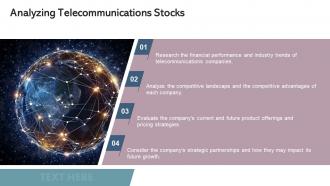
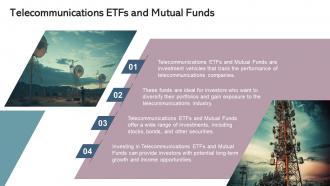
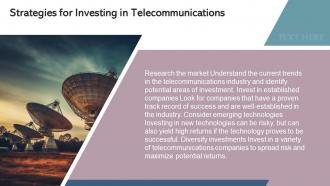
This PowerPoint presentation will provide an overview of investing in telecommunications. It will cover topics such as the current state of the telecommunications industry, the different types of investments available, and the advantages and risks associated with investing in telecommunications. Additionally, it will discuss strategies for making successful investments and provide resources for further research. This presentation is ideal for those interested in learning more about the telecommunications industry and investing in it. It will provide the necessary information to make informed decisions about investing in telecommunications.
People who downloaded this PowerPoint presentation also viewed the following :
Investing Telecommunications Powerpoint Presentation And Google Slides ICP with all 21 slides:
Use our Investing Telecommunications Powerpoint Presentation And Google Slides ICP to effectively help you save your valuable time. They are readymade to fit into any presentation structure.











FAQs for Investing Telecommunications Powerpoint Presentation And
Key factors driving telecommunications investment today include 5G network expansion, fiber infrastructure development, Internet of Things connectivity, edge computing capabilities, and increasing data consumption demands. These technologies enable telecom companies to deliver faster services, reduce operational costs, and capture new revenue streams, with many operators finding that strategic infrastructure investments ultimately enhance competitive positioning in an increasingly digital marketplace.
5G technology transforms telecommunications investment strategies by demanding substantial infrastructure upgrades, creating new revenue streams through enhanced services, and enabling partnerships across industries like healthcare, manufacturing, and autonomous vehicles. This technological shift requires investors to focus on companies with strong balance sheets, strategic spectrum holdings, and innovative service portfolios, ultimately delivering competitive advantages in an increasingly connected marketplace.
Regulatory changes significantly influence telecommunications investment by affecting spectrum allocation, market competition, infrastructure requirements, and pricing structures. These policy shifts create both opportunities and challenges, with investors closely monitoring deregulation trends, 5G deployment mandates, and data privacy regulations, ultimately determining market entry strategies, capital allocation decisions, and long-term profitability across global telecommunications sectors.
Investors can assess telecom profitability through revenue diversification into 5G services, cloud solutions, and IoT offerings, alongside analyzing customer retention rates, average revenue per user growth, and operational efficiency metrics. Companies successfully pivoting beyond traditional services, particularly in enterprise solutions and digital infrastructure, demonstrate stronger competitive positioning and sustainable profit margins despite market saturation challenges.
Telecommunications infrastructure investment risks include regulatory changes, technological obsolescence, high capital requirements, competitive market pressures, and economic sensitivity affecting demand. While these companies face challenges from evolving 5G standards and spectrum allocation uncertainties, many investors find that diversified telecom portfolios deliver steady returns through essential service demand, ultimately providing defensive characteristics in volatile markets.
Global geopolitical events significantly impact telecommunications investments through trade restrictions, regulatory changes, supply chain disruptions, and shifting strategic alliances that affect infrastructure development and technology partnerships. Events like trade wars, sanctions, and regional conflicts create both challenges and opportunities, with many telecommunications companies finding that diversifying supply chains and investing in secure, resilient networks ultimately delivers competitive advantage in an increasingly complex international landscape.
Consumer trends significantly influence telecom financial performance through data usage patterns, device upgrade cycles, service bundling preferences, and demand for emerging technologies like 5G and IoT connectivity. These shifting behaviors directly impact revenue streams, with providers adapting pricing models, infrastructure investments, and service offerings to meet evolving expectations, ultimately driving customer retention and market competitiveness.
Emerging technologies like IoT and AI are transforming telecom investments by driving infrastructure upgrades, creating new revenue streams through smart connectivity services, and requiring strategic capital allocation toward 5G networks and edge computing capabilities. These technologies enable telecom companies to deliver enhanced customer experiences, automate network management, and expand into sectors like healthcare and manufacturing, ultimately positioning them for competitive advantage in an increasingly connected digital economy.
Environmental sustainability initiatives significantly enhance telecom investment opportunities by driving demand for energy-efficient infrastructure, green technologies, and carbon-neutral operations. These initiatives enable telecommunications companies to reduce operational costs, attract ESG-focused investors, and meet regulatory requirements, while many organizations find that sustainable telecom solutions deliver competitive advantages through improved efficiency and enhanced brand reputation.
Investors should focus on revenue per user (ARPU), subscriber growth rates, network coverage expansion, capital expenditure efficiency, and debt-to-equity ratios when evaluating telecom stocks. These metrics reveal operational strength, market positioning, and financial stability, with many institutional investors finding that companies balancing infrastructure investment with cash flow generation deliver superior long-term returns in telecommunications markets.
Telecommunications M&A activity significantly influences investor sentiment by signaling industry consolidation opportunities, enhanced market positioning, and potential synergies through combined infrastructure and customer bases. These strategic combinations often drive stock volatility while ultimately delivering operational efficiencies, expanded service capabilities, and stronger competitive advantages, with many institutional investors finding that successful telecom mergers generate substantial long-term value.
Companies investing in fiber-optic technology typically see returns through recurring revenue from high-speed internet services, reduced maintenance costs compared to copper networks, and premium pricing for superior bandwidth capabilities. Telecommunications providers and infrastructure companies often achieve 15-25% annual returns by capturing growing demand for data services, enabling smart city projects, and delivering faster, more reliable connectivity that commands higher subscription rates in increasingly digital markets.
Tech giants challenge traditional telecommunications by leveraging existing digital infrastructure, offering competitive services like VoIP and messaging, and investing heavily in alternative technologies such as satellite internet and 5G networks. This competition forces telecom companies to accelerate innovation, reduce operational costs, and pivot toward value-added services, ultimately driving industry-wide transformation and more strategic investment approaches.
Asia-Pacific, Africa, and Latin America show the most promise for telecommunications investment due to rapid economic growth, expanding digital infrastructure needs, and large underserved populations. These regions offer significant opportunities for 5G deployment, fiber network expansion, and mobile service penetration, with many emerging markets finding that strategic telecommunications investments deliver substantial returns through increased connectivity demand and government infrastructure initiatives.
Investors can diversify telecom portfolios through infrastructure REITs, wireless tower companies, fiber optic networks, satellite operators, and telecommunications equipment manufacturers. This strategic combination enables exposure to different market segments, from 5G expansion to rural broadband initiatives, while balancing growth potential with dividend-yielding assets, ultimately delivering reduced volatility and enhanced returns.
-
SlideTeam was so customer-centric and quick service-provider that I doubted the amount I was paying and literally re-checked the transaction.
-
Innovative and creative templates with high-quality designs. Helped me with my presentation as the slides were easy to edit.