


Investment Banking Corporation Merger Checklist




Try Before you Buy Download Free Sample Product
 Impress Your
 Audience
 100%
100% Editable
 Save Hours
 of Time


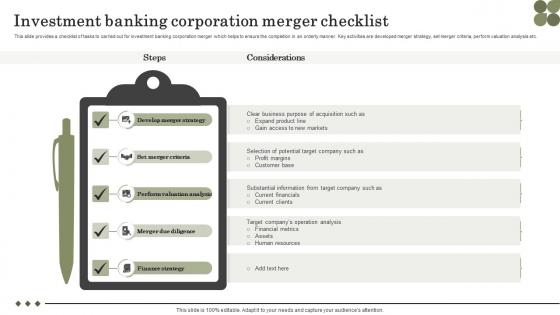
This slide provides a checklist of tasks to carried out for investment banking corporation merger which helps to ensure the completion in an orderly manner. Key activities are developed merger strategy, set merger criteria, perform valuation analysis etc.
People who downloaded this PowerPoint presentation also viewed the following :
Investment Banking Corporation Merger Checklist with all 6 slides:
Use our Investment Banking Corporation Merger Checklist to effectively help you save your valuable time. They are readymade to fit into any presentation structure.





FAQs for Investment Banking
Honestly, start with your pre-merger planning and target identification - that's the foundation. Due diligence comes next and yeah, it's brutal with all those document reviews, but you can't skip it. Then tackle regulatory approvals (ugh, the paperwork), plus you'll need integration planning for the big stuff like IT systems and keeping customers happy. Employee communication is huge too - people freak out during mergers. I always tell people to set weekly milestones because otherwise you're just crossing your fingers and hoping. Oh, and cultural integration? That's where most deals actually fall apart, so don't treat it as an afterthought.
Get your data request list done early and set up that virtual data room ASAP. The real game-changer though? Having teams on both sides who actually respond fast - I've seen deals drag for months just waiting for basic financials, it's ridiculous. Don't reinvent the wheel every time, use those standardized checklists. Focus on deal-breakers first before you dive into the nice-to-have stuff. Oh, and start pulling together your own documents now so you're not scrambling when they ask for them later.
Okay so when you're looking at a merger, start with revenue synergies and cost savings - basically can they make more money together or cut expenses? EBITDA margins are huge too, shows if they're actually profitable or just doing accounting magic tricks. Cash flow analysis is where you see if they're generating real cash or playing games with the books. Oh and debt-to-equity ratios matter because nobody wants to buy someone else's debt disaster, trust me on that one. These four will catch most problems before you get burned.
Dude, mergers are no joke - the legal stuff is insane. Due diligence comes first: contracts, lawsuits, IP, regulatory mess. Antitrust approval takes forever if you're big enough to trigger it (learned that the hard way). Board resolutions and shareholder votes are obvious ones. State filings too. Employment law gets tricky fast - benefits, union contracts, layoffs. Honestly, get a securities lawyer now because disclosure rules will destroy you if you mess up. Oh, and don't even think about rushing the timeline. These things always take longer than expected.
Start with employee surveys and focus groups to see how both companies actually work - their values, communication styles, all that stuff. Cultural due diligence matters just as much as the financial side, trust me. I've watched deals completely blow up because executives thought they could skip this part. Pay attention to how decisions get made and how people handle conflict. Cross-company workshops are gold for this - you'll see the real dynamics when teams interact, not just what shows up on surveys. Leadership styles can make or break everything too.
Oh man, rushing due diligence is probably the worst mistake - you'll get burned every single time. Cultural integration is another killer that people totally underestimate. Don't keep employees in the dark too long either, because rumors fly and your best people will bolt. Though honestly, communication timing is weird since you can't say much until everything's locked down. Tech integration needs way more planning than you'd think. Also watch out for regulatory stuff and getting so obsessed with the numbers that you miss obvious operational problems. Start integration planning ridiculously early.
Before you close this deal, nail down your success metrics or you'll be flying blind later. Revenue synergies and cost savings are the obvious ones - basic EBITDA stuff. But honestly, the operational metrics matter way more for seeing if integration is actually working. Employee retention, customer churn, how fast systems are talking to each other. Maybe cultural alignment if your company tracks that kind of thing. The biggest mistake? Being vague with targets. "Improve efficiency" is useless, but "cut processing time 30% in 12 months" - now that's something you can actually hit.
Dude, communication will literally make or break this whole thing. People absolutely lose it when they don't know what's happening - like, way more than you'd think. Keep everyone in the loop constantly: employees, customers, all your stakeholders. Set up different ways to reach different groups and assign specific people to handle each audience. Start talking early and don't stop. I'm serious about overcommunicating here - it's so much better than having people spiral about whether they'll have jobs next month. Oh, and timelines are huge. People can handle bad news if they know when it's coming.
Definitely save all your due diligence stuff and financial records - audited statements from the past 3-5 years especially. Material contracts with customers, suppliers, employment agreements, IP docs. Trust me on this one: I've watched deals turn into nightmares when someone ditched "old" agreements that suddenly mattered again. Board resolutions and corporate governance records too. Even closed litigation files - weird but they come up. Oh, and any regulatory filings you've got. Set up a digital archive and make someone responsible for it. You'll be so glad you did when random questions surface six months later.
Don't leave retention planning until the end - that's when you lose your best people. First thing is figuring out who's essential and who might bolt. Map out bonuses, stock vesting, maybe guaranteed roles for the ones you can't afford to lose. Communication matters way more than people think. Nobody wants to sit around wondering if they're getting fired next week. Set up regular check-ins and those pulse surveys (though honestly, half the time people don't answer them honestly anyway). Track your numbers weekly and have backup plans ready. Mergers are already a nightmare without key people walking out the door.
Honestly, start by figuring out what tech each company actually uses - you'll find a ridiculous amount of duplicate tools. Focus on customer stuff first since that's where your money comes from. Internal systems can wait. Make your timeline, then double it because this stuff always takes forever. Oh, and test everything in a sandbox before you mess with live systems (learned that one the hard way). Pick some tech-savvy people from both teams to champion the changes. The biggest thing though? Tell everyone what's happening way ahead of time. Nobody likes surprise workflow changes dropped on them Monday morning.
Map out your stakeholder groups first - shareholders, employees, customers, regulators, communities. Each needs their own communication plan. Start early with transparent messaging about why you're merging and what'll happen. Employees want job security info, customers need to know service won't get screwed up, shareholders care about value creation timelines. Honestly feels like juggling flaming torches half the time. Regular updates are key. Oh, and set up feedback channels so people can actually voice concerns. A stakeholder matrix helps track who's worried about what - saves your sanity later.
First thing - do a brand audit to see where they clash or overlap. Map your customer touchpoints and run some focus groups. Decide early if you're doing a full rebrand, keeping both, or mixing them together. Here's the thing that trips everyone up: your employees need to know what's happening before customers do. Otherwise it gets weird fast. Train your teams on whatever new guidelines you create. Oh, and don't rush this - seriously. Give yourself at least 6-12 months because trying to slam it together in a few weeks never works out well.
Talk to your customers constantly - like, way more than you think you need to. People absolutely lose it when their go-to services change without warning. Send updates about what's shifting and what isn't. Get your customer success folks involved early since they know exactly which changes will make people panic. Set up special support just for merger questions and drill your team on the answers. Oh, and watch social media like a hawk - complaints spread fast there. Honestly? The whole thing's a mess if customers feel blindsided, so overcommunicate everything.
Look, you're basically looking at 12-18 months total. First 6-9 months is all the boring stuff - due diligence, getting regulatory people to sign off, planning how you'll actually merge everything. Closing itself? That's like 2-3 weeks once everyone stops dragging their feet. The real nightmare starts after closing though. Give yourself 6-12 months to actually combine operations and get everyone playing nice together. Systems integration alone will make you want to pull your hair out. Pro tip: whatever timeline you think sounds reasonable, add 25% more time. Regulators don't care about your schedule, and something always goes sideways.
-
Nothing beats the well-formatted and professionally designed templates offered. Kudos to SlideTeam for their amazing collection of PPT slides.
-
Great work on designing the presentation. I just loved it!