


Investor profile business investment sureness financial assessment





Try Before you Buy Download Free Sample Product
 Impress Your
 Audience
 100%
100% Editable
 Save Hours
 of Time


Our Investor Profile Business Investment Sureness Financial Assessment are topically designed to provide an attractive backdrop to any subject. Use them to look like a presentation pro.
People who downloaded this PowerPoint presentation also viewed the following :
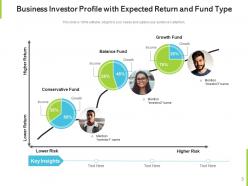
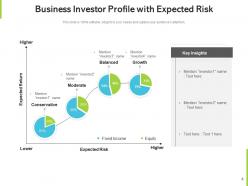
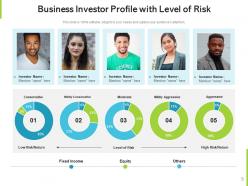
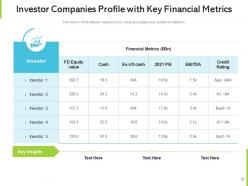
Investor profile business investment sureness financial assessment with all 12 slides:
Use our Investor Profile Business Investment Sureness Financial Assessment to effectively help you save your valuable time. They are readymade to fit into any presentation structure.



FAQs for Investor profile business investment
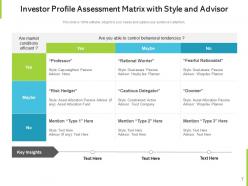
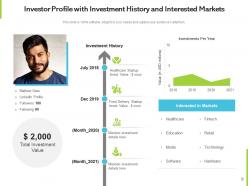
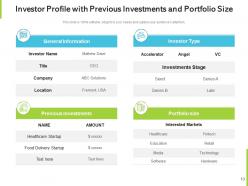
Key components that define an investor profile include risk tolerance, investment timeline, financial goals, liquidity needs, and income requirements. These elements work together by guiding portfolio allocation, asset selection, and strategic diversification, with financial advisors and wealth management firms finding that comprehensive profiles ultimately deliver more personalized investment strategies and better long-term outcomes.
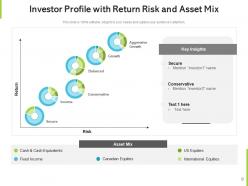
Risk tolerance significantly influences an investor's asset allocation, time horizons, and diversification strategies, with higher risk tolerance enabling equity-heavy portfolios and aggressive growth investments. Conservative investors typically favor bonds, dividend stocks, and stable value funds, while risk-seeking investors pursue growth stocks, emerging markets, and alternative investments, ultimately shaping their portfolio's potential returns and volatility levels.
An investor's financial goals serve as the foundation of their profile, determining risk tolerance, investment timeline, asset allocation strategies, and portfolio diversification approaches. These goals directly influence whether investors pursue aggressive growth through equities, stable income via bonds, or balanced strategies, with financial advisors finding that clearly defined objectives enable more precise portfolio construction and ultimately deliver better alignment between investment choices and desired outcomes.
Personal values and ethics significantly influence investment decisions by guiding portfolio selection, risk tolerance, and long-term strategy alignment with individual beliefs and principles. Many investors increasingly integrate environmental, social, and governance criteria into their decision-making, avoiding industries like tobacco or weapons while favoring sustainable companies, ultimately delivering returns that reflect their moral framework and personal convictions.
Age and life stage significantly influence investment strategies through risk tolerance adjustments, time horizon considerations, income stability factors, and retirement planning needs. Younger investors typically embrace growth-focused portfolios with higher equity allocations, while older investors increasingly shift toward income-generating assets like bonds and dividends, ultimately balancing wealth preservation with strategic growth objectives.
Investors can assess their current portfolio by analyzing asset allocation, risk distribution, sector diversification, and performance metrics against their defined investment objectives, time horizons, and risk tolerance levels. Through portfolio management software and financial advisors, many institutions systematically review holdings quarterly, rebalance allocations, and adjust strategies, ultimately ensuring alignment with evolving financial goals and market conditions.
Tools for creating investor profiles include robo-advisors like Betterment and Wealthfront, brokerage questionnaires, financial planning software, risk assessment platforms, and portfolio analysis tools. These resources streamline the profiling process by evaluating risk tolerance, investment goals, and time horizons, with many financial institutions finding that automated assessments deliver more accurate investor matching and enhanced portfolio recommendations.
Liquidity preference is crucial in investor profiling as it determines asset allocation, investment horizon planning, and risk tolerance assessment. Investors with high liquidity needs require portfolios weighted toward money market funds, short-term bonds, and liquid equities, while those with lower liquidity requirements can pursue long-term growth strategies, ultimately enabling better portfolio optimization and strategic wealth building.
An investor's understanding of market trends significantly shapes their profile by influencing risk assessment capabilities, investment timing decisions, and portfolio diversification strategies. This knowledge enables more informed sector allocation, enhanced due diligence processes, and strategic positioning during market volatility, with many institutional investors finding that trend awareness ultimately delivers better risk-adjusted returns and competitive advantage.
Diversification serves as a cornerstone strategy within an investor profile by aligning asset allocation with individual risk tolerance, time horizons, and financial objectives. Through strategic portfolio construction across asset classes, sectors, and geographic regions, investors can minimize volatility while optimizing returns, with many finding that diversified approaches deliver more consistent long-term performance and reduced downside risk.
Investors typically revise their profiles when major life changes occur, including career transitions, inheritance, marriage, retirement, or significant income shifts, and when market conditions drastically change their risk tolerance. These revisions ensure investment strategies remain aligned with current financial goals, time horizons, and capacity for risk, with many financial advisors recommending annual reviews to maintain optimal portfolio performance and strategic asset allocation.
Economic conditions significantly influence investor profiles by altering risk tolerance, asset allocation preferences, investment timeframes, and return expectations through market volatility and economic uncertainty. During recessions, investors typically shift toward conservative portfolios with bonds and cash, while economic growth periods encourage equity investments and higher risk tolerance, ultimately reshaping strategic asset distribution and investment behaviors.
**INPUT**: What psychological factors should be considered when establishing an investor profile? **OUTPUT**: Psychological factors include risk tolerance, behavioral biases, emotional responses to market volatility, time horizon preferences, and cognitive decision-making patterns. These considerations enable financial advisors to create personalized investment strategies by understanding client reactions, minimizing impulsive decisions, and aligning portfolios with psychological comfort levels, ultimately delivering more sustainable investment outcomes.
Technology assists investors in refining profiles through automated risk assessment tools, AI-driven portfolio analysis, behavioral pattern recognition, and real-time market sentiment tracking. These platforms streamline profile management by continuously analyzing investment preferences, adjusting risk parameters, and providing personalized recommendations, with many financial institutions finding that automated profiling delivers more accurate investor matching and enhanced portfolio performance.
Investors commonly overestimate their risk tolerance, underestimate time horizons needed for growth, and fail to account for emotional biases during market volatility, liquidity needs, and changing life circumstances. These assessment errors often lead to portfolio misalignment, with many financial advisors finding that regular profile reassessments help investors avoid panic selling, inadequate diversification, and ultimately achieve more consistent long-term returns.
-
Out of the box and creative design.
-
Innovative and Colorful designs.
-
Good research work and creative work done on every template.
-
Colors used are bright and distinctive.