


IoT Enabled Equipment Sensors For Manufacturing Automation Smart Production Technology Implementation




Try Before you Buy Download Free Sample Product
 Impress Your
 Audience
 100%
100% Editable
 Save Hours
 of Time


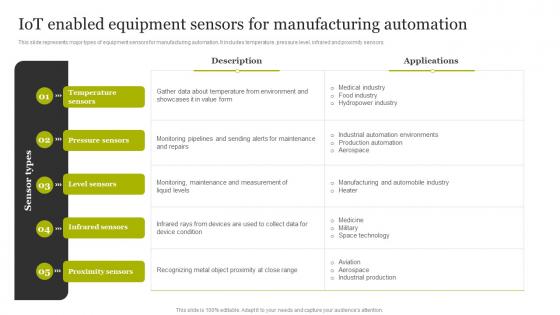
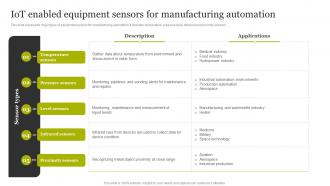
This slide represents major types of equipment sensors for manufacturing automation. It includes temperature, pressure level, infrared and proximity sensors.
People who downloaded this PowerPoint presentation also viewed the following :
IoT Enabled Equipment Sensors For Manufacturing Automation Smart Production Technology Implementation with all 6 slides:
Use our IoT Enabled Equipment Sensors For Manufacturing Automation Smart Production Technology Implementation to effectively help you save your valuable time. They are readymade to fit into any presentation structure.





FAQs for IoT Enabled Equipment Sensors For Manufacturing Automation Smart
IoT sensors enhance manufacturing operational efficiency by enabling real-time monitoring of equipment performance, predictive maintenance scheduling, and automated quality control processes. These smart devices streamline production workflows, minimize unexpected downtime, and optimize resource allocation across factory floors, with automotive and electronics manufacturers finding that sensor-driven insights ultimately deliver cost reductions and faster production cycles.
Manufacturers leverage IoT sensors by embedding devices throughout production lines to monitor equipment temperature, vibration, pressure, and performance metrics continuously. These sensors enable predictive maintenance by identifying potential failures before breakdowns occur, reducing downtime costs, optimizing maintenance schedules, and improving overall equipment effectiveness, with automotive and pharmaceutical manufacturers finding significant operational efficiency gains.
Key IoT sensors in manufacturing include temperature sensors, pressure sensors, vibration sensors, proximity sensors, and flow sensors. These technologies enhance operational efficiency by enabling predictive maintenance, monitoring equipment performance, and optimizing production processes, with many manufacturers finding that strategic sensor deployment significantly reduces downtime and delivers competitive advantages.
IoT sensors enhance supply chain visibility by providing real-time tracking of inventory, shipments, and production status, enabling predictive maintenance scheduling and automated quality control throughout manufacturing processes. These connected devices streamline operations by reducing manual monitoring, minimizing unexpected downtime, and accelerating response times to supply disruptions, with many manufacturers finding that enhanced transparency ultimately delivers improved efficiency and competitive advantage.
IoT sensors in manufacturing face cybersecurity threats, data breaches, network vulnerabilities, device authentication issues, and inadequate encryption protocols. These challenges present both risks and opportunities, with many manufacturers finding that implementing robust security frameworks, regular updates, and multi-layered protection strategies ultimately delivers enhanced operational resilience and competitive advantage.
IoT sensors contribute to energy management by monitoring real-time consumption patterns, identifying inefficiencies, and enabling automated optimization of machinery and lighting systems. These smart technologies help manufacturers reduce waste, minimize carbon footprints, and achieve sustainability goals, with automotive and electronics factories finding that sensor-driven energy management delivers significant cost reductions while enhancing operational efficiency.
Data analytics from IoT sensors revolutionizes manufacturing decision-making by providing real-time insights, predictive maintenance capabilities, quality control monitoring, and operational efficiency optimization. These analytics enable manufacturers to make data-driven decisions that reduce downtime, minimize waste, and enhance production schedules, with automotive and electronics companies finding that sensor-driven insights ultimately deliver faster response times and significant cost savings.
IoT sensors enhance quality control through real-time monitoring of temperature, pressure, vibration, and dimensional accuracy, enabling immediate defect detection and process adjustments. These systems streamline operations by automating inspections, reducing manual errors, and providing continuous data analytics, with manufacturers in automotive and electronics finding significantly improved product consistency and reduced waste costs.
IoT sensors enhance workforce safety by detecting hazardous gases, monitoring temperature fluctuations, tracking worker locations, and identifying equipment malfunctions before accidents occur. Through real-time alerts and predictive analytics, manufacturing facilities streamline safety protocols, reduce workplace injuries, and ensure regulatory compliance, with many organizations finding that these systems ultimately deliver significant cost savings and improved operational efficiency.
IoT sensors serve as the critical data foundation for manufacturing automation and robotics by providing real-time monitoring of equipment performance, environmental conditions, production quality, and workflow status. These sensors enable automated systems to make intelligent decisions, optimize robotic operations, and seamlessly coordinate complex manufacturing processes, with many facilities finding that sensor-driven automation significantly reduces downtime while enhancing operational efficiency.
Manufacturers can quantify IoT sensor ROI by measuring reduced equipment downtime, decreased maintenance costs, improved energy efficiency, enhanced quality control, and increased production throughput. Through predictive analytics and real-time monitoring, facilities typically achieve 10-20% operational cost reductions, with automotive and pharmaceutical manufacturers finding that faster issue detection and automated optimization deliver measurable competitive advantages within 12-18 months.
Companies face integration challenges including legacy system compatibility, data standardization across diverse protocols, network infrastructure requirements, cybersecurity vulnerabilities, and workforce training needs. These obstacles present both technical and operational hurdles, with many manufacturers finding that strategic phased implementation, robust connectivity solutions, and comprehensive security frameworks ultimately deliver enhanced operational efficiency and competitive advantage in an increasingly connected manufacturing landscape.
IoT sensors enable smart factories by providing real-time data collection, predictive maintenance capabilities, automated quality control, and seamless machine-to-machine communication across production lines. These technologies streamline operations by minimizing downtime, optimizing resource allocation, and enhancing production efficiency, with manufacturers like automotive and electronics companies finding that sensor integration ultimately delivers competitive advantage and operational excellence.
Best practices for deploying IoT sensors in regulated manufacturing include ensuring compliance with industry standards, implementing robust data encryption, conducting thorough security audits, establishing clear data governance protocols, and maintaining detailed documentation for regulatory oversight. These practices enable manufacturers in pharmaceuticals, aerospace, and medical device sectors to achieve real-time monitoring and predictive maintenance while meeting stringent compliance requirements, ultimately delivering operational efficiency and regulatory confidence.
Edge computing transforms IoT sensor data processing by enabling real-time analysis at the device level, reducing latency, minimizing bandwidth requirements, and enhancing security through localized processing. This advancement allows manufacturing facilities to achieve immediate fault detection, predictive maintenance alerts, and automated quality control responses, while automotive and electronics manufacturers find that edge-enabled sensors deliver faster decision-making and significantly improved operational efficiency.
-
The service is fast, and I could access any presentation after buying the subscription. I don’t think I’ll ever have to worry about a presentation in my life.
-
SlideTeam is very efficient when it comes to saving time. I am happy that I chose them for my presentation.