


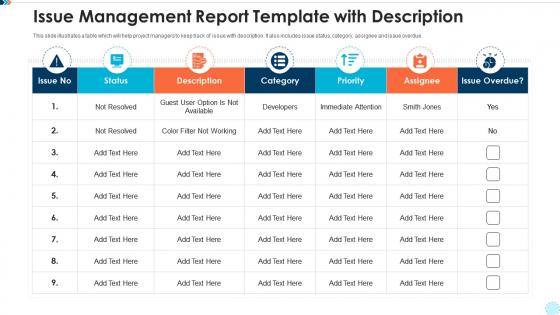
Issue management report template with description




Try Before you Buy Download Free Sample Product
 Impress Your
 Audience
 100%
100% Editable
 Save Hours
 of Time


Our Issue Management Report Template With Description are topically designed to provide an attractive backdrop to any subject. Use them to look like a presentation pro.
People who downloaded this PowerPoint presentation also viewed the following :
Issue management report template with description with all 9 slides:
Use our Issue Management Report Template With Description to effectively help you save your valuable time. They are readymade to fit into any presentation structure.








FAQs for Issue management report
An effective issue management report template should include issue identification and categorization, impact assessment and priority ranking, root cause analysis, resolution strategies and timelines, and stakeholder communication protocols. These components enable organizations to systematically track problems, allocate resources efficiently, and maintain transparency across departments, ultimately delivering faster resolution times and improved operational efficiency.
A well-structured issue management report enhances clarity through consistent sections like executive summary, issue categorization, impact assessment, resolution status, and action plans, ensuring stakeholders quickly locate relevant information. This standardized approach streamlines communication across departments, reduces response times, and improves accountability, with many organizations finding that structured templates minimize confusion and accelerate decision-making processes.
Issue management report templates prove most beneficial during crisis situations, complex project deliveries, regulatory compliance periods, and organizational changes where systematic tracking becomes critical. These templates streamline communication across stakeholders, ensure consistent documentation standards, and accelerate resolution timelines, with many organizations finding that standardized reporting reduces response times significantly while maintaining comprehensive oversight.
Visuals in issue management reports enhance stakeholder engagement by simplifying complex data interpretation, accelerating decision-making processes, and creating more memorable presentations of critical information. Through dashboards, charts, and infographics, organizations streamline communication with executives, project teams, and clients, while reducing meeting times and improving issue resolution tracking, ultimately delivering clearer accountability and faster strategic responses.
Risk assessment plays a foundational role by identifying potential impacts, likelihood of escalation, resource requirements, and mitigation strategies for each documented issue. Through systematic evaluation, organizations can prioritize critical issues, allocate appropriate resources, and develop targeted response plans, ultimately enabling faster resolution times and minimizing operational disruptions across departments.
Teams ensure adaptable issue management report templates by creating modular sections, customizable categories, flexible priority scales, and standardized yet scalable tracking fields. This strategic approach enables organizations across industries, from software development to construction management, to modify templates based on project complexity, stakeholder requirements, and industry-specific compliance needs, ultimately delivering consistent reporting while maintaining project-specific relevance.
**INPUT**: What tools or software can enhance the creation and distribution of issue management report templates? **OUTPUT**: Tools that enhance issue management report templates include project management platforms like Jira and Asana, collaborative software such as Microsoft Teams and Slack, and automated reporting solutions like Tableau and Power BI. These technologies streamline template creation, enable real-time collaboration, and automate distribution processes, with many organizations finding that integrated dashboards ultimately deliver faster issue resolution and improved stakeholder communication across departments. [Word count: 60 words]
Organizations measure issue management reporting effectiveness through key performance indicators like resolution time, escalation rates, stakeholder satisfaction scores, and process compliance metrics. These measurements enable businesses to identify bottlenecks, streamline response procedures, and enhance operational efficiency, with many finding that regular assessment of reporting accuracy and communication speed ultimately delivers improved risk mitigation and stronger stakeholder confidence.
Common pitfalls include overcomplicating layouts with excessive data fields, failing to establish clear escalation pathways, lacking standardized priority classifications, and omitting stakeholder accountability sections. These design flaws often result in delayed response times and unclear ownership, with many organizations finding that streamlined templates focusing on actionable insights and defined workflows ultimately deliver faster issue resolution and improved operational efficiency.
An issue management report template facilitates better decision-making by providing structured data visualization, standardized risk assessment criteria, clear priority rankings, and comprehensive status tracking across all project components. This systematic approach enables project managers to quickly identify critical bottlenecks, allocate resources strategically, and communicate effectively with stakeholders, ultimately delivering faster resolution times and improved project outcomes.
Data collection methods for issue management reports include stakeholder interviews, automated system logs, incident tracking databases, customer feedback surveys, and risk assessment audits. These approaches enable organizations to capture comprehensive information through real-time monitoring, structured interviews, and analytical tools, ultimately delivering accurate reporting and enhanced decision-making capabilities across departments.
Issue management reports should typically be updated weekly or bi-weekly, though frequency depends on project complexity, issue severity, stakeholder requirements, and organizational processes. High-risk projects or critical issues may require daily updates, while stable initiatives can use monthly reporting, with many organizations finding that consistent timing enhances transparency, accelerates resolution, and ultimately delivers better project outcomes.
When presenting issues in report format, follow structured documentation with clear issue descriptions, impact assessments, priority rankings, assigned ownership, and defined timelines for resolution. Use consistent formatting, visual indicators for severity levels, and executive summaries for leadership review, while ensuring regular updates and tracking mechanisms that enable stakeholders to quickly assess status, make informed decisions, and maintain accountability throughout the resolution process.
Stakeholder feedback can be integrated through regular template reviews, user experience surveys, performance metrics analysis, and collaborative workshops with key users. By systematically collecting input from project managers, executives, and operational teams, organizations can refine reporting formats, adjust data visualization elements, and streamline communication workflows, ultimately delivering more actionable insights and enhanced decision-making capabilities.
Successful issue management report templates include executive dashboards with visual status indicators, chronological incident timelines with resolution tracking, risk assessment matrices categorizing severity levels, stakeholder communication logs, and automated escalation workflows. These templates streamline crisis response by enabling faster decision-making, improving transparency across departments, and ensuring consistent documentation, with many organizations finding that standardized reporting reduces resolution time and enhances accountability.
-
Illustrative design with editable content. Exceptional value for money. Highly pleased with the product.
-
Understandable and informative presentation.
-
It saves your time and decrease your efforts in half.
-
Understandable and informative presentation.