


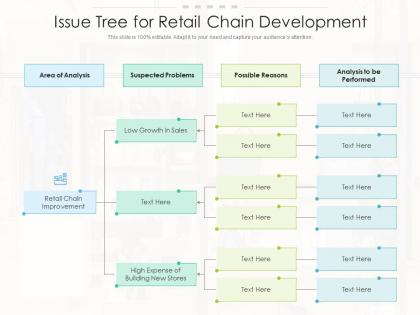
Issue tree for retail chain development




Try Before you Buy Download Free Sample Product
 Impress Your
 Audience
 100%
100% Editable
 Save Hours
 of Time


Our Issue Tree For Retail Chain Development are topically designed to provide an attractive backdrop to any subject. Use them to look like a presentation pro.
People who downloaded this PowerPoint presentation also viewed the following :
Issue tree for retail chain development with all 2 slides:
Use our Issue Tree For Retail Chain Development to effectively help you save your valuable time. They are readymade to fit into any presentation structure.
FAQs for Issue tree for
Key factors driving retail chain development include evolving consumer preferences, digital transformation demands, omnichannel integration needs, supply chain optimization requirements, and competitive market pressures. These drivers enable retailers to streamline operations, enhance customer experiences, and expand market reach, with many retail organizations finding that strategic scaling delivers improved operational efficiency and sustainable competitive advantage.
Technology revolutionizes retail chain expansion by enabling data-driven site selection, streamlined inventory management, and scalable operational systems. Through advanced analytics and cloud-based platforms, retailers can identify optimal locations, predict demand patterns, and maintain consistent customer experiences across multiple locations, while reducing overhead costs and accelerating market entry timelines.
Customer experience serves as the foundation for retail chain development, directly influencing brand loyalty, revenue growth, store expansion strategies, and competitive positioning. Successful retail chains like Starbucks and Apple leverage consistent, personalized customer experiences across all locations to drive repeat business, increase average transaction values, and justify premium pricing, ultimately enabling sustainable growth and market differentiation.
Supply chain disruptions significantly impact retail chain development by creating inventory shortages, increasing operational costs, and delaying store openings across multiple locations. These challenges force retailers to diversify suppliers, invest in local sourcing strategies, and enhance supply chain transparency, with many organizations finding that building resilient distribution networks ultimately delivers competitive advantage and improved customer experiences.
Retail chains face challenges including inconsistent staff training, varying local market preferences, supply chain disruptions, different regional regulations, and maintaining uniform customer experiences across diverse locations. These operational complexities can dilute brand identity and customer loyalty, with many retailers finding that standardized training programs, centralized inventory management, and regular quality audits help streamline consistency while preserving local market relevance.
Retail chains can effectively adapt by leveraging data analytics to track purchasing patterns, implementing flexible supply chain systems, personalizing customer experiences through technology, and maintaining agile inventory management. Through omnichannel strategies and real-time consumer insights, many retailers streamline product offerings, enhance customer engagement, and accelerate response times, ultimately delivering competitive advantage in an increasingly dynamic market.
Common financial hurdles during retail chain expansion include securing adequate capital for new locations, managing cash flow during growth phases, negotiating favorable lease terms, and maintaining inventory levels across multiple stores. These challenges often strain resources significantly, with many retail chains finding that strategic financial planning, phased expansion approaches, and strong supplier relationships help minimize costs while accelerating growth.
E-commerce competition compels brick-and-mortar retailers to adopt omnichannel strategies, enhance in-store experiences, and integrate digital technologies like mobile apps and contactless payments. Many retail chains are transforming stores into experience centers, implementing click-and-collect services, and leveraging data analytics to personalize customer interactions, ultimately delivering seamless shopping experiences that combine physical and digital advantages.
Market research provides critical foundation for retail chain development by identifying target demographics, analyzing competitor landscapes, assessing market demand, evaluating location viability, and understanding consumer behavior patterns. Through comprehensive market analysis, retail organizations can minimize expansion risks, optimize site selection, and tailor product offerings strategically, with many successful chains finding that thorough research significantly reduces costly missteps while accelerating profitable growth across multiple locations.
Retail chains can leverage data analytics to optimize growth strategies by analyzing customer behavior patterns, market demand forecasting, location performance metrics, inventory optimization, and competitive positioning analysis. Through predictive analytics and real-time dashboards, retailers streamline site selection, enhance supply chain efficiency, and personalize customer experiences, ultimately delivering faster expansion decisions and improved profitability across multiple locations.
Real estate costs significantly impact retail expansion through location selection, lease negotiation complexity, operational budget allocation, and long-term profitability planning. These financial considerations influence store size, market entry strategies, and competitive positioning, with many retail chains finding that strategic real estate partnerships and flexible lease structures ultimately deliver sustainable growth and enhanced market presence.
Regulatory challenges for retail chain expansion vary significantly across regions through differing labor laws, tax structures, zoning requirements, and consumer protection standards. While European markets emphasize data privacy and worker protections, Asian markets often focus on foreign ownership restrictions and local partnership requirements, with many retail chains finding that strategic legal partnerships and phased expansion approaches ultimately deliver smoother market entry and sustainable competitive advantage.
Sustainability initiatives present both implementation costs and operational complexity challenges, while creating opportunities for brand differentiation, cost savings through energy efficiency, and enhanced customer loyalty. Many retail chains find that sustainable practices, including renewable energy adoption, waste reduction programs, and eco-friendly packaging, ultimately deliver competitive advantages and improved profit margins despite initial investments.
Retail chains can adopt unified inventory management systems, integrated customer data platforms, consistent brand messaging across channels, real-time order tracking, and flexible fulfillment options like buy-online-pickup-in-store. These strategies streamline operations by connecting digital and physical touchpoints, enabling personalized experiences, and providing customers flexible shopping options, ultimately delivering higher satisfaction and competitive advantage in today's retail landscape.
Franchising models significantly enhance retail chain scalability by reducing capital requirements, accelerating market expansion, and leveraging local expertise while distributing operational risks across franchise partners. Through this strategic approach, retail chains streamline growth by minimizing direct investment, accessing established local networks, and maintaining brand consistency, with many organizations finding that franchising enables faster geographic penetration and sustainable competitive advantage.
-
Best Representation of topics, really appreciable.
-
Enough space for editing and adding your own content.