


IT Project Communication Plan And Budget Approval Process




Try Before you Buy Download Free Sample Product
 Impress Your
 Audience
 100%
100% Editable
 Save Hours
 of Time


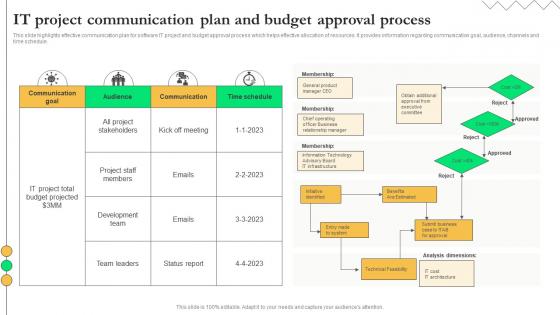
This slide highlights effective communication plan for software IT project and budget approval process which helps effective allocation of resources. It provides information regarding communication goal, audience, channels and time schedule.
People who downloaded this PowerPoint presentation also viewed the following :
IT Project Communication Plan And Budget Approval Process with all 6 slides:
Use our IT Project Communication Plan And Budget Approval Process to effectively help you save your valuable time. They are readymade to fit into any presentation structure.





FAQs for IT Project Communication Plan And
Key components include stakeholder identification matrices, communication frequency schedules, escalation protocols, progress reporting frameworks, and feedback collection mechanisms. These elements work together by establishing clear channels for updates, defining roles and responsibilities, and ensuring timely decision-making, with many IT organizations finding that structured communication reduces project delays and enhances stakeholder buy-in.
Budget allocation for communication tools typically involves assessing project complexity, team size, duration, and required integration capabilities with existing systems. Organizations should evaluate costs for collaboration platforms, project management software, video conferencing solutions, and documentation tools, with many IT departments finding that investing 3-5% of total project budget in robust communication infrastructure ultimately delivers faster project completion and reduced coordination overhead.
Stakeholder analysis identifies key project participants, their communication preferences, influence levels, and information requirements, enabling tailored messaging strategies for each group. By mapping stakeholders like executives, team members, and end users, project managers can determine optimal communication frequencies, channels, and content depth, ultimately ensuring buy-in and minimizing resistance throughout project execution.
Measuring communication effectiveness in IT projects involves tracking stakeholder engagement metrics, feedback response rates, issue resolution times, project milestone adherence, and team collaboration scores. Through regular surveys, meeting participation analysis, and documentation review cycles, organizations streamline project delivery, reduce miscommunication costs, and enhance stakeholder satisfaction, ultimately delivering faster implementations and improved project success rates.
Common pitfalls include underestimating training costs, failing to justify ROI with specific metrics, neglecting stakeholder buy-in processes, overlooking scalability requirements, and presenting vague timelines without clear milestones. These oversights often result in budget rejections or insufficient funding allocations, with many IT leaders finding that detailed cost breakdowns, measurable communication outcomes, and phased implementation approaches significantly improve approval rates and project success.
Project managers can justify communication costs by demonstrating ROI through reduced project delays, fewer misunderstandings, and improved stakeholder alignment, which ultimately minimize expensive rework and scope changes. These investments streamline collaboration, enhance team productivity, and deliver faster project completion times, with many organizations finding that effective communication tools reduce overall project costs by 15-25% while significantly improving success rates.
**INPUT**: What metrics can be used to assess the impact of communication on project success? **OUTPUT**: Communication impact metrics include stakeholder engagement scores, message clarity ratings, response times to project updates, meeting effectiveness measures, and change request frequency. These metrics enable project managers to streamline decision-making processes, enhance stakeholder alignment, and minimize project delays, with many organizations finding that structured communication measurement ultimately delivers faster approvals and improved project outcomes.
Communication channel selection significantly impacts IT project outcomes by influencing information accuracy, stakeholder engagement, and decision-making speed. Projects using strategic combinations of real-time collaboration tools, structured documentation platforms, and targeted reporting channels streamline coordination, minimize misunderstandings, and accelerate problem resolution, with many organizations finding that optimized communication frameworks ultimately deliver faster project completion and enhanced stakeholder satisfaction.
**INPUT**: What strategies can be implemented to ensure buy-in from stakeholders for the communication budget? **OUTPUT**: Effective stakeholder buy-in strategies include demonstrating clear ROI through communication metrics, aligning budget requests with specific project outcomes, presenting tiered investment options, and showcasing risk mitigation benefits. These approaches work by connecting communication costs to business value, transparency improvements, and project success rates, with many organizations finding that strategic communication investment ultimately delivers faster approvals and reduced project delays.
The communication plan integrates with project management methodology by matching its reporting structures, milestone checkpoints, governance processes, and stakeholder engagement frameworks to ensure seamless information flow. In methodologies like Agile or Waterfall, communication protocols align with sprint reviews, phase gates, and decision points, ultimately enabling consistent stakeholder updates, faster approvals, and enhanced project transparency across all phases.
Technology streamlines IT project communication through collaborative platforms, real-time messaging systems, project management software, automated reporting tools, and video conferencing solutions. These technologies enhance coordination by centralizing information, accelerating decision-making, and improving stakeholder visibility, with many organizations finding that integrated communication platforms ultimately deliver faster project timelines and better resource allocation.
Balancing transparency with confidentiality requires establishing clear communication tiers, defining audience-specific information levels, and implementing role-based access controls for sensitive budget data. Organizations achieve this through stakeholder mapping, confidentiality agreements, and structured reporting frameworks, with many finding that tiered communication ultimately enhances trust while protecting proprietary information and maintaining competitive advantage.
Budget considerations for communication tool training include software licensing costs, trainer fees, employee time allocation, ongoing support expenses, and potential productivity impacts during transition periods. Organizations typically find that investing in comprehensive training programs, especially for complex platforms like project management suites or collaborative workflows, ultimately delivers improved team coordination, reduced miscommunication costs, and enhanced project delivery timelines.
Regular updates and feedback loops can be incorporated through scheduled status meetings, automated reporting dashboards, stakeholder surveys, and milestone review sessions, with costs allocated for communication tools and dedicated personnel time. These mechanisms streamline project oversight by enabling real-time adjustments, enhancing transparency, and maintaining stakeholder alignment, ultimately delivering improved project outcomes and reduced risk of budget overruns.
Tailoring communication plans for different audience types is essential for project success, as executives require high-level status updates and ROI metrics, while technical teams need detailed implementation specifics and timelines. This strategic approach enhances stakeholder engagement, minimizes miscommunication, and accelerates decision-making processes, with many organizations finding that customized messaging ultimately delivers faster approvals and stronger project alignment.
-
Time saving slide with creative ideas. Help a lot in quick presentations..
-
I have just started downloading templates for my presentations and I must say this is a great design. It helped accelerate my presentation design process and made it more visually appealing.