


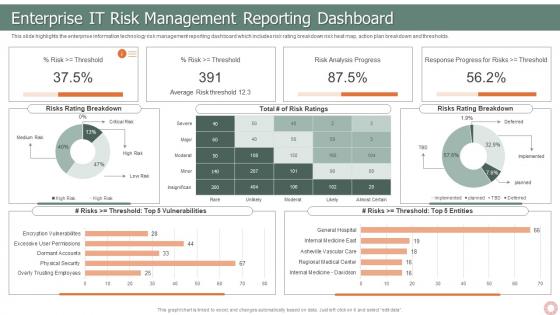
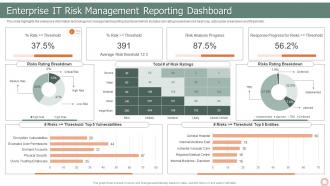
IT Risk Management Strategies Enterprise IT Risk Management Reporting Dashboard




Try Before you Buy Download Free Sample Product
 Impress Your
 Audience
 100%
100% Editable
 Save Hours
 of Time


This slide highlights the impacts of information technology risks on organization which includes graph for overspend project budget and data breach for 2021 year.
People who downloaded this PowerPoint presentation also viewed the following :
IT Risk Management Strategies Enterprise IT Risk Management Reporting Dashboard with all 7 slides:
Use our IT Risk Management Strategies Enterprise IT Risk Management Reporting Dashboard to effectively help you save your valuable time. They are readymade to fit into any presentation structure.





FAQs for IT Risk Management Strategies Enterprise IT Risk
So you'll want to start by listing out all your IT stuff and what could go wrong - cyber attacks, equipment dying, you know the drill. Then figure out which risks are actually likely vs just scary-sounding. I'd focus on the high-impact stuff first since you can't fix everything at once. Build your response plans and set up monitoring to catch new problems early. The documentation part is honestly kind of tedious but you'll thank yourself later when something breaks at 2am and you actually know what to do about it.
Start by mapping out all your IT stuff - systems, data, networks, the whole thing. Then figure out what could mess with each piece (cyberattacks, hardware dying, people screwing up). I'd rate each risk on how likely it is vs how bad it'd be if it happened. Get other teams involved too because they'll catch things you totally missed. The documenting part is honestly kind of tedious but you need it. Oh, and don't just do this once - your tech changes so the risks do too.
Compliance is like your starting line for IT risk stuff - GDPR, SOX, HIPAA, whatever hits your industry. These regs actually point you toward the big risk spots: data protection, who gets access to what, incident response. But here's the thing - just meeting compliance requirements won't cover everything. It's more foundation than finished product, you know? I'd start there since you have to anyway, then layer on your broader risk strategy. Oh, and don't just check boxes. Actually use those frameworks to spot where you're vulnerable.
Honestly, new tech is breaking all the old IT risk rules. AI, IoT gadgets, cloud apps - they're creating attack vectors we've never seen before. Can't just patch things up after the fact anymore (learned that one the hard way). You've gotta flip the script and think predictively instead of just reacting when stuff breaks. Map out what emerging tech your company's actually using first - or planning to use. Then build your risk frameworks around those specific tools. The whole "security as an afterthought" thing? Yeah, that doesn't work anymore.
Honestly, just throw everything into a risk matrix first - probability vs impact, you know the drill. Hit the high-probability, high-impact stuff right away, but those rare catastrophic risks? Don't sleep on them, they'll wreck you. Your industry matters tons here. Security bugs in healthcare are way scarier than in, say, retail. Try putting dollar amounts on risks when possible, and definitely loop in stakeholders - they'll catch blind spots you missed. Compliance stuff usually has to jump the queue no matter what your matrix says. Oh, and update it every quarter because tech moves stupidly fast.
Look at incident frequency first - fewer breaches and outages over time means you're doing something right. Response times matter too, plus how well people actually follow your security policies (spoiler: they probably don't as much as you think). Recovery time is massive when things go wrong. I'd also track cost avoidance - like what disasters you prevented and their potential damage. Survey your team about risk awareness since honestly, human error causes most of our headaches anyway. Don't overthink it though. Pick 3-4 metrics that actually matter to your business and check them quarterly.
So incident response planning is like your backup plan when everything hits the fan. Creates a roadmap your team can actually follow instead of everyone panicking and making dumb decisions. Picture having a fire drill, but for cyberattacks or when your servers decide to take a nap. Without it? You're just winging it during the worst possible time, which drags out recovery and costs way more money. Honestly, most companies think they'll figure it out as they go - spoiler alert: they won't. Start simple: write down your critical systems and who to call first for different types of disasters.
Honestly, these tools are game-changers for making smarter IT decisions. You get frameworks like NIST or ISO 27001 that help you actually quantify risks instead of just winging it. No more "this feels sketchy" conversations with your boss – now you've got real data to back up your recommendations. They're great at catching stuff you'd probably miss on your own too. The trick is finding one framework that matches your company's size (don't overthink this part) and then sticking with it for all your major decisions. Way better than going with gut instinct alone.
So here's the deal - IT risk management and business continuity planning are basically buddies that work together. Risk management is all about spotting potential threats before they bite you. Business continuity? That's your actual game plan for when stuff hits the fan (and trust me, it will). Your risk assessments basically tell you what disasters to prep for and which systems you absolutely can't live without. Honestly, most companies do this backwards - they wait for something to break first. Start by figuring out your biggest IT vulnerabilities, then build your recovery procedures around those. Super straightforward once you get the hang of it.
Oh totally, culture makes a huge difference in IT risk stuff. Risk-averse companies? They're super slow with new tech and have like a million approval steps. The bold ones move fast but sometimes skip important security checks - which honestly drives me crazy. What's really weird is when executives preach one thing but middle managers do whatever they want. You end up with departments handling risk completely differently. My advice? Figure out what your company actually does about risk, not just what the handbook says. Then build your IT policies around that reality or nobody will follow them anyway.
Small businesses usually struggle with tight IT budgets and zero dedicated security people. Your systems are probably outdated, and backup processes? Pretty basic. Large companies have completely different headaches - their infrastructure is insanely complex, hackers specifically target them, and don't get me started on compliance across different countries. Sure, they've got money, but their attack surface is massive. Both deal with phishing and ransomware obviously. Enterprises worry more about insider threats though. Honestly, just focus your risk assessment on where you actually are, not where you think you should be.
Dude, forget the tech speak - executives care about money and what breaks their business. Use those red/yellow/green charts because honestly, that's about as technical as most C-suite people want to get. Don't say "vulnerabilities" - say "here's what hackers could steal and when." Put dollar signs on everything you can. Write different versions too. Your CEO needs the 30-second version, your security team needs the nitty-gritty details. Oh, and never walk in with just problems - always have fixes ready with real timelines. Trust me on this one.
Okay so for continuous IT risk monitoring, you've got a few routes. SIEM tools like Splunk or QRadar are pretty solid - they pull in logs and catch weird stuff happening. Vulnerability scanners (Nessus, Qualys) will auto-scan for new threats. GRC platforms tie it all together with dashboards, though honestly some of them can be overkill. No single tool's gonna catch everything, so most people end up mixing and matching. I'd probably figure out where your biggest headaches are first, then build from there. Budget's always the fun part, right?
Honestly, focus your time and money on the stuff that could actually wreck your business. High-impact, likely risks get priority - that's just common sense. Everything else? Document why you're accepting it and get your boss to sign off. Covers your ass legally and shows you're not just being lazy about security. Low-impact scenarios are usually fine to accept, especially when fixing them costs more than the potential damage. Just don't accept anything that could completely tank the company - I've seen that mistake before. Map out what's actually critical first, then work backwards from there.
Honestly, that whole "set it and forget it" mindset is totally dead after all these recent hacks. Threats move too fast now - you've gotta stay on top of monitoring and assessments constantly. What gets me is how many breaches still happen from stupid basic stuff. Unpatched systems, terrible passwords, no multi-factor auth. Come on, people. You can't build perfect walls anymore, so just assume someone's getting in eventually. Your risk management has to move as fast as the hackers do. Oh, and those tabletop exercises where you practice responding? Actually do them - they're not just corporate theater.
-
Wow, never been this impressed with any online service provider. Really appreciate the customer support all along from the navigation to purchasing the right products.
-
Impressive templates. Designing a presentation is fun now!