


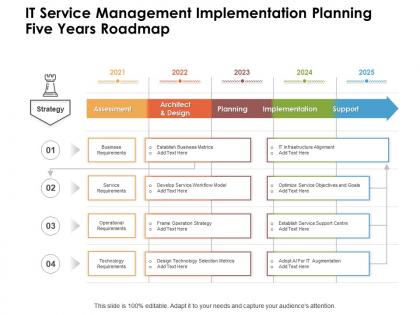
It service management implementation planning five years roadmap




Try Before you Buy Download Free Sample Product
 Impress Your
 Audience
 100%
100% Editable
 Save Hours
 of Time


The success rate of business plans is hugely dependent on the plan of action, and this editable IT Service Management Implementation Planning Five Years Roadmap rightly serves the purpose. Encapsulate all the information related to the project in a well structured manner to obtain maximum efficiency by incorporating our stunning PowerPoint theme. State the critical deliverable, steps involved, time frame, workforce allocation, and lots more in an easy to understand manner by utilizing this pre designed roadmap PowerPoint layout. You can also prioritize your tasks and discuss the problem areas with your colleagues by incorporating this tailor made PPT layout. Empower your work plan by employing this professionally designed PPT theme. Entrepreneurs can download IT Service Management Implementation Planning Five Years Roadmap as a beneficial communication tool that facilitates in collaborating with different tasks and achieve targets.
People who downloaded this PowerPoint presentation also viewed the following :
It service management implementation planning five years roadmap with all 2 slides:
Give your audience a fulfilling experience. They will find our IT Service Management Implementation Planning Five Years Roadmap elevating.
FAQs for It service management implementation planning
Effective ITSM roadmaps include service strategy development, process standardization, technology infrastructure assessment, governance frameworks, and performance measurement systems. These components work together by aligning IT services with business objectives, streamlining operations through automated workflows, and enabling continuous improvement, with many organizations finding that strategic roadmapping delivers enhanced service quality and operational efficiency.
Organizations align their ITSM roadmap with business objectives by establishing clear KPIs that directly support revenue goals, customer satisfaction targets, and operational efficiency metrics, while ensuring regular stakeholder engagement across departments. Through strategic prioritization of service improvements that enhance user experiences, reduce downtime costs, and accelerate digital transformation initiatives, companies create measurable value propositions that demonstrate IT's contribution to competitive advantage.
Stakeholder engagement ensures ITSM roadmaps align with business objectives, user needs, and operational requirements through collaborative planning, feedback collection, and priority setting. Through regular workshops and communication channels, organizations streamline change management, enhance user adoption, and deliver strategic outcomes, with many IT departments finding that engaged stakeholders ultimately accelerate implementation timelines and improve service delivery success rates.
Organizations can measure ITSM success through key performance indicators like incident resolution times, service availability percentages, customer satisfaction scores, first-call resolution rates, and mean time to recovery metrics. These measurements enable IT departments to demonstrate tangible value by tracking operational efficiency improvements, cost reductions, and enhanced user experiences, while identifying areas for continuous service optimization.
**INPUT**: What best practices should be followed when prioritizing ITSM projects? **OUTPUT**: ITSM project prioritization should follow business impact assessment, stakeholder alignment, resource availability analysis, regulatory requirements evaluation, and technical dependency mapping. These practices enable organizations to streamline implementation by focusing on high-value initiatives first, minimizing operational disruptions, and ensuring seamless integration, with many enterprises finding that strategic prioritization ultimately delivers faster ROI and enhanced service quality. [Word count: 54 words]
Tools enhancing ITSM roadmap implementation include service desk platforms, configuration management databases, automation tools, monitoring solutions, and cloud-based ITSM suites. These technologies streamline incident management, automate routine processes, and provide real-time visibility into service performance, with many organizations finding that integrated platforms significantly reduce response times while improving service quality and operational efficiency.
ITSM roadmaps should be reviewed quarterly and updated annually, with major reassessments triggered by significant business changes, technology shifts, or service performance gaps. Many organizations find that quarterly reviews enable proactive adjustments to emerging priorities and market demands, while annual updates ensure strategic alignment, ultimately delivering improved service quality and operational efficiency.
Common ITSM roadmap challenges include inadequate stakeholder buy-in, resistance to change, insufficient resource allocation, unrealistic timelines, and lack of clear communication across departments. These obstacles often stem from poor planning and limited executive support, with many organizations finding that addressing cultural resistance and establishing proper governance frameworks early significantly improves implementation success rates.
ITSM frameworks like ITIL integrate into roadmaps by establishing standardized processes, defining service lifecycle stages, creating governance structures, and aligning IT operations with business objectives. Through systematic implementation phases, organizations streamline incident management, change control, and service delivery, while ensuring scalability and continuous improvement, ultimately delivering enhanced operational efficiency and better customer experiences across their IT infrastructure.
Change management ensures ITSM transformations minimize disruption while maximizing adoption by establishing clear communication protocols, training frameworks, and stakeholder engagement strategies. Through structured change processes, organizations streamline technology transitions, reduce resistance, and accelerate user acceptance, with many enterprises finding that effective change management ultimately delivers faster implementation timelines and higher ROI.
Automation revolutionizes ITSM roadmaps by streamlining incident resolution, accelerating change management processes, and enabling proactive service monitoring through AI-driven analytics. Organizations implementing automated workflows experience faster ticket resolution, reduced manual errors, and enhanced resource allocation, with many enterprises finding that strategic automation ultimately delivers improved customer satisfaction and significant operational cost reductions.
User adoption of new ITSM processes requires comprehensive change management strategies including stakeholder engagement, targeted training programs, clear communication of benefits, and phased rollout approaches. Organizations achieve success by involving end-users in design phases, providing ongoing support resources, and demonstrating immediate value through quick wins, with many IT departments finding that regular feedback collection and process refinement ultimately delivers higher adoption rates and operational efficiency.
Organizations can incorporate continuous improvement into their ITSM roadmap by establishing regular performance reviews, implementing feedback loops from stakeholders, conducting periodic process assessments, and integrating lessons learned from incidents and changes. Through systematic monitoring and analysis, companies streamline service delivery, enhance user satisfaction, and reduce operational costs, while many finding that iterative refinements ultimately deliver sustained competitive advantage in an increasingly digital landscape.
Key ITSM performance indicators include incident resolution time, first-call resolution rates, service availability, customer satisfaction scores, and mean time to recovery. These metrics enable organizations to streamline operational efficiency, enhance user experiences, and minimize service disruptions, with many IT departments finding that comprehensive KPI tracking ultimately delivers improved service quality and strategic competitive advantage.
Organizations leverage feedback by establishing systematic collection mechanisms across stakeholders, customers, and IT teams, then analyzing performance metrics, incident patterns, and user satisfaction scores. This data-driven approach enables continuous roadmap refinement, helping prioritize high-impact improvements, eliminate service bottlenecks, and align ITSM initiatives with evolving business needs for enhanced operational efficiency.
No Reviews