


Itil Service Transition Overview Corporate Governance Of Information Technology Cgit




Try Before you Buy Download Free Sample Product
 Impress Your
 Audience
 100%
100% Editable
 Save Hours
 of Time


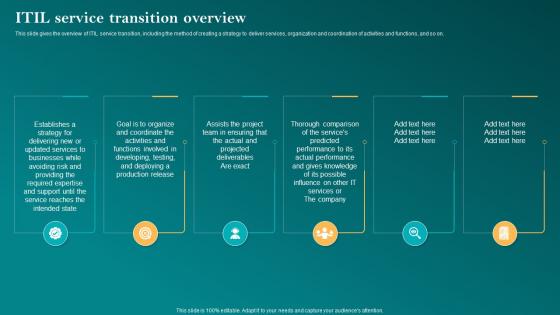
This slide gives the overview of ITIL service transition, including the method of creating a strategy to deliver services, organization and coordination of activities and functions, and so on.
People who downloaded this PowerPoint presentation also viewed the following :
Itil Service Transition Overview Corporate Governance Of Information Technology Cgit with all 6 slides:
Use our Itil Service Transition Overview Corporate Governance Of Information Technology Cgit to effectively help you save your valuable time. They are readymade to fit into any presentation structure.






FAQs for Itil Service Transition Overview Corporate Governance Of
ITIL Service Transition objectives include ensuring new or changed services meet business requirements, minimizing service disruption during transitions, improving success rates of changes, and establishing efficient knowledge management practices. These objectives align with overall IT service management by streamlining the bridge between service design and operations, ultimately delivering improved service quality, reduced implementation risks, and enhanced organizational capability to adapt services while maintaining operational stability.
ITIL Service Transition focuses on implementing and deploying new or modified services from design into live operation, while Service Design creates blueprints and Service Operation manages day-to-day running of established services. Service Transition bridges these phases by managing change, release, and deployment processes, ensuring seamless handoffs between teams and minimizing operational disruptions during service introductions.
Change management serves as the central control mechanism within ITIL Service Transition, systematically evaluating, authorizing, and coordinating all service changes to minimize risk and business disruption. Through standardized change advisory boards, impact assessments, and rollback procedures, organizations streamline their transition processes while maintaining service quality, with many IT departments finding that structured change management reduces failed deployments and enhances operational stability.
Organizations manage service transition risks through comprehensive change evaluation, thorough testing protocols, detailed rollback plans, stakeholder communication frameworks, and phased deployment strategies. These ITIL practices enable businesses to minimize service disruptions, maintain operational continuity, and reduce financial impacts, with many enterprises finding that structured risk assessment ultimately delivers smoother transitions and enhanced customer satisfaction.
**INPUT**: What are the best practices for stakeholder engagement during the ITIL Service Transition phase? **OUTPUT**: Best practices for stakeholder engagement during ITIL Service Transition include establishing clear communication channels, conducting regular progress reviews, implementing structured change advisory boards, maintaining comprehensive documentation, and creating feedback loops throughout the transition process. These approaches streamline stakeholder alignment by ensuring transparency, minimizing resistance, and facilitating smoother service deployments, with many organizations finding that proactive engagement ultimately delivers faster implementations and enhanced service quality.
ITIL Service Transition supports continuous service improvement by establishing robust change management processes, comprehensive knowledge management systems, and thorough service validation procedures that capture lessons learned from each deployment. Through systematic evaluation and feedback loops, organizations can identify optimization opportunities, streamline future transitions, and enhance service quality, ultimately delivering more reliable services and reduced operational risks.
Technologies that enhance ITIL Service Transition include configuration management databases (CMDBs), automated deployment tools, release orchestration platforms, change management software, and service validation frameworks. These technologies streamline transitions by automating release deployments, maintaining accurate configuration baselines, and enabling comprehensive testing workflows, with many organizations finding that integrated toolchains significantly reduce deployment risks while accelerating service delivery timelines.
Key metrics for evaluating ITIL Service Transition success include transition time reduction, defect rates, rollback frequency, stakeholder satisfaction scores, and resource utilization efficiency. These measurements enable organizations to streamline change management processes, minimize service disruptions, and enhance operational performance, with many IT departments finding that comprehensive metrics tracking ultimately delivers faster deployments and improved service quality.
Effective communication and documentation in ITIL service transitions ensures stakeholder alignment, reduces deployment risks, and maintains service quality through structured knowledge transfer, change schedules, and configuration management. These practices enable organizations to minimize service disruptions, accelerate rollback procedures when needed, and maintain operational continuity, with many enterprises finding that comprehensive documentation ultimately delivers faster implementations and improved customer experiences.
Organizations typically face challenges including inadequate change management processes, insufficient stakeholder buy-in, resource constraints, poor communication between teams, and resistance to cultural shifts during ITIL Service Transition implementation. These obstacles can be overcome by establishing clear governance frameworks, investing in comprehensive staff training, implementing phased rollouts with measurable milestones, and fostering cross-functional collaboration, ultimately delivering streamlined operations and enhanced service quality.
ITIL Service Transition and Agile methodologies complement each other by combining structured change management with iterative development approaches, enabling organizations to maintain service quality while accelerating delivery cycles. This strategic combination enhances deployment predictability, minimizes service disruptions, and streamlines release processes, with many technology companies finding that integrated frameworks deliver faster time-to-market and improved operational efficiency.
Organizations ensure alignment between ITIL Service Transition and business objectives by establishing clear governance frameworks, integrating business stakeholders into transition planning, and implementing robust change evaluation processes that assess business impact. Through strategic service design reviews and continuous stakeholder communication, companies across sectors like financial services and healthcare streamline service deployments while minimizing business disruption, ultimately delivering faster time-to-market and enhanced operational efficiency.
Essential skillsets for ITIL Service Transition teams include change management expertise, configuration management proficiency, risk assessment capabilities, release planning knowledge, and stakeholder communication skills. These competencies enable teams to seamlessly coordinate deployment activities, minimize service disruptions, and ensure quality deliverables, with many organizations finding that comprehensive ITIL Foundation certification combined with hands-on transition experience ultimately delivers faster implementations and improved service reliability.
Automation enhances ITIL Service Transition efficiency by streamlining change management workflows, automating deployment processes, and accelerating testing procedures. Through automated configuration management and release orchestration, organizations minimize manual errors, reduce deployment timeframes, and ensure consistent service delivery, with many enterprises finding that automated transition processes ultimately deliver faster time-to-market and improved operational reliability.
ITIL Service Transition frameworks can be tailored through selective process adoption, customized workflow integration, industry-specific risk assessments, and scaled governance structures that align with organizational maturity and sector requirements. Financial services organizations often emphasize rigorous change authorization and rollback procedures, while manufacturing companies focus on operational continuity and minimal production disruption, ultimately delivering enhanced service reliability and competitive advantage.
-
Amazing slides! Unique, attractive, and easy to understand.
-
The designs by SlideTeam are honestly the best I have seen so far. Will be definitely coming back for more.