


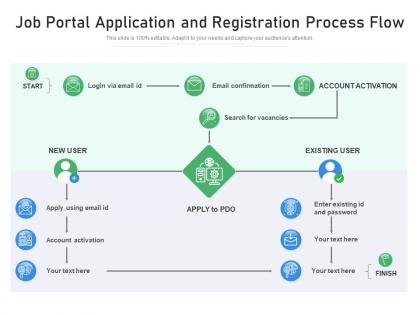
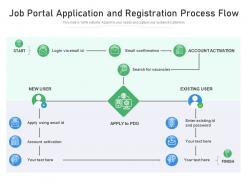
Job portal application and registration process flow




Try Before you Buy Download Free Sample Product
 Impress Your
 Audience
 100%
100% Editable
 Save Hours
 of Time


Our Job Portal Application And Registration Process Flow are topically designed to provide an attractive backdrop to any subject. Use them to look like a presentation pro.
People who downloaded this PowerPoint presentation also viewed the following :
Job portal application and registration process flow with all 2 slides:
Use our Job Portal Application And Registration Process Flow to effectively help you save your valuable time. They are readymade to fit into any presentation structure.
FAQs for Job portal application and
Key features include advanced search filters, personalized job recommendations, one-click application processes, real-time application tracking, and integrated communication tools between candidates and employers. These capabilities streamline recruitment by reducing time-to-hire, improving candidate matching accuracy, and enhancing engagement, with many organizations finding that comprehensive portals ultimately deliver better talent acquisition outcomes and competitive hiring advantages.
Job portals ensure data security through encrypted data transmission, multi-factor authentication, regular security audits, secure database storage, and strict access controls. These measures protect sensitive information by preventing unauthorized access, safeguarding personal details during application processes, and maintaining compliance with privacy regulations, with many platforms finding that robust security protocols ultimately enhance user trust and competitive positioning.
Algorithms analyze job seeker profiles, skills, experience, and preferences against employer requirements, location preferences, and company culture to identify optimal matches. These intelligent systems streamline recruitment by automatically ranking candidates, filtering applications based on specified criteria, and suggesting relevant opportunities, with many HR departments finding that algorithmic matching reduces hiring time while improving candidate quality and fit.
Job portals facilitate communication through integrated messaging systems, real-time chat features, video interview scheduling, automated status updates, and collaborative feedback tools. These platforms streamline recruitment by enabling instant candidate screening, seamless interview coordination, and transparent application tracking, with many organizations finding that enhanced communication reduces hiring timelines while improving candidate experiences and employer branding.
Job portal administrators should track application completion rates, time-to-hire metrics, user session duration, job posting visibility, candidate-employer match accuracy, and repeat user engagement rates. These metrics enable platforms to streamline recruitment processes, enhance user experiences, and optimize matching algorithms, with many successful portals finding that combining conversion data with user behavior analytics ultimately delivers improved placement rates and sustained platform growth.
Job portals adapt to changing market dynamics by integrating remote work filters, freelance project listings, skills-based matching algorithms, and flexible employment categorizations. Through enhanced search functionalities and partnership networks, platforms now accommodate hybrid work arrangements, contract opportunities, and location-independent roles, while delivering personalized job recommendations and streamlined application processes, ultimately enabling both employers and job seekers to navigate increasingly diverse employment landscapes.
Best practices include intuitive navigation, mobile-responsive design, advanced search filters, streamlined application workflows, and clear communication channels between users. These elements enhance user experience by reducing friction during job searches, enabling faster application submissions, and providing seamless employer-candidate interactions, with many platforms finding that simplified interfaces increase user engagement and successful job placements significantly.
Job portals integrate AI through machine learning algorithms, natural language processing, predictive analytics, automated screening tools, and intelligent chatbots for candidate interactions. These technologies streamline recruitment by analyzing skills compatibility, predicting candidate success rates, and automating initial assessments, with many companies finding that AI-enhanced matching reduces hiring time while delivering more accurate candidate-job alignments.
Job portals face challenges including intense competition, user experience issues, outdated job listings, inadequate matching algorithms, and declining user engagement rates. These platforms increasingly struggle with balancing recruiter demands and candidate expectations, while many organizations find that streamlining interface design, implementing AI-powered matching, and enhancing mobile accessibility ultimately delivers better retention and competitive advantage.
Job portal application processes vary by industry through specialized requirements, screening methods, and evaluation criteria tailored to sector-specific needs. While healthcare and finance emphasize certifications and compliance checks, tech companies prioritize coding assessments and portfolio reviews, with manufacturing focusing on safety training and hands-on skills, ultimately enabling employers to streamline candidate selection while delivering more targeted, efficient hiring experiences.
Job portals must navigate anti-discrimination laws, data privacy regulations like GDPR, equal opportunity compliance, accessibility requirements, and wage transparency mandates. These legal frameworks require careful implementation across posting guidelines, candidate screening processes, and data handling protocols, with many platforms finding that proactive compliance ultimately delivers reduced liability risks and enhanced employer trust.
Job portals enhance job seeker success by offering comprehensive resume templates, AI-powered optimization tools, interview simulation platforms, skill assessment modules, and personalized career guidance. These integrated resources streamline the job search process while building candidate confidence, with many professionals finding that portal-provided preparation tools significantly improve their interview performance and ultimately deliver higher placement rates and better job matches.
Social media integration enhances job portals through seamless profile importing, expanded networking opportunities, social recruiting capabilities, and enhanced candidate verification processes. These features streamline application workflows by enabling one-click applications, professional network leveraging, and employer brand showcasing, with many organizations finding that integrated platforms deliver faster hiring cycles, broader talent reach, and improved candidate engagement rates.
Job portals handle user feedback through integrated rating systems, surveys, support tickets, analytics tracking, and direct communication channels. This feedback enables continuous improvement by identifying interface issues, enhancing search algorithms, streamlining application processes, and optimizing matching capabilities, with many platforms finding that user-driven improvements significantly increase engagement rates and successful job placements.
**INPUT**: What are the implications of having a mobile application for a job portal? **OUTPUT**: Mobile applications for job portals enhance accessibility, streamline application processes, enable real-time notifications, and expand candidate reach significantly. These platforms deliver faster job matching, improved user engagement, and competitive advantage, with many recruitment agencies finding that mobile-first approaches increase application rates and candidate satisfaction while reducing time-to-hire across industries. **Word count: 53 words**
-
Nice and innovative design.
-
Unique research projects to present in meeting.
-
Easily Editable.
-
Helpful product design for delivering presentation.
-
Attractive design and informative presentation.