


Kaizen form showing before and after ppt slide




Try Before you Buy Download Free Sample Product
 Impress Your
 Audience
 100%
100% Editable
 Save Hours
 of Time


Greatly accelerate your growth with our Kaizen Form Showing Before And After Ppt Slide. The decades ahead will appear to contract.
People who downloaded this PowerPoint presentation also viewed the following :
Content of this Powerpoint Presentation
Description:
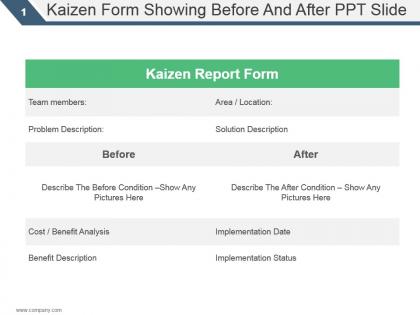
The image is a PowerPoint slide of a "Kaizen Report Form," a structured template used for continuous improvement processes. It is typically employed to document and visualize the impact of changes made within an organization. The form is divided into several sections:
1. Team members:
Where the names of individuals involved in the process are listed.
2. Area / Location:
This specifies where the issue or process being addressed is located.
3. Problem Description:
A detailed description of the current problem or process before improvement is entered here.
4. Solution Description:
This section is for the proposed or implemented solution to the problem described.
5. Before:
An area designated for describing or showing with pictures the condition or process before improvements.
6. After:
Similar to the "Before" section, but for the condition or process after the improvements.
7. Cost / Benefit Analysis:
An evaluation of the costs involved in implementing the solution versus the benefits derived from it.
8. Benefit Description:
Detailed description of the benefits achieved through the improvement.
9. Implementation Date:
The date when the solution was or will be implemented.
10. Implementation Status:
Current status of the solution's implementation process.
Use Cases:
The Kaizen form is a tool for teams to systematically approach problem-solving and can be used in various industries, including:
1. Manufacturing:
Use: Streamlining production processes.
Presenter: Process Engineer
Audience: Production team, management
2. Healthcare:
Use: Improving patient care procedures.
Presenter: Healthcare Administrator
Audience: Medical staff, hospital management
3. IT Services:
Use: Enhancing software development workflows.
Presenter: IT Project Manager
Audience: Development team, stakeholders
4. Education:
Use: Refining educational programs and administration.
Presenter: Academic Coordinator
Audience: Teaching staff, administrative board
5. Hospitality:
Use: Optimizing guest services and operations.
Presenter: Operations Manager
Audience: Hotel staff, department heads
6. Logistics and Supply Chain:
Use: Increasing efficiency in supply chain management.
Presenter: Logistics Director
Audience: Supply chain team, partners
7. Retail:
Use: Improving customer service and in-store processes.
Presenter: Retail Manager
Audience: Store employees, retail executives
Kaizen form showing before and after ppt slide with all 5 slides:
Be delighted with the bounty. Our Kaizen Form Showing Before And After Ppt Slide ensure excellent gains.


FAQs for Kaizen form showing before and
Kaizen's key principles include continuous small improvements, employee involvement at all levels, waste elimination, standardization of processes, and customer focus. These principles drive transformation by fostering a culture where teams identify inefficiencies, implement incremental changes, and measure results consistently, with many manufacturing and service organizations finding that this approach delivers sustained operational excellence and competitive advantage.
Kaizen transformation in remote work environments requires digital collaboration tools, virtual suggestion systems, regular video-based team meetings, and cloud-based process tracking platforms. Through online workshops and digital dashboards, remote teams can identify inefficiencies, implement continuous improvements, and maintain engagement, with many organizations finding that virtual Kaizen actually accelerates innovation cycles and enhances cross-departmental collaboration.
Leadership plays a pivotal role in fostering Kaizen culture by modeling continuous improvement behaviors, providing resources and training, empowering employees to identify inefficiencies, and consistently recognizing improvement initiatives. Through visible commitment and strategic support, leaders enable organizations to embed Kaizen principles across all departments, ultimately delivering enhanced operational efficiency, increased employee engagement, and sustainable competitive advantage in an increasingly dynamic business environment.
Small businesses can leverage Kaizen practices by implementing continuous improvement processes, employee suggestion systems, waste reduction initiatives, standardized workflows, and regular performance reviews. These approaches enable organizations to streamline operations, reduce costs, and enhance productivity through incremental changes, with many small businesses finding that consistent daily improvements ultimately deliver significant competitive advantages and operational efficiency gains.
Common challenges include employee resistance to change, lack of leadership commitment, insufficient training, unclear communication, and inadequate measurement systems. These obstacles often stem from cultural inertia and resource constraints, with many organizations finding that successful transformation requires sustained leadership support, comprehensive employee engagement, and systematic tracking of improvements to maintain momentum and demonstrate value.
Effective Kaizen metrics include cycle time reduction, defect rates, employee suggestion implementation rates, cost savings per improvement, and customer satisfaction scores. These KPIs enable organizations to track operational efficiency, engagement levels, and quality enhancements across manufacturing, healthcare, and service sectors, with many companies finding that regular measurement cycles ultimately deliver sustained competitive advantage and continuous improvement momentum.
Essential tools include value stream mapping, root cause analysis templates, process flowcharts, data collection sheets, and standardized improvement forms. These techniques facilitate systematic problem identification, collaborative solution development, and measurable outcomes tracking, with many manufacturing and service organizations finding that structured workshop formats accelerate employee engagement and deliver sustainable operational improvements.
Employee engagement significantly influences Kaizen effectiveness by driving participation rates, quality of improvement suggestions, and sustained implementation of changes. When employees feel valued and empowered, they actively identify inefficiencies, propose solutions, and champion continuous improvement processes, with many manufacturing and healthcare organizations finding that engaged teams deliver 40% more successful Kaizen implementations.
Kaizen emphasizes incremental daily improvements through employee engagement and cultural change, while Lean focuses on waste elimination and Six Sigma targets defect reduction through statistical analysis. Unlike Lean's process-centric approach or Six Sigma's data-driven methodology, Kaizen integrates seamlessly across organizations by fostering continuous small changes, ultimately delivering sustainable transformation through widespread participation and gradual optimization.
Kaizen transformation contributes to sustainability by systematically eliminating waste through continuous improvement processes, optimizing resource utilization, reducing energy consumption, and minimizing material waste streams. Through small, incremental changes, manufacturing organizations achieve significant environmental benefits while reducing operational costs, with many facilities finding that employee-driven improvements create lasting sustainability practices that enhance both environmental performance and competitive advantage.
**INPUT**: What strategies can be employed to ensure long-term adherence to Kaizen principles post-transformation? **OUTPUT**: Long-term Kaizen adherence requires embedding continuous improvement metrics into performance reviews, establishing cross-functional improvement teams, regular leadership reinforcement sessions, and systematic celebration of incremental wins. These strategies work by creating accountability structures, maintaining momentum through visible progress tracking, and fostering cultural ownership, with many organizations finding that consistent leadership modeling and employee recognition programs ultimately deliver sustained operational excellence and competitive advantage. [Word count: 60 words]
Feedback loops can be implemented through regular gemba walks, employee suggestion systems, performance metric tracking, cross-departmental reviews, and structured reflection sessions after each improvement cycle. These mechanisms enable organizations to identify process gaps, capture frontline insights, and measure improvement effectiveness, with many manufacturing and service companies finding that systematic feedback collection accelerates their transformation outcomes and sustains long-term operational excellence.
Toyota's production system revolutionized automotive manufacturing through continuous improvement, while hospitals like Virginia Mason reduced patient wait times by 85%, and banks like ING streamlined loan processing from weeks to days. These transformations demonstrate how Kaizen principles enable organizations across manufacturing, healthcare, and financial services to eliminate waste, enhance operational efficiency, and deliver superior customer experiences while maintaining competitive advantage.
Technology supports Kaizen practices through digital suggestion platforms, real-time data analytics, mobile reporting apps, workflow automation tools, and collaborative dashboards. These solutions streamline continuous improvement by enabling instant feedback collection, identifying bottlenecks through data visualization, and facilitating cross-departmental collaboration, with many manufacturing and service organizations finding that integrated systems accelerate implementation cycles and measurably enhance operational efficiency.
Kaizen adapts to different cultural contexts by incorporating local communication styles, decision-making processes, and organizational hierarchies while maintaining core continuous improvement principles. Global organizations achieve this by allowing regional teams to customize implementation approaches, integrating cultural values like consensus-building in Asia or individual initiative in Western markets, ultimately delivering unified improvement outcomes while respecting diverse workplace traditions.
-
Great experience, I would definitely use your services further.
-
Great designs, really helpful.