


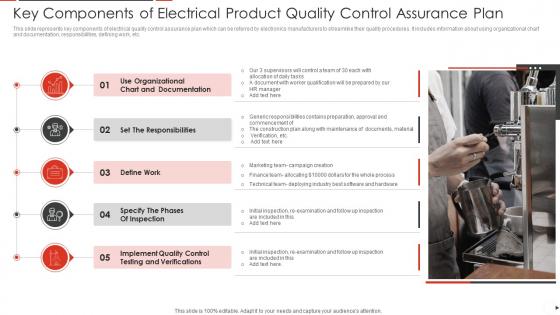
Key Components Of Electrical Product Quality Control Assurance Plan




Try Before you Buy Download Free Sample Product
 Impress Your
 Audience
 100%
100% Editable
 Save Hours
 of Time


This slide represents key components of electrical quality control assurance plan which can be referred by electronics manufacturers to streamline their quality procedures. It includes information about using organizational chart and documentation, responsibilities, defining work, etc.
People who downloaded this PowerPoint presentation also viewed the following :
Key Components Of Electrical Product Quality Control Assurance Plan with all 6 slides:
Use our Key Components Of Electrical Product Quality Control Assurance Plan to effectively help you save your valuable time. They are readymade to fit into any presentation structure.





FAQs for Key Components Of Electrical Product Quality
Key components of an effective quality control system include standardized procedures, regular inspections, statistical process control, documentation protocols, and corrective action frameworks. These elements work together by identifying defects early, maintaining consistency across operations, and ensuring compliance standards, with manufacturing and healthcare organizations finding that systematic quality control reduces costs, minimizes risks, and enhances customer satisfaction.
Statistical process control enhances quality management by monitoring production variations, identifying trends before defects occur, and establishing control limits for consistent output. Manufacturing companies, pharmaceutical firms, and food processors use SPC charts to reduce waste, minimize rework costs, and maintain compliance standards, ultimately delivering improved product reliability and operational efficiency.
Employee training plays a critical role in maintaining quality standards by ensuring consistent processes, reducing errors, enhancing technical competencies, and fostering a quality-focused culture across organizations. Through comprehensive training programs, companies in manufacturing, healthcare, and financial services achieve improved product consistency, faster issue resolution, and enhanced customer satisfaction, while employees develop the skills necessary to identify defects early, ultimately delivering competitive advantage and operational excellence.
Companies determine acceptable quality levels through statistical sampling methods, customer expectations analysis, industry standards review, and cost-benefit assessments of defect rates versus inspection costs. These quality benchmarks enable manufacturers across sectors like electronics, automotive, and textiles to balance production efficiency with customer satisfaction, ultimately delivering consistent products while maintaining competitive pricing and operational scalability.
Quality assurance focuses on preventing defects through systematic process design, standards establishment, and proactive planning, while quality control involves detecting and correcting defects through testing, inspection, and reactive measures. QA ensures processes deliver consistent outcomes across manufacturing, software development, and healthcare operations, whereas QC validates final products meet specifications, with many organizations finding that combining both approaches significantly reduces costs and enhances customer satisfaction.
Businesses implement TQM by establishing customer-focused objectives, training employees in quality principles, creating cross-functional improvement teams, and implementing continuous measurement systems. Manufacturing companies like Toyota and service organizations like Ritz-Carlton demonstrate how this philosophy streamlines operations, reduces defects, and enhances customer satisfaction, ultimately delivering competitive advantage through systematic quality excellence.
Common quality control tools include statistical process control charts, Six Sigma methodologies, root cause analysis, inspection checklists, and automated testing systems. These approaches streamline operations by identifying defects early, reducing waste, and ensuring consistent standards, with manufacturing companies, healthcare facilities, and software developers finding that systematic quality frameworks ultimately deliver lower costs, faster production cycles, and enhanced customer satisfaction.
AI and machine learning enhance quality control by automating defect detection, predicting equipment failures, and analyzing production patterns in real-time. These technologies streamline inspection processes through computer vision, reduce human error, and enable predictive maintenance, with manufacturers in automotive, electronics, and pharmaceuticals finding significantly faster quality assessments and improved product consistency.
Customer feedback can be integrated into quality control through real-time monitoring systems, automated defect tracking, sentiment analysis tools, product testing panels, and continuous improvement workflows. These approaches enable organizations to identify quality issues faster, adjust manufacturing processes proactively, and enhance product reliability, with many companies finding that customer-driven quality insights ultimately deliver stronger brand loyalty and reduced warranty costs.
Documentation and record-keeping in quality control provide essential traceability, compliance evidence, and continuous improvement insights through systematic data collection, process verification, and performance tracking. These practices enable organizations to identify trends, demonstrate regulatory compliance, and streamline corrective actions, with manufacturing and pharmaceutical companies finding that comprehensive documentation ultimately delivers operational transparency and competitive advantage.
Fail-safe design improves product quality by preventing errors through built-in constraints, automated shutoffs, and mistake-proofing mechanisms that eliminate human error opportunities. Manufacturing companies, especially in automotive and electronics sectors, find that these design principles significantly reduce defect rates, minimize costly recalls, and streamline production processes, ultimately delivering enhanced customer satisfaction and competitive advantage.
Organizations face quality control challenges including inconsistent processes across departments, inadequate training programs, resource constraints, outdated monitoring systems, and varying supplier standards. These issues often result in product defects, customer complaints, and regulatory compliance risks, with many manufacturers finding that implementing standardized procedures, automated quality management systems, and regular audits significantly improves consistency while reducing costs and enhancing customer satisfaction.
Quality control significantly enhances customer satisfaction by ensuring consistent product performance, reducing defects, and meeting established standards across all deliverables. This reliability builds trust and confidence, with companies in automotive, electronics, and consumer goods finding that rigorous quality processes minimize returns, strengthen reputation, and ultimately foster long-term brand loyalty through consistently positive customer experiences.
Outsourcing quality control presents both cost reduction opportunities and oversight challenges, requiring careful vendor selection, clear quality standards, and robust communication protocols. While manufacturers can access specialized expertise and reduce operational expenses, they must maintain stringent supplier audits and quality agreements to ensure product consistency, with many finding that hybrid approaches deliver optimal results while preserving brand integrity.
Quality control methodologies can be adapted for small businesses through lean approaches like simplified checklists, streamlined inspection processes, risk-based sampling, and automated quality tracking systems. These scalable methods enable startups to maintain consistent standards while minimizing resource allocation, with many emerging companies finding that strategic quality frameworks ultimately deliver customer satisfaction and competitive advantage without overwhelming operational capacity.
-
Unique research projects to present in meeting.
-
Appreciate the research and its presentable format.