


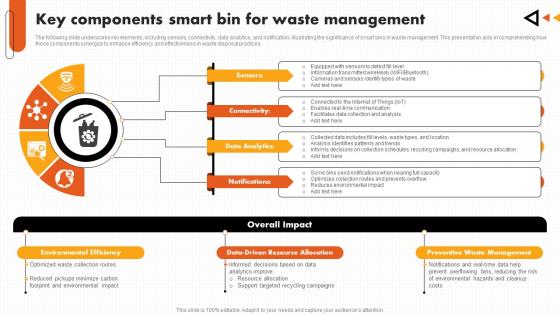
Key Components Smart Bin For Waste Management




Try Before you Buy Download Free Sample Product
 Impress Your
 Audience
 100%
100% Editable
 Save Hours
 of Time


The following slide underscores key elements, including sensors, connectivity, data analytics, and notification, illustrating the significance of smart bins in waste management. This presentation aids in comprehending how these components synergize to enhance efficiency and effectiveness in waste disposal practices.
People who downloaded this PowerPoint presentation also viewed the following :
Key Components Smart Bin For Waste Management with all 9 slides:
Use our Key Components Smart Bin For Waste Management to effectively help you save your valuable time. They are readymade to fit into any presentation structure.








FAQs for Key Components Smart Bin
Smart bin technology includes IoT sensors, wireless connectivity modules, data analytics platforms, mobile applications, and automated collection systems. These components work together by monitoring fill levels, optimizing collection routes, and providing real-time insights, with many municipalities and waste management companies finding that this strategic combination reduces operational costs while enhancing service efficiency.
Smart bin technology enhances waste management efficiency by providing real-time fill-level monitoring, optimizing collection routes, and reducing unnecessary pickups through IoT sensors and data analytics. Through automated scheduling and predictive maintenance, municipalities and facilities streamline operations, minimize fuel costs, and improve service reliability, with many organizations finding significantly reduced operational expenses and enhanced environmental sustainability.
IoT enables smart bins to function as connected waste management systems by facilitating real-time data collection, remote monitoring, and automated communication with waste management services. Through IoT sensors and connectivity, municipalities and businesses can track fill levels, optimize collection routes, and reduce operational costs, while ultimately delivering more efficient waste services and enhanced urban sustainability.
Smart bins utilize sensors to optimize waste collection schedules by monitoring fill levels in real-time, detecting waste types through weight and volume sensors, and transmitting data to centralized management systems. Through IoT connectivity and predictive analytics, waste management companies can schedule pickups only when bins reach capacity thresholds, ultimately reducing operational costs by up to 40% while minimizing unnecessary collection routes.
Smart bin systems integrate fill-level monitoring, waste composition analysis, collection route optimization, usage pattern tracking, and predictive maintenance analytics. These capabilities enable waste management companies and municipalities to reduce collection costs by up to 40%, optimize resource allocation, and enhance service efficiency, with many cities finding that data-driven insights significantly streamline operations.
Smart bins help municipalities reduce operational costs by optimizing collection routes, minimizing unnecessary pickups, and automating waste monitoring through IoT sensors and data analytics. These technologies streamline fleet management, reduce fuel consumption, and maximize staff efficiency, with many cities finding that predictive maintenance and real-time monitoring ultimately deliver 20-30% cost savings while enhancing service reliability.
Smart bins significantly boost urban recycling rates by providing real-time contamination alerts, optimizing collection schedules, and delivering user-friendly interfaces that guide proper sorting behaviors. These technologies streamline waste management operations by reducing contamination levels, increasing collection efficiency, and enhancing public engagement, with many cities finding that automated feedback systems ultimately deliver 20-40% improvements in recycling participation and material quality.
Smart bins ensure compliance with waste disposal regulations by automatically monitoring waste types, tracking disposal volumes, and generating audit trails for regulatory reporting. These systems use sensors and AI to detect contamination, send real-time alerts for improper disposal, and maintain detailed records, with many municipalities and commercial facilities finding that automated compliance monitoring significantly reduces violations while streamlining regulatory documentation processes.
Emerging innovations include gamification features with points and rewards, mobile apps for bin location and fill status, interactive touchscreens displaying environmental impact, QR code scanning for waste sorting guidance, and AI-powered feedback systems. These engagement technologies enhance recycling compliance by making waste disposal educational, competitive, and convenient, with many municipalities finding that interactive features significantly boost proper sorting rates and community participation.
Smart bins revolutionize waste management by providing real-time fill monitoring, optimized collection routes, and predictive analytics, unlike traditional scheduled pickups. Through IoT sensors and data integration, municipalities and businesses reduce operational costs by 30-40%, minimize unnecessary trips, and enhance service efficiency, ultimately delivering improved resource allocation and environmental benefits.
Cities face implementation challenges including high upfront infrastructure costs, complex sensor integration with existing waste systems, reliable connectivity requirements, and staff training needs. While these present initial hurdles, many municipalities find that strategic phased rollouts, public-private partnerships, and pilot programs in high-traffic areas help minimize costs while demonstrating clear ROI through operational efficiency and citizen satisfaction improvements.
Smart bins enhance environmental sustainability by optimizing waste collection routes, reducing fuel consumption through real-time fill-level monitoring, and improving recycling accuracy with automated sorting capabilities. These systems enable municipalities and organizations to minimize carbon emissions from collection vehicles, increase recycling rates, and reduce operational costs, with many cities finding that data-driven waste management delivers both environmental benefits and significant resource savings.
Smart bin data requires encryption during transmission and storage, secure authentication protocols, regular software updates, access controls limiting data viewing, and compliance with privacy regulations like GDPR. These measures protect sensitive location patterns and usage data, with many municipalities finding that robust cybersecurity frameworks ultimately deliver citizen trust and operational transparency.
Smart bins contribute to smart city initiatives by providing real-time waste monitoring, optimizing collection routes, and reducing operational costs through IoT sensors and data analytics. These systems enable municipalities to streamline waste management operations, minimize unnecessary truck rolls, and enhance urban cleanliness, while delivering significant cost savings and improved citizen satisfaction in increasingly connected urban environments.
Essential partnerships for smart bin deployment include technology providers for sensors and connectivity, waste management companies for collection services, local municipalities for regulatory compliance, and maintenance contractors for ongoing technical support. These strategic collaborations streamline implementation by combining technical expertise, operational knowledge, and regulatory understanding, with many cities finding that integrated partnerships deliver more efficient waste collection, reduced operational costs, and ultimately enhanced urban sustainability outcomes.
-
Great designs, Easily Editable.
-
SlideTeam provides PPTs on every single topic. Their templates suit my job very well. I am very grateful!