

Key market drivers and restraints with harvey balls ppt slide




Try Before you Buy Download Free Sample Product
 Impress Your
 Audience
 100%
100% Editable
 Save Hours
 of Time


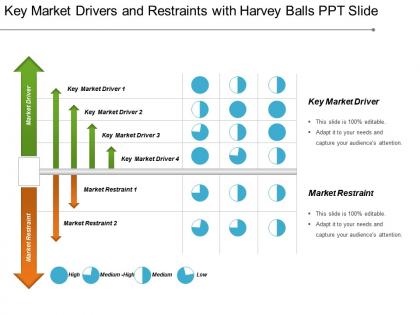
Presenting you this key market drivers and restraints with harvey balls PPT slide along with the important features which makes it comprehensible and effective. The primary market drivers and barriers with round ideograms PowerPoint slide is a business presentation to mark the success of your organization through proper analysis of market in terms of market players and barriers. The business drivers and restrictions with harvey balls PowerPoint shape is comprised of unique features such as key market drivers and restraints along with the round ideograms which will make your presentation grasping and impressive, as it may be used to analyze and foresee the market dynamics and related forthcoming. Needless to say that any organization cannot gain profits until and unless key market drivers and restraints are not taken into consideration. This graphics of this presentation helps you to make you crucial work much easy and interesting. This inserted features of this PowerPoint shape enables you to plan market strategies. Our team of experts have come with this well-researched and visually appealing editable slide that let you draft a remarkable slideshow while saving your time. Generate that feel good effect with our Key Market Drivers And Restraints With Harvey Balls Ppt Slide. Get your brand to epitomize enjoyment.
People who downloaded this PowerPoint presentation also viewed the following :
Key market drivers and restraints with harvey balls ppt slide with all 5 slides:
Generate abundant funds with our Key Market Drivers And Restraints With Harvey Balls Ppt Slide. Folks will hurry to cash in on your ideas.


FAQs for Key market drivers and restraints with harvey
Honestly? It's mostly tech stuff turning everything upside down right now. AI's basically rewriting the rules while customers want everything yesterday - and personalized too, obviously. Supply chains are still a mess from all the geopolitical drama, plus companies are scrambling to look climate-friendly. Everything feels like it's moving at warp speed. That whole "annual planning" thing? Pretty much dead. I'd do quarterly check-ins instead because what made sense last year might be completely useless now. Flexibility's everything - you gotta be ready to pivot fast.
Honestly, it all comes down to what people actually want to buy. Companies just follow the money trail. Remember when everyone went crazy for plant-based stuff? Suddenly every restaurant had impossible burgers - even though half of them tasted awful, let's be real. Businesses pivot fast when they see consumer demand shifting. Want to predict what's coming next in the market? Just scroll through TikTok and see what people are obsessing over or complaining about. That's literally your best indicator of where trends are headed.
Here's my take: tech basically bulldozes existing markets by making it way easier for new players to jump in. Look at how smartphones completely wiped out cameras, GPS devices, you name it - while spawning tons of new industries. Apps let people deal directly with each other now, so middlemen are getting squeezed out left and right. Meanwhile AI gives companies crazy insights into what we actually want to buy (kinda scary tbh). Automation flips cost structures upside down too. Bottom line for your business? Don't get comfortable. Keep watching what's coming next because it'll either sink you or make you rich.
Honestly, you've gotta build in flexibility from day one. Multiple revenue streams are your friend - I can't stress this enough after watching so many businesses crash during COVID. Watch your data like a hawk: sales patterns, what customers are actually saying, seasonal stuff. Cross-train your team so people can jump between roles when things get weird. Oh, and talk to your customers constantly! They usually know something's shifting before your numbers show it. Scalable staffing helps too - you don't want to be stuck with overhead you can't afford. Basically keep your inventory flexible enough to pivot when needed.
Look, competition is what makes markets actually move and change. Companies have to adapt when new players show up or when existing ones shift their game plan - maybe they'll cut prices, innovate products, or chase different customers. It's honestly like watching a chess match sometimes. Markets get more efficient because everyone's fighting for the same buyers, which typically means lower prices and better quality for us. Oh, and here's the thing that really matters: how all this competitive pressure changes what customers expect and how they shop. That's what drives where everything goes next.
Look, inflation and unemployment basically show how confident people are with their money. Rising inflation freaks out investors because it usually means interest rates go up, making loans pricier. Nobody wants that. High unemployment hits different though - people spend less, so companies make less profit. It's wild how connected everything gets. The magic combo? Low unemployment with just a little inflation. That's when markets actually behave. Oh, and those monthly reports always shake things up immediately, so you can kinda see the chaos coming if you're paying attention.
Global events mess with markets in crazy ways - nobody really predicts how bad it'll get. People panic sell first, then supply chains break down and whole industries either crash or explode overnight. Look at COVID - travel stocks got destroyed while everyone bought tech. Wars make oil and food prices go nuts. Pandemics push everything digital faster than normal. Honestly, the best move is spreading your money around different stuff and keeping some cash handy. When everyone's freaking out, that's usually when you can grab good deals on solid companies.
So regulatory policy is basically setting the ground rules for who gets to play and how they compete. Licensing requirements and compliance costs can totally lock out smaller players - like how crazy expensive financial regs make it for fintech startups to take on big banks. It's honestly kind of unfair sometimes. But then you've got antitrust stuff that can actually break up the big guys and level things out. For your analysis, just figure out which regulations hit market access, what companies can charge, and how much it costs them to operate. That's where the real impact shows up.
Honestly, start with just talking to your customers more - they'll tell you what's coming before anyone else does. Set up some surveys and keep an eye on what people are saying about you on social media. I'd also watch what your competitors are doing, though don't get too obsessed with copying them. Market research is huge too, but some of those industry reports are total snoozefests. The smart move? Build some kind of early warning system with your data so you can spot trends early. Pick whatever method works with your budget first, then add more as you go.
Honestly, social media flips the whole marketing thing on its head. You're not just shouting into the void anymore - people actually talk back. And they expect you to respond fast, like within hours or you look like you don't care. The crazy part? They're already talking about your brand whether you jump in or not. But that's actually gold because you get real feedback instantly. You can see what's working and change course super quick. Oh, and don't try to sound all corporate-y - people see right through that fake stuff online. Just be real with them.
Dude, supply chain issues are like dominoes falling everywhere. Prices shoot up first when stuff gets scarce. Then people start panic buying or switching to random alternatives, which throws off all the normal buying patterns. Some companies find out about shortages way before others do, so they hoard inventory while everyone else scrambles. Honestly, the whole thing spirals fast. What really helps is tracking your suppliers' suppliers too - not just who you buy from directly. That way you'll spot trouble coming instead of getting blindsided when your market implodes.
So basically, you'll want to track customer behavior and competitor pricing in real-time using dashboards. Mix your internal stuff (sales, inventory) with external data like industry reports and social listening. Honestly, the social sentiment tracking is where you'll catch trends early. Start simple though - pick one or two data sources you've already got, then build from there. Short sentences work. The whole point is catching opportunities before everyone else does. Search volumes are huge too, forgot to mention that first. Once you get the hang of it, you can expand to more complex analytics.
Look, when markets get crazy, don't just think about profits - consider everyone affected by your choices. Transparency matters big time. Avoid price-gouging during shortages or cutting corners just because customers are desperate. That stuff always backfires. Be upfront about product changes. If you're going digital, respect people's data privacy too. Layoffs and switching suppliers? Think about the communities you're impacting. I know it sounds idealistic, but companies that stick to their values during rough patches actually end up with way more loyal customers and employees. Maybe start by checking if what you're doing matches what you claim to stand for.
Think of loyal customers as your safety net when markets go crazy. They'll stick around during recessions, supply chain nightmares, or when competitors start price wars. Trust matters more than flashy deals - people stay when they believe you're worth it long-term. Honestly, I've seen companies with strong loyalty barely flinch during major disruptions while others tank completely. Your revenue won't swing wildly up and down. Start building those relationships now, not when you're already in trouble. Focus on consistent quality and actually caring about customers. You'll thank yourself later when things inevitably get messy.
Honestly, the biggest thing right now is circular economy stuff - companies are finally designing products without waste baked in from day one. Supply chain transparency is huge too since people actually want to know where their crap comes from. ESG investing is pushing a lot of this (kinda annoying but whatever), and B-Corp certifications are everywhere. Some carbon-neutral commitments feel like total greenwashing though. But here's the thing - sustainability isn't just marketing BS anymore, it's actually giving companies real competitive edges. My advice? Don't try to fix everything at once. Audit what you're doing now and pick one area to nail first.
-
Qualitative and comprehensive slides.
-
Commendable slides with attractive designs. Extremely pleased with the fact that they are easy to modify. Great work!