


Regulatory Framework For Anti Money Navigating The Anti Money Laundering Fin SS




Try Before you Buy Download Free Sample Product
 Impress Your
 Audience
 100%
100% Editable
 Save Hours
 of Time


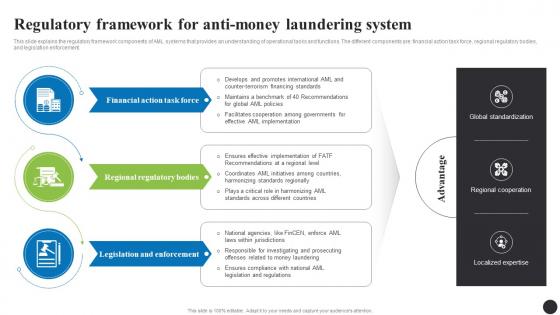
This slide explains the regulatory framework components of AML systems that provides an understanding of operational tasks and functions. The different components are financial action task force, regional regulatory bodies, and legislation enforcement.
People who downloaded this PowerPoint presentation also viewed the following :
Regulatory Framework For Anti Money Navigating The Anti Money Laundering Fin SS with all 9 slides:
Use our Regulatory Framework For Anti Money Navigating The Anti Money Laundering Fin SS to effectively help you save your valuable time. They are readymade to fit into any presentation structure.








FAQs for Regulatory Framework For Anti Money Navigating The Anti Money
Effective AML regulatory frameworks include comprehensive customer due diligence requirements, suspicious transaction reporting systems, record-keeping mandates, risk assessment protocols, and regular compliance audits. These components work together by enabling financial institutions to identify suspicious activities, maintain transaction transparency, and ensure regulatory compliance, with banks and financial services firms finding that robust frameworks significantly reduce regulatory risks while enhancing operational security.
FATF standards significantly influence national AML regulations by establishing comprehensive guidelines for customer due diligence, suspicious transaction reporting, beneficial ownership identification, and cross-border cooperation that countries must implement to avoid blacklisting. These international frameworks enable financial institutions to maintain consistent compliance across jurisdictions, streamline regulatory reporting, and enhance global financial crime detection, ultimately delivering stronger anti-money laundering defenses.
Financial institutions serve as the primary enforcement mechanism for AML regulations, implementing customer due diligence, transaction monitoring, suspicious activity reporting, and record-keeping requirements. Through advanced detection systems and compliance programs, banks and financial services organizations identify potential money laundering activities, file regulatory reports, and maintain detailed audit trails, ultimately delivering enhanced financial system integrity while protecting institutions from significant regulatory penalties and reputational risks.
STRs serve as critical intelligence tools within AML frameworks, enabling financial institutions to report potentially suspicious activities to regulatory authorities like FinCEN, while protecting institutions from liability through safe harbor provisions. These reports help law enforcement agencies identify money laundering patterns, terrorist financing networks, and other illicit activities across banking, securities, and insurance sectors, ultimately enhancing financial system integrity and regulatory compliance.
Technology and data analytics significantly enhance AML compliance through automated transaction monitoring, machine learning algorithms for pattern detection, real-time risk scoring, predictive analytics for suspicious activity identification, and advanced data integration across multiple sources. These sophisticated tools enable financial institutions to process vast transaction volumes more accurately, reduce false positives by up to 80%, and detect complex money laundering schemes faster, ultimately delivering improved regulatory compliance and operational efficiency.
Different jurisdictions approach cryptocurrency AML regulation through varying frameworks, with the US emphasizing FinCEN reporting requirements, the EU implementing comprehensive MiCA regulations, and Asia-Pacific countries adopting diverse licensing schemes and transaction monitoring standards. These regulatory approaches enable financial institutions to enhance compliance through standardized KYC procedures, automated transaction screening, and cross-border information sharing, ultimately delivering greater transparency and reduced financial crime risks.
Regulators face challenges including jurisdictional inconsistencies, cross-border transaction complexity, varying compliance standards, technological gaps, and resource limitations across different financial systems. These obstacles create enforcement difficulties, especially for international banks and financial institutions, with many regulatory bodies finding that enhanced cooperation, standardized frameworks, and advanced monitoring technologies ultimately deliver more effective oversight and stronger global financial security.
Organizations ensure continuous AML compliance through automated monitoring systems, regular regulatory updates, staff training programs, and robust audit frameworks that adapt to changing requirements. By implementing real-time transaction screening, conducting periodic risk assessments, and maintaining comprehensive documentation, financial institutions streamline compliance processes while minimizing regulatory risks, ultimately delivering enhanced transparency and competitive advantage in increasingly regulated markets.
**INPUT**: What penalties or consequences do entities face for non-compliance with AML laws? **OUTPUT**: AML non-compliance penalties include substantial financial fines, criminal charges, license revocation, regulatory sanctions, and reputational damage that can severely impact operations. Financial institutions face particularly steep consequences, with banks receiving multi-billion dollar fines and executives facing imprisonment, while businesses experience customer loss and restricted market access, ultimately making robust compliance programs essential for sustainable operations.
Employee training is critically important for AML compliance, as it ensures staff can identify suspicious transactions, understand reporting requirements, follow proper due diligence procedures, and stay current with evolving regulations. Financial institutions find that comprehensive training programs significantly reduce compliance violations, enhance detection capabilities, and minimize regulatory penalties, while ultimately strengthening their overall risk management framework and competitive positioning.
Recent global events significantly reshape AML regulatory frameworks through enhanced digital transaction monitoring, stricter cross-border compliance requirements, and accelerated adoption of real-time reporting systems. These developments enable financial institutions to better detect suspicious activities across evolving payment channels, strengthen international cooperation against illicit financing, and ultimately deliver more robust protection against money laundering in an increasingly complex global landscape.
Regulatory bodies assess money laundering risks through sector-specific evaluations, transaction pattern analysis, customer due diligence requirements, and compliance monitoring systems. Banks face heightened scrutiny through suspicious activity reporting and enhanced KYC protocols, while real estate, casinos, and money service businesses undergo targeted risk assessments, ultimately enabling regulators to allocate resources strategically.
Beneficial ownership transparency reveals the actual individuals controlling companies and trusts, preventing criminals from hiding behind shell entities and complex corporate structures to launder illicit funds. This transparency enables financial institutions, regulators, and law enforcement to conduct more effective due diligence, identify suspicious ownership patterns, and trace money flows across jurisdictions, ultimately strengthening global anti-money laundering efforts.
Public-private partnerships enhance AML effectiveness by combining regulatory oversight with industry expertise, sharing threat intelligence across institutions, and leveraging advanced technologies for better detection capabilities. Through collaborative frameworks, banks and government agencies can streamline compliance processes, accelerate suspicious activity reporting, and develop comprehensive risk assessments, ultimately delivering stronger financial crime prevention and more robust protective measures against money laundering schemes.
Organizations should adopt comprehensive best practices including risk-based customer due diligence, continuous transaction monitoring, regular staff training, automated screening systems, and robust record-keeping protocols. These measures work together by identifying suspicious activities early, ensuring regulatory adherence, and streamlining compliance processes, with many financial institutions finding that integrated technology solutions significantly reduce operational costs while enhancing detection capabilities.
-
The ease of modifying templates is just superb! Also, the vast collection offers plenty of options to choose from.
-
Enough space for editing and adding your own content.