


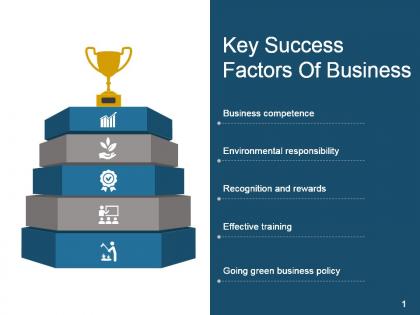
Key success factors of business good ppt example




Try Before you Buy Download Free Sample Product
 Impress Your
 Audience
 100%
100% Editable
 Save Hours
 of Time


Bring folks around to feeling appreciated again with our Key Success Factors Of Business Good Ppt Example. Enable folks to get over the jilt.
People who downloaded this PowerPoint presentation also viewed the following :
Key success factors of business good ppt example with all 5 slides:
Thoughts get under control with our Key Success Factors Of Business Good Ppt Example. You can arrange them to your advantage.




FAQs for Key success factors of business
Leadership drives key success factors by setting strategic vision, fostering innovation, building strong organizational culture, and making critical resource allocation decisions. Effective leaders in sectors like technology, healthcare, and manufacturing enhance operational efficiency, accelerate decision-making processes, and create competitive advantages, with many organizations finding that strong leadership ultimately delivers sustained growth and improved market positioning.
Companies can effectively measure core competencies through performance benchmarking, competitive analysis, customer feedback assessment, internal capability audits, and market positioning studies. These analytical approaches enable organizations to identify strategic strengths, evaluate resource allocation effectiveness, and determine competitive advantages, with many finding that regular competency mapping ultimately delivers enhanced operational focus and improved market differentiation.
Company culture significantly impacts business success by influencing employee engagement, productivity, decision-making processes, talent retention, and overall organizational performance. A strong, positive culture enhances collaboration, accelerates innovation, and streamlines operations, with many organizations finding that aligned cultural values ultimately deliver competitive advantage, reduced turnover costs, and sustained growth in increasingly dynamic markets.
Market research is crucial for identifying growth factors, enabling businesses to understand customer needs, analyze competitor strategies, assess market trends, and validate product opportunities. Through comprehensive research methodologies, companies can minimize investment risks, optimize resource allocation, and identify untapped market segments, with many organizations finding that data-driven insights ultimately deliver sustainable competitive advantages and accelerated growth trajectories.
Businesses can enhance customer satisfaction through personalized service delivery, omnichannel support systems, proactive communication, streamlined complaint resolution processes, and continuous feedback integration. These strategies enable organizations to build stronger relationships by addressing individual needs, reducing response times, and anticipating customer concerns, with many retail and financial services companies finding that this approach significantly improves loyalty and retention rates.
Innovation can be integrated through strategic product development, process automation, customer experience enhancement, data-driven decision making, and agile operational frameworks. These approaches streamline workflows, accelerate market responsiveness, and deliver competitive advantages, with many organizations finding that systematic innovation across departments ultimately drives revenue growth, cost reduction, and sustained market positioning in increasingly dynamic business environments.
Employee engagement significantly enhances business performance by increasing productivity, reducing turnover costs, and improving customer satisfaction rates. Engaged employees deliver higher quality work, generate more innovative solutions, and create stronger customer relationships, with many organizations finding that companies with highly engaged workforces experience 23% higher profitability and substantially improved operational efficiency.
Best practices for aligning organizational goals with key success factors include establishing clear performance metrics, conducting regular strategic reviews, ensuring cross-departmental communication, implementing cascading goal frameworks, and maintaining stakeholder engagement. Through systematic alignment processes, organizations streamline resource allocation, enhance operational efficiency, and accelerate decision-making, with many companies finding that consistent goal-performance integration delivers sustained competitive advantage and measurable growth outcomes.
Businesses leverage technology to improve operational efficiency through automation, cloud computing, data analytics, AI-powered decision making, and integrated management systems. These solutions streamline workflows by reducing manual tasks, optimizing resource allocation, and enhancing real-time visibility, with many organizations finding that strategic technology adoption delivers faster processes, lower costs, and competitive advantage.
Essential financial metrics include revenue growth, profit margins, cash flow, return on investment (ROI), and customer acquisition costs. These metrics enable businesses to assess operational efficiency, strategic performance, and market positioning, with many organizations finding that consistent tracking across these areas delivers better resource allocation, improved decision-making, and sustainable competitive advantage.
Competitive advantages significantly enhance long-term business sustainability by creating defensible market positions, enabling premium pricing strategies, and fostering customer loyalty through unique value propositions. These strategic differentiators help organizations weather economic downturns, adapt to market changes, and maintain profitability, with many companies finding that sustainable advantages ultimately deliver consistent revenue growth and market resilience.
Brand reputation serves as a fundamental driver of customer trust, market differentiation, competitive advantage, and long-term business sustainability. A strong reputation enhances customer loyalty, attracts top talent, facilitates partnerships, and enables premium pricing, with companies like Apple and Johnson & Johnson demonstrating how consistent brand integrity ultimately delivers sustained market leadership and resilience during challenging periods.
Businesses foster agility by implementing flexible organizational structures, investing in cross-functional teams, embracing data-driven decision making, and developing rapid prototyping capabilities. Through cloud technologies and streamlined processes, companies in retail, financial services, and manufacturing accelerate product launches, pivot strategies quickly, and adapt operations seamlessly, ultimately delivering competitive advantage in increasingly dynamic markets.
Techniques for strengthening partnerships include establishing clear communication protocols, defining mutual objectives and performance metrics, implementing regular review processes, and creating shared governance structures. Through strategic alignment workshops and joint planning sessions, organizations enhance trust, streamline decision-making, and foster innovation, with many businesses finding that collaborative frameworks ultimately deliver improved market positioning and accelerated growth outcomes.
Effective communication enhances organizational success by streamlining decision-making processes, aligning team objectives, and minimizing operational inefficiencies that often derail strategic initiatives. Through clear messaging frameworks, companies in sectors like healthcare and financial services deliver faster project outcomes, improved employee engagement, and stronger customer relationships, ultimately building competitive advantage in increasingly complex business environments.
-
Attractive design and informative presentation.
-
Unique research projects to present in meeting.