


Kpi for schedule adherence fulfilment supply days inventory ppt slide




Try Before you Buy Download Free Sample Product
 Impress Your
 Audience
 100%
100% Editable
 Save Hours
 of Time


Alter anything as you desire with our Kpi For Schedule Adherence Fulfilment Supply Days Inventory Ppt Slide. It allows you to improvise freely.
People who downloaded this PowerPoint presentation also viewed the following :
Content of this Powerpoint Presentation
Description:
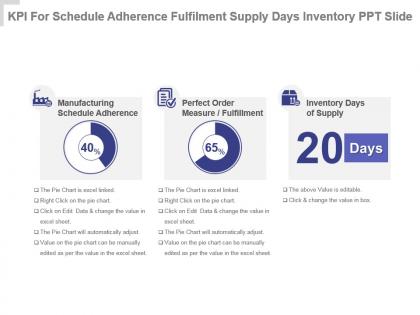
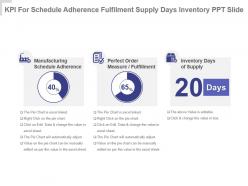
The image is a PowerPoint slide titled "KPI For Schedule Adherence Fulfilment Supply Days Inventory PPT Slide." It features three main elements, each representing a different Key Performance Indicator (KPI) related to supply chain management:
1. Manufacturing Schedule Adherence:
Illustrated with a pie chart showing 40%, indicating the percentage of manufacturing schedules that are adhered to. The instructions below suggest that the chart is linked to an Excel file and can be updated by editing the data in Excel or directly within the chart.
2. Perfect Order Measure / Fulfillment:
Another pie chart is shown with 65%, presumably representing the percentage of orders that are perfect or without issues. Similar to the first chart, this is also linked to Excel and can be edited directly.
3. Inventory Days of Supply:
Displays a number "20 Days," which likely represents the average number of days that inventory is held. The text indicates this value is editable.
Use Cases:
This slide is particularly useful in industries where supply chain management, manufacturing efficiency, and order fulfillment are critical to operations:
1. Manufacturing:
Use: Monitoring production and supply efficiency
Presenter: Operations Manager
Audience: Production Team, Supply Chain Analysts
2. Logistics:
Use: Tracking order fulfillment and inventory management
Presenter: Logistics Coordinator
Audience: Warehouse Managers, Distribution Partners
3. Retail:
Use: Managing stock levels and order accuracy
Presenter: Inventory Manager
Audience: Store Managers, Merchandising Team
4. Pharmaceuticals:
Use: Ensuring timely production and distribution
Presenter: Supply Chain Director
Audience: Compliance Officers, Pharmacy Managers
5. E-Commerce:
Use: Streamlining order processing and delivery
Presenter: E-commerce Analyst
Audience: Customer Service Managers, Operations Team
6. Automotive:
Use: Overseeing parts inventory and production schedules
Presenter: Production Supervisor
Audience: Assembly Line Managers, Quality Control Inspectors
7. Consumer Goods:
Use: Balancing supply with demand and market needs
Presenter: Demand Planner
Audience: Sales Forecasters, Marketing Strategists
Kpi for schedule adherence fulfilment supply days inventory ppt slide with all 6 slides:
Process the data with our Kpi For Schedule Adherence Fulfilment Supply Days Inventory Ppt Slide. Get all the numbers to add up.



FAQs for Kpi for schedule adherence fulfilment supply days
Common schedule adherence KPIs include Schedule Performance Index (SPI), schedule variance, milestone completion rate, critical path delay metrics, and earned schedule analysis. These metrics enable project managers to track progress across manufacturing, construction, and software development projects, ultimately delivering improved resource allocation, proactive risk management, and enhanced client satisfaction through consistent deadline achievement.
Organizations effectively track schedule adherence across multiple teams through centralized project management platforms, automated progress monitoring systems, and standardized reporting frameworks. These tools enable real-time visibility into project timelines, milestone completion rates, and resource allocation patterns, with many companies finding that integrated dashboards streamline communication while delivering improved coordination and enhanced operational efficiency.
Project complexity significantly influences schedule adherence KPIs by requiring more granular tracking metrics, extended buffer periods, and milestone-based measurements rather than simple completion percentages. Complex projects in sectors like construction, software development, and manufacturing often incorporate risk-weighted schedules, dependency mapping, and phase-gate approvals, with many organizations finding that adaptive KPI frameworks deliver better predictability and stakeholder confidence than rigid timeline targets.
Real-time data analytics enhances schedule adherence reporting by providing instant visibility into deviations, automated alerts for potential delays, and predictive insights for proactive adjustments. Through continuous monitoring dashboards, organizations can identify bottlenecks immediately, optimize resource allocation dynamically, and maintain accurate completion forecasts, ultimately delivering improved project outcomes and enhanced stakeholder confidence across operations.
Schedule adherence significantly impacts project success by maintaining budget control, resource allocation efficiency, stakeholder confidence, and delivery timelines. When projects stay on schedule, organizations avoid cost overruns, prevent resource conflicts across multiple initiatives, and maintain client trust, with many finding that consistent schedule performance creates competitive advantages and enables more predictable business planning.
Proactive strategies include predictive analytics for bottleneck identification, resource buffer allocation, milestone tracking systems, cross-functional communication protocols, and automated alert mechanisms. These approaches enable organizations to anticipate delays, reallocate resources dynamically, and maintain project momentum, with many companies finding that early intervention reduces schedule variance by 30-40% while enhancing overall operational efficiency.
Cultural differences significantly impact schedule adherence through varying time orientations, communication styles, hierarchical structures, and work-life balance priorities across global teams. While polychronic cultures may prioritize relationship-building over strict timelines, monochronic cultures emphasize punctuality, with many multinational organizations finding that establishing clear expectations, flexible scheduling approaches, and culturally-sensitive performance metrics ultimately delivers improved adherence and enhanced team collaboration.
**INPUT**: What tools or software are best suited for monitoring schedule adherence KPIs? **OUTPUT**: Schedule adherence monitoring tools include project management platforms like Microsoft Project, workforce management systems, ERP solutions, real-time dashboards, and specialized analytics software. These technologies streamline tracking by automating data collection, providing visual progress indicators, and generating predictive insights, with many organizations finding that integrated platforms ultimately deliver enhanced operational efficiency and proactive schedule management capabilities. [Word count: 56 words]
Resource allocation directly impacts schedule adherence by determining whether projects have sufficient personnel, budget, and materials to meet deadlines, with optimal allocation reducing bottlenecks and delays. Strategic resource planning enables organizations to streamline project timelines, minimize cost overruns, and enhance operational efficiency, with many companies finding that proactive allocation delivers improved schedule performance and competitive advantage.
**INPUT**: How should KPIs for schedule adherence be communicated to all stakeholders? **OUTPUT**: KPIs for schedule adherence should be communicated through real-time dashboards, regular status reports, automated alerts, and structured stakeholder meetings that present data in accessible formats. These communication channels enable project managers to maintain transparency across teams, facilitate proactive decision-making, and ensure alignment on deliverables, with many organizations finding that consistent visibility ultimately enhances accountability and project success rates. **Word count: 57 words**
Visualizing schedule adherence data in presentations enhances stakeholder understanding, facilitates faster decision-making, identifies trends and bottlenecks, and improves accountability across project teams. Through interactive dashboards and clear visual formats, organizations streamline project reviews, reduce meeting times, and enable proactive adjustments, with many finding that visual data presentation ultimately delivers better resource allocation and stronger project outcomes.
Historical data on schedule adherence reveals patterns in task duration, resource allocation, and potential bottlenecks, enabling project managers to create more realistic timelines and buffer strategies. Through analyzing past performance metrics, organizations can identify recurring delays, optimize resource distribution, and implement proactive risk mitigation measures, ultimately delivering improved project outcomes and enhanced stakeholder confidence.
When schedule adherence KPIs reveal consistent delays, organizations can implement resource reallocation, process optimization, timeline adjustments, bottleneck identification, and stakeholder communication protocols. These corrective measures enable project managers to streamline workflows, enhance team coordination, and minimize future disruptions, with many companies finding that proactive schedule management ultimately delivers improved operational efficiency and stronger client satisfaction.
Team collaboration enhances schedule adherence by establishing shared timelines, improving cross-departmental communication, and creating accountability systems that align priorities across functions. Through regular coordination meetings and integrated project management tools, departments like manufacturing, logistics, and sales can synchronize workflows, identify potential bottlenecks early, and adjust resources proactively, ultimately delivering improved on-time performance.
**INPUT**: What are some innovative methods for incentivizing improved schedule adherence among team members? **OUTPUT**: Innovative incentivization methods include gamification with leaderboards, flexible work arrangements, performance-based bonuses, peer recognition programs, and professional development opportunities tied to adherence metrics. These approaches enhance engagement by creating competitive elements, rewarding consistency, and offering meaningful benefits, with many organizations finding that combining multiple incentive types delivers improved compliance while boosting overall team morale and productivity.
-
Use of icon with content is very relateable, informative and appealing.
-
Amazing product with appealing content and design.