


KPMG Business Canvas Model Key Partners Comprehensive Guide To KPMG Strategy SS





Try Before you Buy Download Free Sample Product
 Impress Your
 Audience
 100%
100% Editable
 Save Hours
 of Time


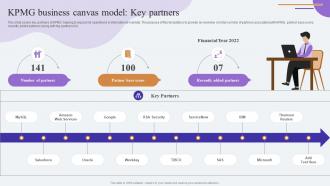
This slide covers key partners of KPMG helping to expand its operations in international markets. The purpose of this template is to provide an overview on total number of partners associated with KPMG, partner base score, recently added partners along with top partners list.
People who downloaded this PowerPoint presentation also viewed the following :
KPMG Business Canvas Model Key Partners Comprehensive Guide To KPMG Strategy SS with all 6 slides:
Use our KPMG Business Canvas Model Key Partners Comprehensive Guide To KPMG Strategy SS to effectively help you save your valuable time. They are readymade to fit into any presentation structure.





FAQs for KPMG Business Canvas Model Key Partners Comprehensive Guide To
The KPMG Business Canvas Model includes value propositions, customer segments, key partnerships, revenue streams, cost structure, key resources, key activities, customer relationships, and channels. This strategic framework streamlines business planning by integrating operational elements with financial considerations, enabling organizations across sectors like consulting, financial services, and technology to optimize resource allocation, enhance customer experiences, and ultimately deliver sustainable competitive advantage.
The KPMG Business Canvas Model emphasizes stakeholder value creation and sustainability integration, while traditional models focus primarily on shareholder returns and short-term profitability. This strategic approach enables organizations to assess environmental impact, social responsibility, and long-term viability alongside financial metrics, with many enterprises finding that this comprehensive framework delivers enhanced risk management, stronger stakeholder relationships, and ultimately sustainable competitive advantage in increasingly conscious markets.
The KPMG Business Canvas Model proves most effective in financial services, healthcare, technology, and manufacturing industries where complex regulatory requirements and operational transformations converge. These sectors benefit from the model's strategic framework for digital transformation, risk management, and process optimization, with many organizations finding that it streamlines decision-making while enhancing competitive positioning.
Businesses can leverage the KPMG Business Canvas Model by systematically mapping value propositions, customer segments, revenue streams, and operational capabilities across a comprehensive visual framework. This strategic approach enables organizations to identify market opportunities, optimize resource allocation, and align cross-functional teams, with many companies finding that the model accelerates decision-making and enhances competitive positioning.
Customer segmentation in the KPMG Business Canvas Model enables organizations to identify distinct customer groups, understand their specific needs, behaviors, and value propositions, and tailor strategic approaches accordingly. This segmentation streamlines resource allocation, enhances targeted marketing efforts, and optimizes service delivery, with many businesses finding that precise customer categorization ultimately delivers improved customer experiences and competitive advantage.
The KPMG Business Canvas Model supports innovation and agility by providing structured frameworks for analyzing market opportunities, identifying revenue streams, optimizing resource allocation, and accelerating decision-making processes. Through systematic evaluation of value propositions and customer segments, organizations streamline strategic planning, enhance operational flexibility, and minimize implementation risks, with many companies finding that this approach ultimately delivers faster market responses and sustainable competitive advantage.
Common challenges include resistance to organizational change, difficulty mapping complex interdependencies, inadequate stakeholder alignment, resource constraints during transformation, and maintaining momentum throughout implementation phases. While these obstacles can initially slow adoption, many enterprises find that systematic change management, cross-functional collaboration, and phased rollouts ultimately deliver enhanced strategic clarity and operational efficiency.
Organizations measure KPMG Business Canvas Model strategy success through key performance indicators aligned with each canvas element, including revenue growth metrics, customer acquisition costs, operational efficiency ratios, and stakeholder satisfaction scores. Through systematic tracking across financial performance, market positioning, and operational outcomes, companies can evaluate strategic effectiveness while identifying optimization opportunities, with many finding that regular canvas reviews enable continuous strategy refinement and competitive advantage.
KPMG provides digital canvas templates, strategic frameworks, industry-specific guides, assessment tools, and collaborative workshops to help businesses develop their canvas models. These resources enable organizations across sectors like financial services, healthcare, and manufacturing to streamline strategic planning, enhance operational alignment, and accelerate business transformation initiatives, ultimately delivering improved competitive positioning.
The KPMG Business Canvas Model incorporates sustainability by integrating environmental, social, and governance factors across all nine canvas components, from value propositions to revenue streams. This strategic approach enables organizations to identify sustainable value creation opportunities, assess ESG risks and impacts, and develop business models that deliver long-term profitability while meeting stakeholder expectations for responsible growth.
KPMG Business Canvas Model effectiveness is demonstrated through digital transformation initiatives at financial institutions, retail optimization projects for consumer goods companies, and operational restructuring in healthcare organizations. These implementations show how the model streamlines strategic planning, enhances cross-functional collaboration, and accelerates decision-making processes, with many enterprises finding that it reduces project timelines by 30-40% while improving stakeholder alignment.
Startups can leverage the KPMG Business Canvas Model to systematically map their value propositions, revenue streams, key partnerships, and cost structures in a comprehensive visual framework. This strategic planning tool enables emerging companies to identify market gaps, validate business assumptions, and streamline operational processes, while facilitating investor communications and strategic pivots, ultimately delivering clearer business focus and enhanced scalability potential.
Best practices for KPMG Business Canvas workshops include thorough pre-workshop preparation, diverse stakeholder participation, structured facilitation with clear timelines, and collaborative visual mapping of business components. Successful facilitators ensure balanced discussion across all canvas elements, encourage cross-functional input from finance, operations, and strategy teams, while maintaining focus on actionable outcomes that drive strategic alignment and measurable business improvements.
The KPMG Business Canvas Model enhances collaboration by creating shared visual frameworks, standardizing communication across departments, and aligning teams around common strategic objectives. Through structured workshops and collaborative mapping sessions, organizations streamline cross-functional project planning, eliminate departmental silos, and accelerate decision-making processes, with many enterprises finding that unified business modeling ultimately delivers improved transparency and faster innovation cycles.
The KPMG Business Canvas Model guides businesses through systematic value proposition identification by mapping customer segments, analyzing pain points, and aligning solutions with market needs. Through structured workshops and strategic frameworks, organizations streamline their value creation process, enhance customer-centricity, and develop competitive positioning, with many companies finding that this approach delivers clearer market differentiation and stronger customer relationships.
-
SlideTeam’s pool of 2Million+ PPTs has really benefited my team, everyone from the IT department to HR. We are lucky to have crossed ways with them.
-
Excellent design and quick turnaround.