


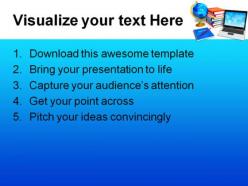
Laptop and books education powerpoint backgrounds and templates 0111





Try Before you Buy Download Free Sample Product
 Impress Your
 Audience
 100%
100% Editable
 Save Hours
 of Time


Beckon the future with our Laptop And Books Education PowerPoint Backgrounds And Templates 0111. Your thoughts will look far into the morrow.
People who downloaded this PowerPoint presentation also viewed the following :
Laptop and books education powerpoint backgrounds and templates 0111 with all 3 slides:
Overachievers can finally step away from their computers. With our Laptop And Books Education PowerPoint Backgrounds And Templates 0111 flawless design is only an easy click away.

FAQs for Laptop and books education powerpoint backgrounds
Laptops enhance learning by providing interactive content, real-time collaboration tools, multimedia resources, instant access to information, and personalized learning platforms that traditional textbooks cannot offer. These digital capabilities streamline research, enable seamless note-taking and organization, and deliver adaptive learning experiences, with many educational institutions finding that students demonstrate improved engagement and faster knowledge retention.
Students can effectively integrate laptops with reading materials by using digital annotation tools, creating searchable note databases, and employing active reading applications that sync across devices. This strategic combination enables enhanced organization through cloud-based storage, faster research through instant access to supplementary resources, and improved retention via multimedia integration, with many educational institutions finding that students demonstrate significantly better comprehension outcomes.
E-books offer significant advantages in laptop-focused education, including instant access to vast digital libraries, searchable text functionality, interactive multimedia content, automatic syncing across devices, and reduced physical storage requirements. These digital resources streamline learning by enabling seamless note-taking integration, real-time updates, and cost-effective distribution, with many educational institutions finding that e-books enhance student engagement while delivering operational efficiency and accessibility.
Screen time from laptops impacts students' reading habits by reducing deep reading focus, encouraging rapid information scanning, and creating preference for digital over print materials. While excessive use can fragment attention spans, strategic laptop integration enhances research capabilities, enables interactive learning experiences, and develops digital literacy skills, with many educational institutions finding that balanced screen time ultimately delivers improved academic engagement when combined with traditional reading methods.
Students can use note-taking applications like Notion or OneNote, reference managers such as Zotero, flashcard platforms like Anki, and research databases including JSTOR or Google Scholar to enhance their traditional book studies. These digital tools streamline information organization, enable cross-referencing between sources, and facilitate active recall techniques, with many educational institutions finding that students combining physical texts with complementary software achieve significantly better comprehension and retention rates.
Laptops facilitate collaborative learning through real-time document sharing, virtual group projects, peer review platforms, video conferencing capabilities, and cloud-based research tools. These technologies streamline teamwork by enabling seamless file exchange, simultaneous editing, and remote collaboration, with many educational institutions finding that students develop stronger communication skills and produce higher-quality work outcomes.
Educators can effectively utilize laptops by creating multimedia presentations that incorporate interactive elements, visual aids, case studies, real-world examples, and collaborative activities that extend beyond traditional textbook limitations. Through presentation software and digital tools, teachers enhance student engagement, facilitate dynamic discussions, and deliver personalized learning experiences, while seamlessly integrating textbook concepts with current industry applications, ultimately transforming static content into compelling educational experiences.
Challenges include digital eye strain, technology dependency, internet connectivity requirements, distraction potential, and reduced retention from screen reading. While laptops enhance accessibility and interactive learning, educational institutions find that students often struggle with focus management, technical troubleshooting, and the tactile learning benefits that traditional textbooks provide, ultimately requiring balanced approaches.
Laptop accessibility directly impacts educational equity by determining which students can access digital resources, participate in online learning, and develop essential technology skills. Students without reliable laptop access, particularly in underserved communities and rural areas, face significant disadvantages in completing assignments, accessing educational platforms, and preparing for increasingly digital workplaces, ultimately widening achievement gaps.
**INPUT**: What best practices should be followed when using laptops to take notes from textbooks? **OUTPUT**: Effective laptop note-taking from textbooks includes creating structured digital folders, using split-screen layouts, employing active summarization techniques, integrating visual elements, and maintaining consistent formatting systems. These methods streamline information retention by enabling searchable content, multimedia integration, and seamless organization, with many students finding that strategic digital workflows ultimately enhance study efficiency and academic performance. **Word count: 54 words**
Digital literacy skills develop through laptops by enabling students to master essential software applications, navigate online research platforms, create multimedia presentations, and collaborate through cloud-based tools. Educational institutions increasingly find that integrating laptops into curriculum allows students to develop critical thinking through information evaluation, enhance communication skills via digital collaboration, and build technical competencies, ultimately preparing them for an increasingly digital workplace environment.
Laptop use for textbook study presents both challenges and opportunities for information retention, with research showing decreased comprehension for certain content types while enabling enhanced note-taking, searchability, and multimedia integration. Many educational institutions find that strategic combination of digital and physical resources optimizes learning outcomes, with students increasingly developing hybrid study approaches that leverage technology for organization and traditional books for deep reading, ultimately delivering personalized learning experiences.
Students can minimize laptop distractions by using website blockers, turning off notifications, keeping laptops closed when reading physical books, and creating designated study zones where digital devices remain elsewhere. This strategic combination of physical and digital boundaries helps maintain focus on book-based learning, with many students finding that alternating between focused reading sessions and structured laptop research time ultimately delivers better comprehension and academic performance.
Effective methods include creating folder hierarchies by subject or project, using note-taking apps like Notion or OneNote with tagging systems, implementing consistent naming conventions, and utilizing cloud synchronization for accessibility. These organizational approaches streamline study workflows by enabling quick retrieval, cross-referencing between materials, and seamless collaboration, with many students finding that structured digital systems ultimately enhance learning efficiency and academic performance.
Educators can assess laptop-book integration effectiveness through student engagement metrics, learning outcome comparisons, digital literacy skill development, and feedback surveys from both students and parents. Many schools track academic performance data, classroom participation rates, and assignment completion times, while conducting periodic assessments that measure comprehension across both digital and traditional formats, ultimately delivering insights into optimal teaching method combinations.
-
Nice and innovative design.
-
Unique research projects to present in meeting.