


Last Mile Logistics Dashboard To Track Route Optimization Infographic Template Visual Aids




Try Before you Buy Download Free Sample Product
 Impress Your
 Audience
 100%
100% Editable
 Save Hours
 of Time


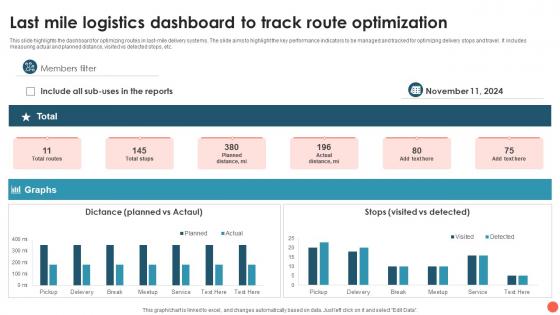
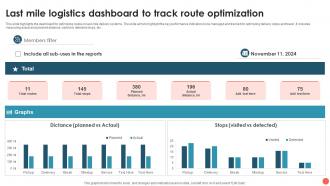
This slide highlights the dashboard for optimizing routes in last mile delivery systems. The slide aims to highlight the key performance indicators to be managed and tracked for optimizing delivery stops and travel. It includes measuring actual and planned distance, visited vs detected stops, etc.
People who downloaded this PowerPoint presentation also viewed the following :
Last Mile Logistics Dashboard To Track Route Optimization Infographic Template Visual Aids with all 10 slides:
Use our Last Mile Logistics Dashboard To Track Route Optimization Infographic Template Visual Aids to effectively help you save your valuable time. They are readymade to fit into any presentation structure.








FAQs for Last Mile Logistics Dashboard To Track Route Optimization Infographic
Last mile logistics faces challenges including rising delivery costs, customer expectations for speed, urban congestion, failed delivery attempts, and limited delivery windows. These issues significantly impact operational efficiency and customer satisfaction, with many retailers finding that addressing driver shortages, route optimization, and sustainable delivery options becomes increasingly critical for maintaining competitive advantage in today's demanding marketplace.
Technological advancements revolutionize last mile delivery efficiency through route optimization algorithms, real-time tracking systems, automated sorting facilities, AI-powered demand forecasting, and delivery management platforms. These innovations streamline operations by reducing fuel costs, minimizing delivery times, and enhancing customer visibility, with many logistics companies finding that strategic technology integration ultimately delivers competitive advantage and improved customer experiences.
Customer expectations significantly influence last mile logistics strategies through demands for faster delivery, real-time tracking, flexible delivery options, personalized services, and seamless returns processes. These evolving expectations drive companies to invest in advanced routing technologies, micro-fulfillment centers, and alternative delivery methods like drones or lockers, ultimately delivering competitive advantage and enhanced customer loyalty.
Companies optimize last mile operations through route optimization software, delivery consolidation hubs, alternative delivery methods like lockers and pickup points, dynamic scheduling algorithms, and strategic partnerships with local carriers. These approaches streamline operations by reducing fuel costs, minimizing delivery attempts, and maximizing vehicle capacity utilization, with many logistics providers finding that combining multiple optimization strategies delivers significant cost reductions while enhancing customer satisfaction.
Urban environments significantly impact last mile logistics through traffic congestion, limited parking spaces, delivery time restrictions, and dense population clusters requiring efficient route optimization. These challenges drive logistics companies toward innovative solutions like micro-fulfillment centers, electric delivery vehicles, and drone technologies, with many retailers finding that strategic urban warehousing and alternative delivery methods ultimately reduce costs while enhancing customer experiences.
Different shipping methods significantly impact last mile effectiveness through varying speed, cost structures, and delivery flexibility capabilities. Express services enhance customer satisfaction with same-day delivery but increase operational costs, while standard shipping streamlines expenses through consolidated routes, and flexible options like click-and-collect enable retailers to optimize resource allocation while meeting diverse consumer preferences.
Best practices for managing returns in last mile logistics include automated return authorization systems, flexible pickup scheduling, consolidated return centers, real-time tracking capabilities, and streamlined reverse logistics networks. These approaches enhance customer satisfaction by simplifying return processes, reducing processing times, and minimizing costs, while enabling retailers to recover value through efficient refurbishment and restocking operations.
Data analytics improves last mile delivery performance by optimizing route planning, predicting demand patterns, and enabling real-time tracking adjustments. Through machine learning algorithms, logistics companies streamline delivery windows, reduce fuel costs, and enhance customer satisfaction, with many retail and e-commerce organizations finding that predictive analytics ultimately delivers 20-30% faster deliveries.
Emerging last mile delivery innovations include autonomous delivery vehicles, drone networks, smart lockers, crowdsourced delivery platforms, and AI-powered route optimization systems. These technologies streamline operations by reducing delivery times, minimizing costs, and enhancing customer flexibility, with many retailers and logistics companies finding that strategic combinations of these solutions ultimately deliver competitive advantages in an increasingly demanding e-commerce landscape.
Small businesses typically leverage local partnerships, third-party delivery services, and flexible routing strategies, while larger corporations invest in dedicated distribution centers, advanced logistics technology, and comprehensive fleet management systems. Through strategic partnerships with local couriers and delivery platforms, smaller companies can achieve competitive delivery times and cost efficiency, while larger organizations utilize economies of scale, predictive analytics, and automated sorting facilities to streamline operations and enhance customer experiences across broader geographic regions.
Last mile logistics presents both environmental challenges and opportunities, with traditional delivery methods contributing to urban pollution, increased carbon emissions, traffic congestion, and packaging waste. However, companies are increasingly adopting sustainable practices like electric delivery vehicles, route optimization software, consolidated delivery hubs, and eco-friendly packaging, ultimately delivering reduced environmental impact while maintaining operational efficiency.
Partnerships with local carriers enhance last mile delivery by leveraging regional expertise, reducing operational costs, and expanding coverage areas efficiently. These strategic alliances enable businesses to access established route networks, local market knowledge, and flexible capacity, while carriers benefit from increased volume, ultimately delivering faster services, improved customer satisfaction, and competitive advantage in increasingly demanding markets.
Emerging trends shaping last mile logistics include autonomous delivery vehicles, drone networks, micro-fulfillment centers, predictive analytics, and sustainable packaging solutions. These innovations streamline operations by reducing delivery times, minimizing costs, and enhancing customer experiences, with many retailers finding that strategic combinations of these technologies deliver significant competitive advantages in increasingly demanding markets.
Regulations significantly impact last mile logistics through varying delivery hour restrictions, vehicle emission standards, urban access controls, and driver qualification requirements across regions. European cities often enforce strict low-emission zones and narrow delivery windows, while Asian markets focus on traffic congestion rules and licensing requirements, ultimately requiring logistics providers to adapt fleet composition, routing strategies, and operational schedules for competitive advantage.
Customer feedback plays a crucial role in identifying delivery pain points, optimizing route efficiency, and enhancing service quality in last mile logistics operations. By analyzing customer insights about delivery times, communication preferences, and service experiences, companies can refine their strategies, ultimately improving customer satisfaction and reducing operational costs across their delivery networks.
-
Exclusive and extensive collection of templates. Really helped me create a professional presentation in just no time.
-
“I've always gotten excellent slides from them and the customer service is up to the mark.”